
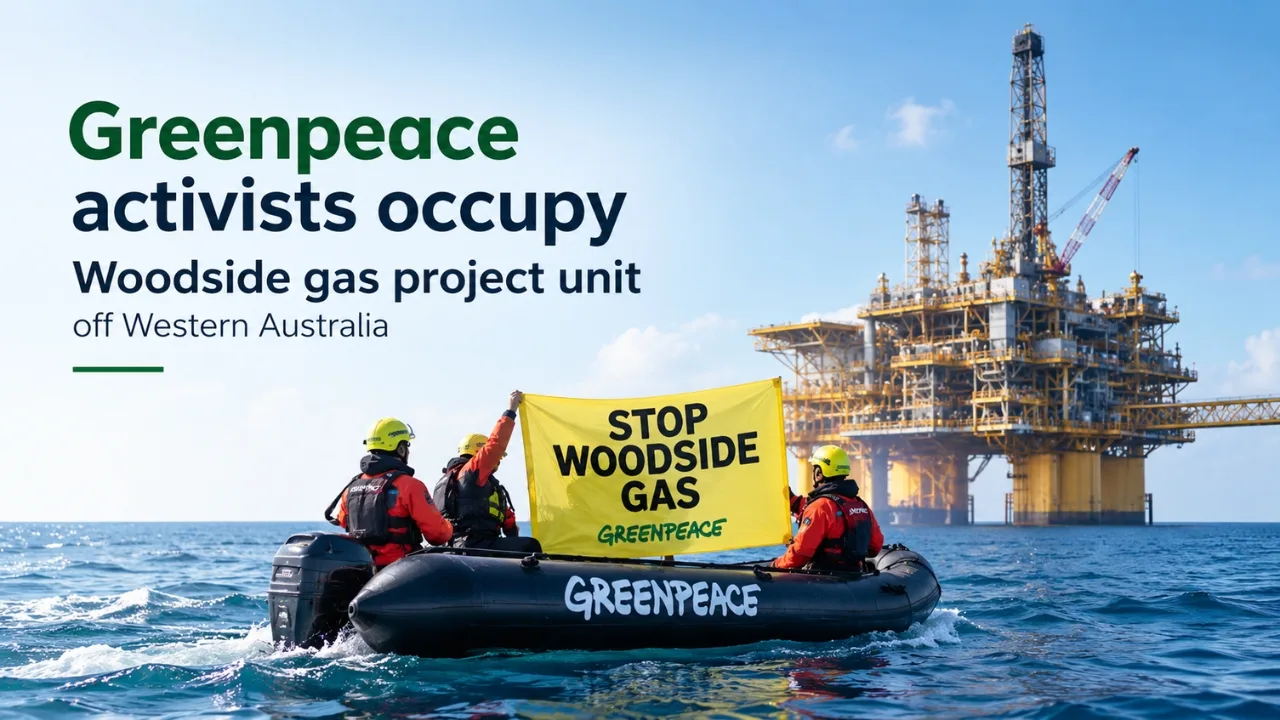
On the morning of Saturday, 17 October 2026, a small boat carrying four people left the Greenpeace flagship Rainbow Warrior and headed for one of the largest pieces of industrial infrastructure off the Australian coast. By the time the day was out, the Greenpeace Woodside protest had become a national story: activists were sitting on a 70,000-tonne floating gas platform, and the operator had started a temporary shutdown. This guide explains what happened, why the activists chose this target, and what both sides say.
What Happened at the Scarborough Gas Field
At about 5:45am Western Australian time, four Greenpeace Australia Pacific activists launched from the Rainbow Warrior and climbed onto the floating production unit (FPU) at Woodside’s Scarborough gas project. They unfurled banners reading “Stop Woodside’s Dirty Gas. Save Scott Reef.” The unit sits well over 200 kilometres off the coast of Western Australia, roughly 375 km from Karratha.
Woodside said it was responding to an incident involving people who had gained unlawful access to the unit, and it activated its incident-management procedures. Greenpeace said the platform began a temporary shutdown of operations. The group called its action a peaceful protest and said the activists intended to stay as long as possible. For anyone following the Greenpeace Woodside protest, the key point is that the occupation happened at an offshore site, so safety, access and response all involve far more logistics than a protest on land.
Why Scott Reef Is at the Centre of the Protest
Here is the detail many headlines skip: the Scarborough platform is not where the activists’ main concern lies. Their target is Woodside’s separate Browse proposal, which Greenpeace says would put drilling near Scott Reef, a coral system roughly 390 km off the state’s northwest coast. The reef is also described as a foraging area for the endangered pygmy blue whale.
Greenpeace chief executive David Ritter said the Browse plan would turn the reef into “an industrial gas zone” and called on the federal government to act. Occupying Scarborough gave the group a highly visible stage, because it is Woodside’s flagship offshore development and sits in the same general region. That is a communications choice as much as a geographic one.
The Scarborough Project at a Glance
| Detail | What has been reported |
|---|---|
| Date of occupation | Saturday, 17 October 2026 |
| Number of activists | Four, launched from the Rainbow Warrior |
| Structure occupied | Floating production unit (about 70,000 tonnes) |
| Location | Over 200 km off Exmouth; about 375 km off Karratha |
| Banner message | “Stop Woodside’s Dirty Gas. Save Scott Reef.” |
| Project value | Reported at around $12.5 billion |
| Unit’s arrival on site | Mid-January, after a roughly two-month tow from China |
| Protest focus | Woodside’s separate Browse proposal near Scott Reef |
| Operational impact | Temporary shutdown reported |
Figures such as project cost and output vary between outlets depending on currency and reporting date, so treat them as indicative rather than final.
Two Very Different Readings of the Same Event
The two sides describe the project in sharply different terms.
Woodside’s position:
- Scarborough has been through extensive environmental review and consultation, which the company says has been running since 2018.
- It says the project will deliver one of the lowest-carbon LNG sources in Australia.
- It describes the boarding as unlawful and a safety matter.
Greenpeace’s position:
- New gas development is incompatible with the global shift to clean energy.
- The Browse proposal poses an unacceptable risk to Scott Reef and its marine life.
- Peaceful direct action is justified when it exposes risks the group believes governments are underweighting.
Neither framing settles the question on its own. The environmental approvals process, emissions accounting and reef-risk assessments are where the real arguments get tested, and they are worth reading in full if you want to form your own view.
What to Watch Next
A few things will shape how this story develops. First, how long the occupation lasts and how authorities respond, since boarding an offshore facility raises serious safety and legal questions. Second, whether the temporary shutdown affects the project’s timeline, as commercial LNG production has been expected to begin by the end of the year. Third, whether the protest changes the political conversation around the Browse proposal and Scott Reef.
If you want to follow the story responsibly, rely on direct statements from Woodside and Greenpeace, plus established news agencies, and be cautious with unverified social posts. Offshore incidents move quickly and early details often change.
FAQs
Who occupied the Woodside platform?
Four Greenpeace Australia Pacific activists, who launched from the Rainbow Warrior and climbed the Scarborough floating production unit on 17 October 2026.
Why are Greenpeace protesting at Scarborough if the concern is Scott Reef?
The main concern is Woodside’s separate Browse proposal near Scott Reef. Greenpeace targeted Scarborough because it is Woodside’s high-profile offshore project in the region and offers a highly visible protest site.
Did the protest stop gas production?
Greenpeace said operations at the unit were temporarily shut down. Woodside said it was responding to an incident involving unlawful access to the unit.
What does Woodside say about the Scarborough project?
Woodside says the project has undergone extensive environmental review and consultation since 2018 and will be one of the lowest-carbon LNG sources in Australia.
Designing with Country: How Seasonal Calendars Can Shape Respectful Site Planning!
1 thought on “Greenpeace Woodside Protest: Why Four Climbers Halted a Gas Platform at Sea!”
Comments are closed.