
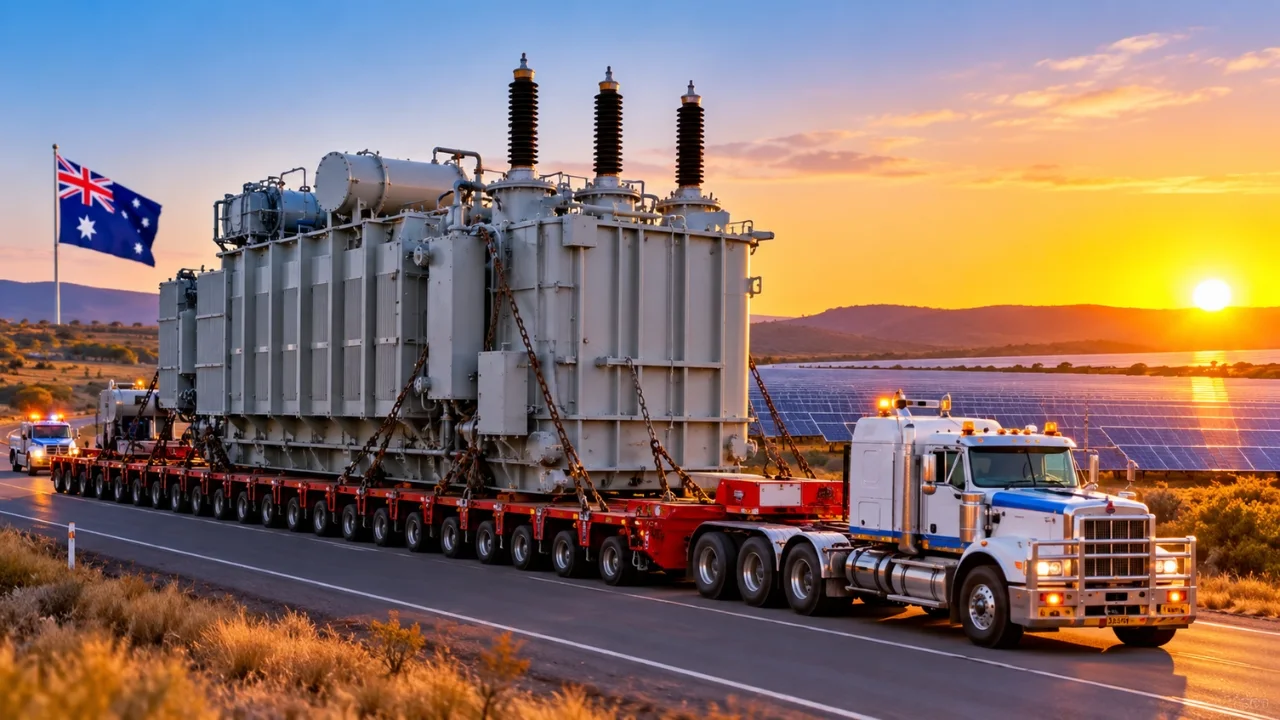
Most people picture a solar farm as endless rows of panels glinting in the sun. Far fewer think about the single piece of equipment that makes the electricity usable: the transformer. When a 244-tonne transformer recently finished a 2,165 km road trip across the country to reach Australia’s largest solar project, it showed how much heavy logistics sits behind clean energy. The journey is a good reminder that building renewable power is as much about roads, trailers and planning as it is about panels and turbines.
Why the 244-Tonne Transformer Matters to a Solar Farm
A large solar farm produces power at a relatively low voltage. A transformer steps that voltage up so the electricity can travel along high-voltage transmission lines and reach homes and businesses with minimal loss. Without it, the farm could generate plenty of power with no practical way to deliver it to the grid.
This particular unit was delivered to the substation at the New England solar farm in northern New South Wales, which is developed and owned by Acen Renewables. It will support construction of the project’s second stage, a 320-megawatt expansion that lifts total capacity to 720 MW. That makes it the biggest solar project in the country, at least for now. A single piece of equipment this size is also hard to replace or reroute if something goes wrong, which is why every step of its delivery is planned so carefully.
The Route: From Port of Adelaide to Northern NSW
The transformer began its trip at the port of Adelaide. Its contractor, Epec Group, said the overland route covered about 555 km to the New South Wales border, followed by a further 1,610 km to the site. That adds up to the 2,165 km total.
Long hauls of this kind rarely look like ordinary freight. Oversize loads typically need road upgrades along the way and often move at night, when traffic is lightest. The same challenge is playing out across the industry, as developers, logistics specialists and local communities work out how to get large equipment to remote project sites without disrupting everyone else on the road.
Key Facts About the Transformer Delivery
The table below summarises the main details of this movement.
| Detail | Information |
|---|---|
| Transformer weight | 244 tonnes |
| Transformer size | 11 m long, 4.4 m high |
| Starting point | Port of Adelaide, South Australia |
| Destination | New England Solar substation, northern NSW |
| Total distance | Approximately 2,165 km |
| Route breakdown | About 555 km to the NSW border, then 1,610 km to site |
| Trailer type | 18-axle modular platform trailer |
| Convoy length | About 70 m, with prime movers at the front and back |
| Project owner and developer | Acen Renewables |
| Stage 2 capacity | 320 MW, taking the project to 720 MW |
What It Takes to Move Something This Big
Acen Renewables described this as the heaviest and largest transformer supplied to New England Solar. To carry it, the crew used an 18-axle modular platform trailer with several prime movers at the front and rear of a convoy roughly 70 metres long.
Several things make a move like this hard:
- Weight distribution: Spreading 244 tonnes across many axles helps protect roads and bridges along the route.
- Length and turning: A 70 m convoy cannot take corners the way a normal truck can, so the route must be checked in advance.
- Time on the road: Covering more than two thousand kilometres means coordinating across state borders and local conditions.
- Teamwork: The delivery relied on Australian-owned heavy haulage company Ares Group, which helped plan and carry out the move, working alongside Epec Group.
The Bigger Picture for Australian Renewables
This delivery is one example of a wider pattern. As more wind, solar and battery projects are built, the logistics become a defining part of the job. Ares Group, for instance, is also handling roughly 900 turbine parts travelling by truck along a 400 km route from the Port of Newcastle to the Uungula wind farm near Wellington in central west NSW.
For readers and local communities, the lesson is that renewable projects are physical, industrial undertakings. They depend on skilled drivers, careful planning and good relationships with the towns the convoys pass through. When it all works, a quiet overnight delivery turns into another step toward more clean electricity on the grid.
Frequently Asked Questions
How heavy is the transformer delivered to New England Solar?
It weighs 244 tonnes and measures 11 metres long and 4.4 metres high, making it the heaviest and largest transformer supplied to the project so far.
How far did the transformer travel?
It travelled about 2,165 km by road, starting at the port of Adelaide and ending at the substation in northern New South Wales.
What will the transformer be used for?
It will help pave the way for construction of the 320 MW second stage of New England Solar, taking the project’s total capacity to 720 MW.
Why are transformers like this moved by road at such scale?
Large transformers are single, heavy components that cannot be broken down for transport. They need specialised trailers and careful route planning, and oversize loads often travel at night to reduce disruption.
Australia Solar Panel Uptake: Why the Rooftop Boom Still Has Room to Grow…