
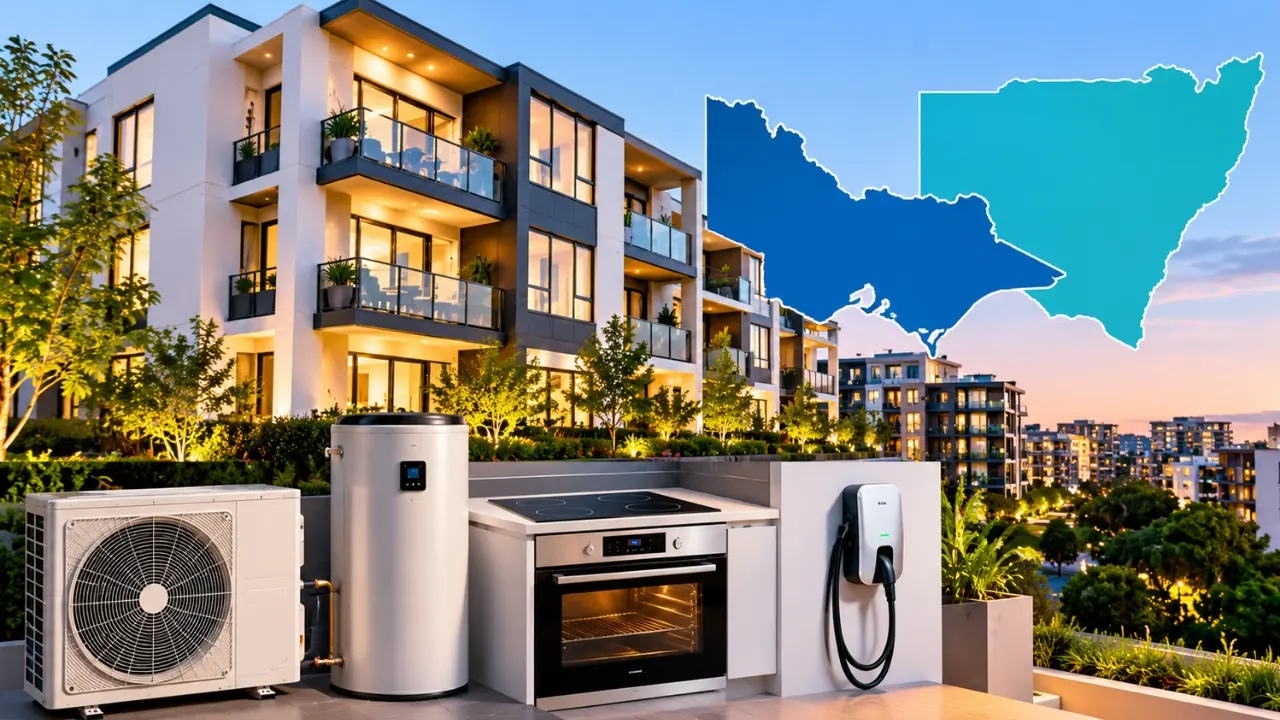
Apartment electrification is a different job from electrifying a house. You rarely own the roof, the hot water system is often shared, and the switchboard sits in common property. Governments in Victoria and New South Wales have noticed. Both now run programs aimed at apartment buildings, but the money mostly flows through the owners corporation, not to the individual resident. Knowing who can apply, and for what, saves a lot of wasted effort.
Proposals vs. programs: sort the headlines first
Recent election promises have made the picture noisier. The Victorian Greens have proposed grants of up to $3,000 for renters and $1,500 for homeowners, plug-in balcony solar from 2027, and solar-ready rules for new apartments. That is a policy pitch, not a funded program, so nothing in it can be claimed today. The programs below are the ones that exist now. Where a scheme depends on funding rounds, check the official site before planning around it.
What Victoria currently funds
Victoria’s main apartment-specific scheme is Solar for Apartments, co-funded with the Commonwealth and delivered by Solar Victoria. It offers rebates of up to $2,800 per apartment, capped at $140,000 per building covering up to 50 apartments, and applications go through the owners corporation. The government estimates savings of up to $500 a year per apartment. The third round was set to run until 30 April 2026 or until rebates ran out, so confirm whether another round is open.
For appliances, the Victorian Energy Upgrades program discounts items such as heat pump hot water, reverse-cycle air conditioners and induction cooktops. Solar Homes also offers hot water rebates. Combined, the two can cut up to $2,030 off an eligible locally made hot water system. Household income eligibility for solar and hot water rebates dropped from $210,000 to $150,000 on 1 July 2026.
What NSW currently funds
NSW takes a similar building-level approach. The Solar for Apartment Residents (SoAR) grant covers up to 50% of a shared solar system, to a maximum of $150,000 per project. Only owners corporations or their authorised strata managers can apply, and individual residents cannot. A separate SoAR Boost stream, aimed at priority locations, covers up to 80% with a $200,000 cap. It requires the owners corporation to pass a sustainability infrastructure resolution and share costs and benefits with all residents.
Batteries are the newest addition. Since 1 September 2026, the Peak Demand Reduction Scheme has an apartment battery activity (BESS3) for buildings with at least four dwellings and batteries between 20 and 200 kWh. The Energy Savings Scheme also continues to support efficient hot water and air conditioning through accredited providers, though rules changed on 1 July 2026, so installer quotes should name the activity they are claiming under.
Side-by-side: who applies and what’s covered
| Program | State | Who applies | What it supports | Key limits |
|---|---|---|---|---|
| Solar for Apartments | Vic | Owners corporation | Shared or individual rooftop solar | Up to $2,800 per apartment, $140,000 per building (up to 50 apartments); round-based |
| Victorian Energy Upgrades | Vic | Household via approved provider | Heat pump hot water, reverse-cycle AC, induction cooktops | Discount applied at purchase; provider must be approved |
| Solar Homes hot water rebate | Vic | Eligible household | Heat pump or solar hot water | Household income cap of $150,000 |
| SoAR grant | NSW | Owners corporation or strata manager | Shared rooftop solar | Up to 50%, max $150,000 |
| SoAR Boost | NSW | Owners corporation | Shared rooftop solar in priority areas | Up to 80%, max $200,000; payback test applies |
| PDRS apartment battery (BESS3) | NSW | Via accredited provider | Batteries of 20–200 kWh in buildings with 4+ dwellings | Rules and incentive rates set by the scheme |
| Energy Savings Scheme | NSW | Household or building via accredited provider | Efficient hot water, air conditioning | Activity rules changed 1 July 2026 |
Where the gaps are
Several things the programs will not do are worth knowing before you commit time.
- They won’t let an individual resident act alone. Building-level solar in both states depends on an owners corporation decision.
- They don’t cover plug-in balcony solar. It remains a proposal, not a rebate you can claim.
- They don’t pay for everything. Co-contributions, such as NSW’s 50% share under standard SoAR, usually come from the building’s funds or a special levy.
- They’re not always open. Funding rounds, income caps and building-size limits all apply.
- They don’t rewrite who is responsible in rentals. In Victoria, from 1 March 2027, a failed gas hot water system in a rental must be replaced with an efficient electric one. Buildings with centralised hot water may be exempt, so shared systems follow a different path.
A practical sequence tends to work best. Start with the common-property decisions (solar, shared hot water, a battery) because they need a vote. Then handle in-unit upgrades, such as air conditioning and cooktops, through the appliance discount schemes.
Frequently asked questions
Can I get a rebate for solar if I rent an apartment?
Not directly in either state. Both programs fund the owners corporation, so a renter’s practical route is to ask the landlord to raise it with the body corporate.
Is balcony solar funded in Victoria or NSW?
No. Plug-in balcony solar has been proposed by the Victorian Greens for 2027, but it is not an existing funded program.
Do these programs cover a shared hot water system?
It depends on the program and the system. Victoria’s discounts mainly target household-level installs, and its rental standards treat centralised systems differently. Ask an accredited provider which scheme your specific system qualifies under.
Are NSW apartment batteries subsidised?
Yes, from 1 September 2026, for eligible apartment buildings with at least four dwellings and a 20–200 kWh battery. The actual incentive depends on the scheme rules and the installer’s claim, so get it written into the quote.
NCC 2025 in NSW: Why May 2027 Changes How Builders Plan Across State Borders…