
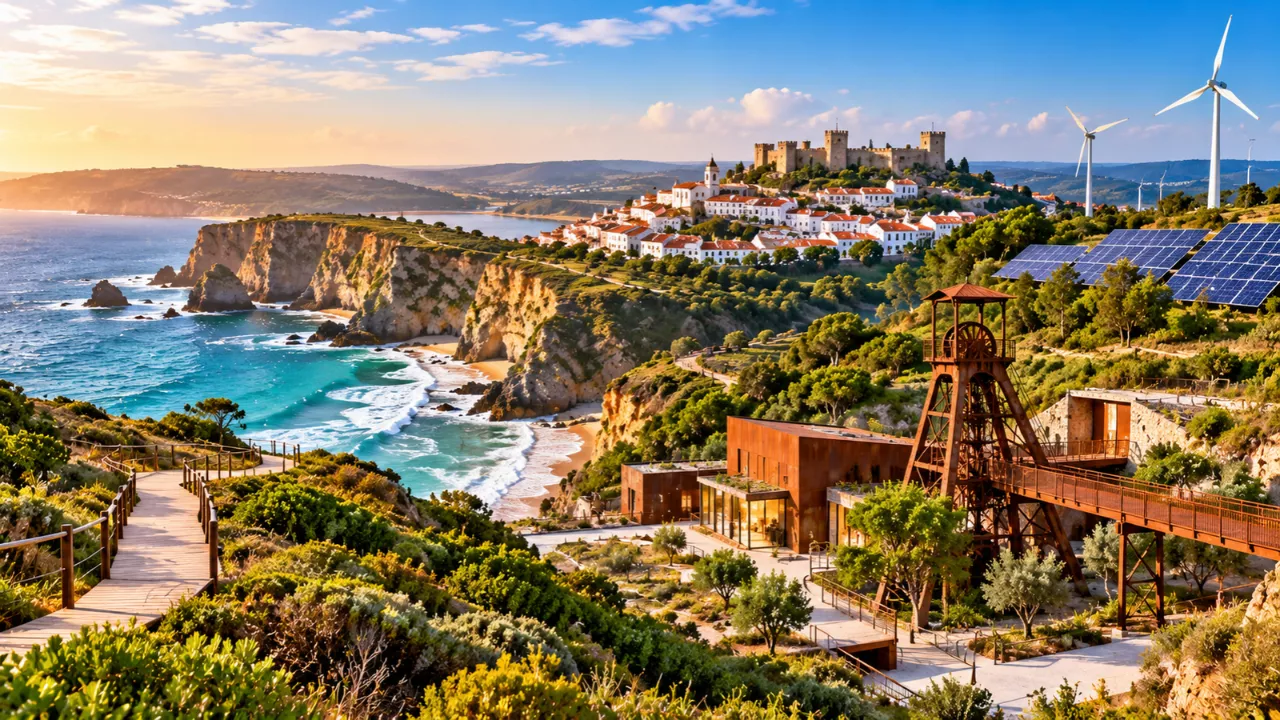
Portugal’s green transition is often described through big headlines: solar records, wind farms, marine parks. The shortlist for this year’s European Funds Awards tells a quieter and more useful story. The five green projects in Portugal competing in the “Portugal + Verde” category cover vineyards, a long Atlantic coastline, a metropolitan climate plan, textile reuse and a former uranium mine. Each one is a practical answer to a specific local problem.
Why This Shortlist Matters
The Prémios dos Fundos Europeus are run by Portugal’s Agency for Development and Cohesion (AD&C) as part of the Portugal 2030 communication network. They recognise projects co-financed by EU funds that have a real social, economic or environmental effect. The “Portugal + Verde” category covers the green transition, energy efficiency, circular economy and sustainable mobility.
Public voting follows the jury’s shortlist, so readers can back a favourite. The key dates:
- 3–5 November 2026: the third Mostra dos Fundos Europeus at the Lisbon Congress Centre
- 5 November: finalists present their projects
- After the presentations: jury deliberation, then the awards ceremony
The Five Finalists at a Glance
| Project | Where | Focus | Worth knowing |
|---|---|---|---|
| Alentejo Wine Sustainability Programme | Alentejo | Greener practices in vineyards and wineries | Created in 2014 by the regional wine commission; named “Best Joint Initiative” at the 2024 V d’Or awards |
| Lisbon Metropolitan Climate Adaptation Plan | 18 municipalities around Lisbon | Heat, drought, floods, sea-level rise | Presented in 2019; its measures are being reviewed for 2025–2030 |
| COSMO coastal monitoring | Mainland coastline | Tracking beaches, dunes and cliffs | Run by the Portuguese Environment Agency since 2018; data is free to access |
| re.store® | Portugal | Textile reuse and social inclusion | Founded in 2020; works with companies and social institutions |
| Urgeiriça mine rehabilitation (final phase) | Nelas, Viseu district | Environmental clean-up of a former uranium mine | The mine closed in 1999; the final phase restored about 13 hectares |
Coast and Capital: Planning for Erosion, Heat and Floods
Two of the finalists are about knowing what is coming and acting early. COSMO surveys beaches, dunes, cliffs and the nearby seabed using topographic and hydrographic methods, including drone flights. The results feed directly into decisions about where to protect, where to intervene and whether past interventions worked. A second phase, COSMO 2.0, began in January 2025, and the Environment Agency now publishes the monitoring data openly. That makes it a resource for researchers and local planners as well as engineers.
Lisbon’s metropolitan adaptation plan works at a different scale but follows the same logic. It brings the capital’s 18 municipalities under one framework for heat waves, droughts, floods and rising seas. Its studies point to a sea-level rise of around 90 centimetres by 2100, with areas around the Tagus estuary, including Lisbon, Almada and Seixal, among the most exposed. A plan is only as good as its follow-through, so the ongoing review of its measures matters as much as the original document.
Vineyards and Textiles: Greener Everyday Economies
The Alentejo Wine Sustainability Programme shows what a sector-wide approach can achieve. Rather than leaving sustainability to individual estates, the regional wine commission built a shared framework in 2014 covering soil management, biodiversity and resource use. Producers assess themselves against it and work towards higher categories. Its recognition in Paris in 2024 suggests the model is being noticed beyond Portugal.
re.store® tackles waste from the other end. Founded in 2020, it turns textiles that have lost their original use into new products. It works with businesses and social organisations, so the environmental gain comes with a social one. Reuse often attracts less attention than recycling, but it keeps materials in circulation longer.
Urgeiriça: From Uranium Mine to Public Space
The Urgeiriça mine in Nelas is probably the most striking story on the list. The uranium mine closed in 1999, and the state mining-remediation company took on a long clean-up. The project’s final phase covered roughly 13.4 hectares and involved removing or treating around 351,000 tonnes of waste and soil. Eligible costs were just over €11 million, most of it from the EU Cohesion Fund, and the work was completed in 2021. Part of the wider aim was to return the area to the community, and a leisure and sports area has already opened on the site. It shows that rehabilitation can be measured, finished and handed back to the people who live nearby.
Frequently Asked Questions
What are the Prémios dos Fundos Europeus?
They are awards organised by Portugal’s AD&C that highlight projects co-financed by European funds and their impact on the country’s economic, social and environmental development.
When will the winners be announced?
The finalists present on 5 November 2026 during the Mostra dos Fundos Europeus in Lisbon (3–5 November), followed by jury deliberation and the awards ceremony.
Can the public vote for a finalist?
Yes. Public voting opened after the finalists were announced and runs through the official awards website.
Is COSMO coastal data free to use?
Yes. The Portuguese Environment Agency’s renewed COSMO 2.0 platform offers updated monitoring data for beaches, dunes and cliffs free of charge.
Starpipe SpaceX: Why Musk’s Gas Pipeline Could Mean 11 Million Tonnes of LNG a Year!