
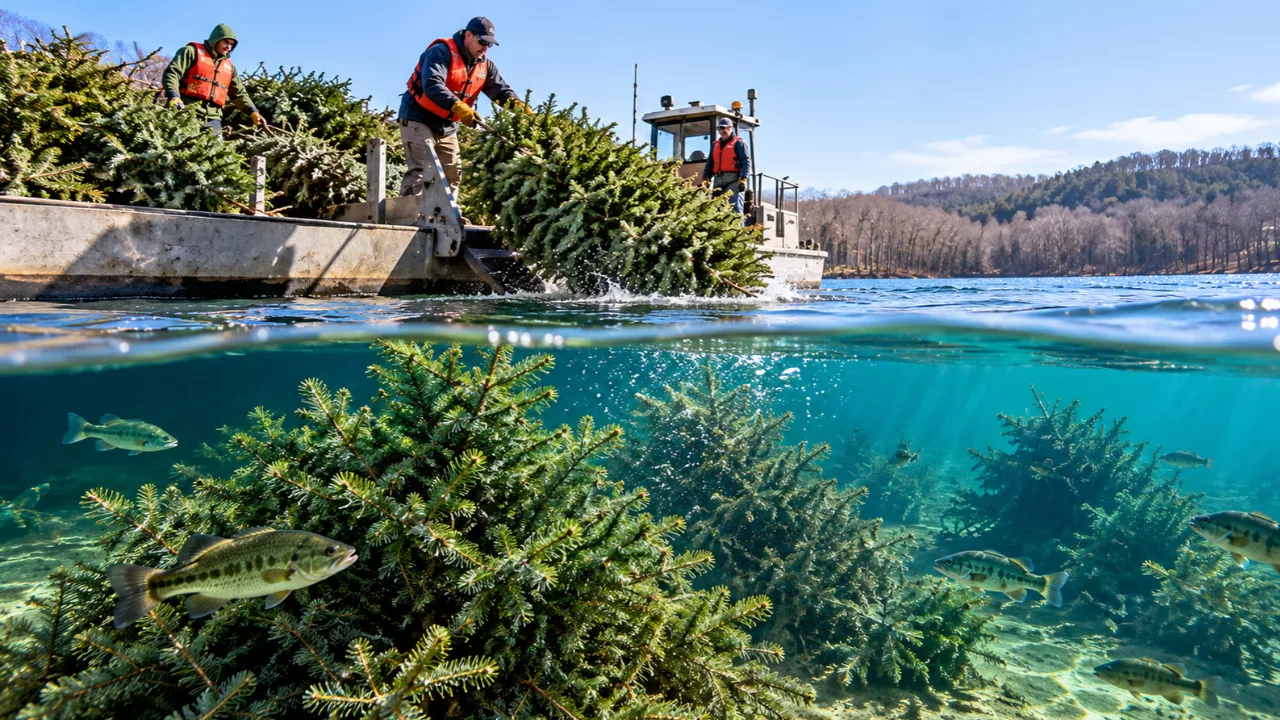
Every January, millions of Christmas trees end up at curbs and in landfills. In Kentucky, thousands of them take a different route: to the bottom of a lake. In 2026, the state collected about 5,000 discarded trees, and officials sank 1,700 of them in a single lake to replace underwater shelter that had gradually disappeared. It is a rare case where recycling, conservation and fishing all benefit from the same effort. Here is how Kentucky Christmas trees become fish habitat, and why wildlife biologists keep coming back to the idea.
What Is Kentucky’s “Christmas for the Fishes” Program?
The Kentucky Department of Fish and Wildlife Resources runs an annual recycling effort called Christmas for the Fishes. Residents drop off natural, cut trees at designated collection points across the state after the holidays. Fisheries crews gather them, bundle them and sink them in state lakes and reservoirs, where they work as fish attractors.
The rules are simple. Trees must be real, and they must be stripped of lights, tinsel, ornaments and garlands. Artificial trees, wreaths and loose trimmings are not accepted. Drop-off sites are typically open during daylight hours and are unstaffed, so a quick stop on a weekend is usually all it takes. Because collection dates and locations change each season, check the department’s website or call its information line before you go.
Why Kentucky’s Lakes Need Underwater Shelter
Most of Kentucky’s large lakes are reservoirs, built decades ago. When they were filled, they flooded standing timber, stumps and brush that gave fish plenty of places to hide and feed. Over the years that wood has rotted away or been buried under sediment, leaving open stretches of lake bottom with little cover.
That matters because fish are structure-oriented. Young fish need tight spaces to avoid predators, and larger fish gather where small fish and insects congregate. Sunken trees help in a few ways:
- Dense branches create hiding spots for juvenile fish.
- Algae grows on the submerged wood and feeds invertebrates and baitfish, so the tree provides both shelter and food.
- Larger game fish such as crappie and bass are drawn to the concentrated activity.
- Anglers get predictable places to fish, since the department records the locations.
Biologists describe a single tree as modest habitat, but a cluster of 50 to 100 trees can form something closer to a brush reef, which tends to hold more fish the denser it gets. A single tree is also not a permanent fix, since it slowly decays, but its benefits can last several years.
The 2026 Numbers at a Glance
| Detail | What it means |
|---|---|
| About 5,000 trees collected in 2026 | Trees diverted from landfills and curbside piles |
| About 1,700 trees in one lake | A large, concentrated habitat restoration |
| Typical cluster size | Roughly 50 to 100 trees per site to build a “reef” |
| Habitat lifespan | Several years as the wood slowly breaks down |
| Accepted trees | Natural, undecorated, cut trees only |
| Angler access | GPS locations published by the department |
For context, the department has reported receiving around 3,000 trees in some recent years, so a total near 5,000 points to strong public participation. Putting 1,700 into one lake is also a big commitment. Earlier coverage of a Grant County lake described crews dropping roughly 1,400 trees over three days, which gives a sense of how much boat time and labor goes into a project of this scale.
How the Trees Actually Get to the Bottom
It is more hands-on than tossing trees off a boat. Crews load donated trees onto barges and haul them to the target lake. Trees are bundled into stacks, anchored with weights so they stay put, and placed at planned depths. Staff choose sites based on each lake’s management goals and, in some cases, on angler feedback. At one lake, for example, anglers asked for more structure along cliff walls where crappie gather, so crews built stacks for exactly that.
Once a stack is in place, it is marked with a GPS coordinate. Those coordinates go on the department’s website and in the FishBoatKY app, so anglers can find the new spots. The department is funded through fishing and hunting license sales, boat registrations and related grants, which means the people who fish are helping pay for the habitat they use.
Why This Matters Beyond Kentucky
Americans throw away an estimated 15 million real Christmas trees every year. Many are chipped into mulch or landfilled, and both are fine outcomes. But sinking them gives the wood a second job in a place where it is genuinely scarce. It also solves a practical problem for biologists. Collecting and hauling enough timber to build habitat is slow, expensive work, and donated trees arrive already cut.
If you want to take part, the steps are straightforward:
- Remove every light, ornament and strand of tinsel.
- Take only a natural, cut tree. No artificial trees, wreaths or loose branches.
- Check the current drop-off list and dates before you go.
- Later in the year, look up the lake’s fish attractor coordinates if you fish.
Frequently Asked Questions
Is it safe to put Christmas trees in a lake?
Wildlife agencies use untreated natural trees, remove decorations beforehand and anchor them with environmentally friendly weights. That is why Kentucky only accepts undecorated, natural trees.
Can I donate an artificial tree?
No. Only real, cut evergreen trees are accepted. Artificial trees do not decompose and do not provide the same habitat or food benefits.
How long do sunken Christmas trees help fish?
Each tree can provide benefits for several years while it slowly breaks down, which is why the department refreshes sites with new trees every year.
Can anglers find where the trees were placed?
Yes. The department records the GPS coordinates of its fish attractors and publishes them on its website and in the FishBoatKY app.