
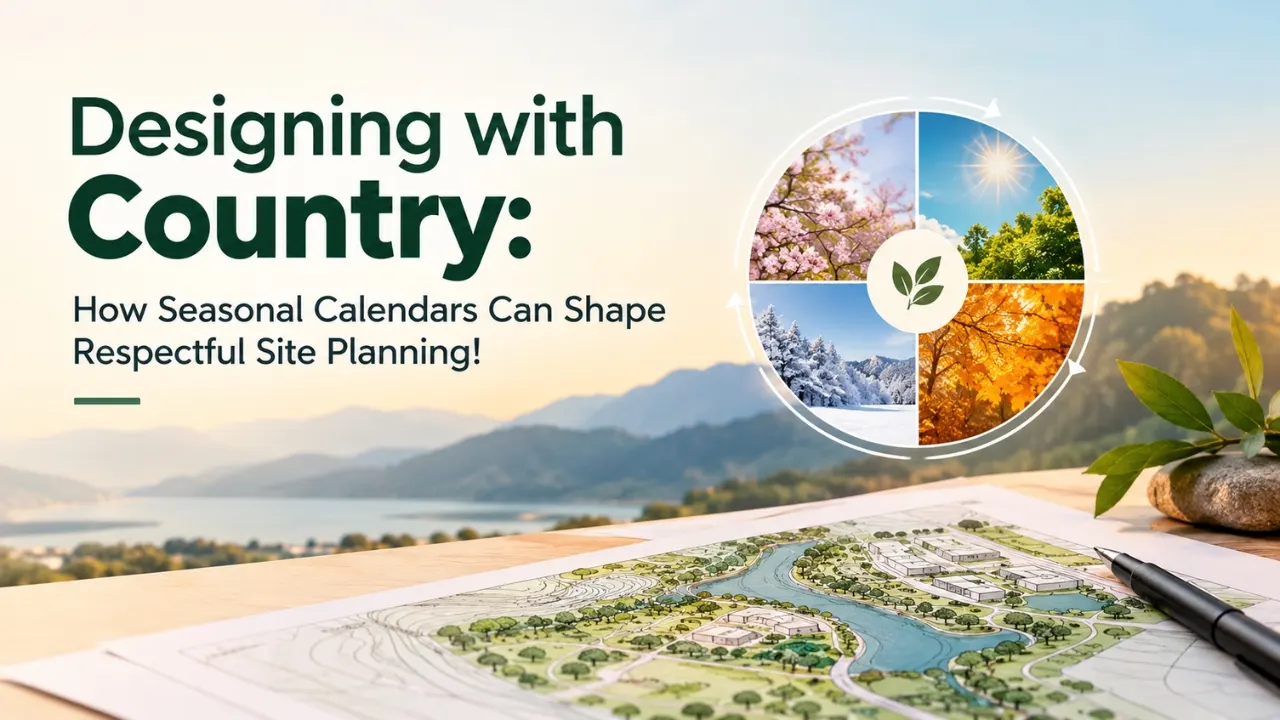
Designing with Country starts from a simple idea: Country is not just scenery or a site boundary. For many Aboriginal and Torres Strait Islander peoples, Country includes land, water, sky, animals, plants, stories, law and kinship, past, present and future. A development site is therefore never a blank slate. It already sits inside a living system with its own rhythms and responsibilities.
That shift matters for landscape architects, architects, planners and developers. At the University of Melbourne’s Melbourne School of Design, a studio called Design with Country has been co-taught with an Indigenous designer and the Wurundjeri Woi-wurrung Aboriginal Heritage Corporation since 2021. Its premise is that practices like ecological restoration, regeneration and walking a site have natural parallels with caring for Country. Designers who treat these as partnerships, rather than as inspiration to borrow, tend to produce better outcomes.
Why Seasonal Calendars Matter in Site Planning
Most of us plan around four seasons that were imported from the Northern Hemisphere. Many First Nations calendars work differently. They are tied to local indicators: when a particular plant flowers, when an animal breeds or migrates, when rain or wind shifts. The Wurundjeri Woi-wurrung calendar, for example, describes seven seasons rather than four.
For a designer, this is practical knowledge as well as cultural knowledge. A seasonal calendar can tell you when a site is wet, when it is fire-prone, when species are nesting and when certain materials or foods are available. It encourages you to plan across time instead of freezing a site into a single drawing. The Melbourne studio frames this as designing with past, present and future in mind, and it pairs naturally with near, mid and long term strategies for climate adaptation.
How to Bring a Seasonal Calendar into Your Design Process
The first rule is that the calendar is not yours to extract. Seasonal knowledge belongs to specific Traditional Owners and knowledge holders, and it is specific to Country. A calendar from one region cannot be applied to another. Begin by contacting the relevant Traditional Owner organisation, and let them decide what is shared, how, and for what purpose.
Once a relationship exists, the calendar can inform decisions at every stage. During site analysis it shapes when you visit and what you observe. During concept design it guides planting palettes, water management and habitat links. During delivery and maintenance it can inform construction timing, so that earthworks avoid sensitive periods, and long-term care schedules.
The table below shows how common seasonal indicators can translate into planning decisions. These are general examples, and the actual indicators and meanings must come from the knowledge holders for your site.
| Seasonal Indicator | Typical Planning Question | Possible Design Response |
|---|---|---|
| Flowering of key plants | Which species support local fauna through the year? | Planting palettes timed to continuous flowering and food availability |
| Breeding or nesting periods | When is disturbance most harmful? | Construction windows that avoid sensitive periods |
| Wet and dry periods | How does water move across the site? | Swales, wetlands and flood-tolerant zones sized for seasonal extremes |
| Fire-risk periods | How should vegetation and access be managed? | Fuel management and landscape zoning informed by cultural burning advice |
| Availability of traditional foods or materials | What can people gather or use on site? | Gathering areas and species selection led by Traditional Owners |
| Gathering or ceremony times | Who needs access, and when? | Flexible access, quiet zones and culturally appropriate gathering spaces |
Crediting Knowledge Holders the Right Way
Crediting is more than a line in the acknowledgements. A genuine credit names the people and organisation, explains what knowledge was shared, and states what was agreed about its use. It also respects Indigenous Cultural and Intellectual Property, meaning that knowledge shared for one project is not automatically available for the next.
Good practice usually includes:
- Engaging Traditional Owners early, before concepts are fixed, not after
- Paying knowledge holders fairly for their time and expertise, as you would any consultant
- Agreeing in writing how knowledge, imagery and stories will be used and attributed
- Showing the knowledge holders drafts and getting their approval before publishing
- Looking for ways the project can deliver real benefits to Traditional Owners, such as employment, land stewardship roles or enterprise opportunities
The Melbourne research group’s work on the Birrarung (Yarra River) is an example of this thinking. Its report for the Yarra Riverkeeper treats the river as one living entity from source to sea. It also places the identification of opportunities for Traditional Owners at the centre of its adaptation strategies.
Common Mistakes to Avoid
A few pitfalls come up repeatedly when teams are new to this approach:
- Treating a seasonal calendar as a decorative graphic or branding device
- Using a calendar from a different Country because it is easier to find
- Consulting once, at the end, to tick a compliance box
- Using cultural stories or designs without permission or credit
- Assuming one person speaks for all Traditional Owners of an area
The common thread is time and trust. Designing with Country asks practitioners to slow down, listen and accept that some decisions are not theirs to make. The reward is work that is better grounded, more resilient and more meaningful to the people who live with it.
Frequently Asked Questions
What is Country in the context of design?
Country is a holistic Aboriginal and Torres Strait Islander concept that includes land, waters, skies, living things, cultural law and stories. In design, it means treating a site as a living, connected system rather than an empty parcel.
Can I use an Indigenous seasonal calendar I found online in my project?
Not without permission. Seasonal calendars are specific to particular Countries and belong to the relevant knowledge holders. Contact the Traditional Owner organisation for your site, and use only what they agree to share and credit.
How do seasonal calendars help with climate adaptation?
They record long-term observations of how local weather, plants and animals change through the year. That helps designers time works, choose suited species and plan water and fire management across near, mid and long term horizons.
Should knowledge holders be paid?
Yes. Their expertise is professional and cultural knowledge, and it should be valued and compensated as such, alongside agreed credit and benefit-sharing.
Australia’s Housing Ministers Just Agreed to Rewrite How Homes Get Built: Here’s What Changed..
4 thoughts on “Designing with Country: How Seasonal Calendars Can Shape Respectful Site Planning!”
Comments are closed.