
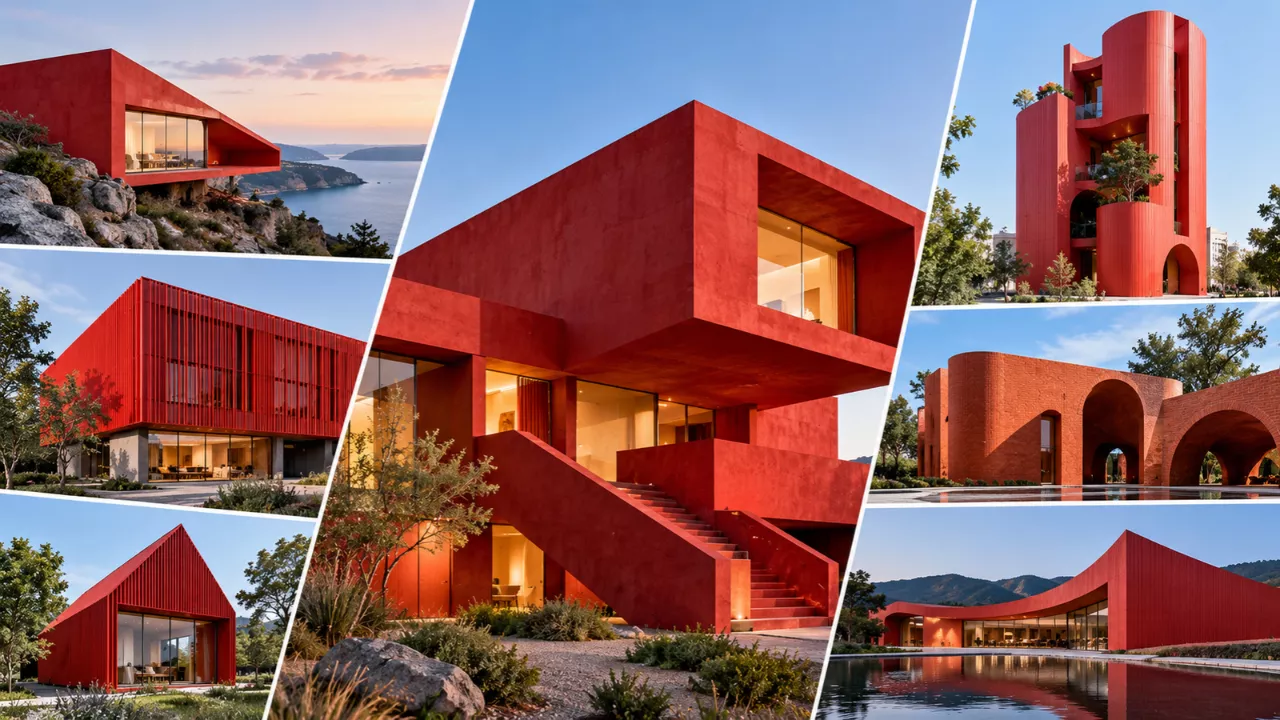
Few colours stop people in their tracks like red. Architects tend to use it carefully, but the seven red buildings below show how confidently it can work when it is tied to a clear idea. They span four countries and very different uses: a fire station, an arena, a logistics hub, a woodland cabin, family homes and a university extension.
Why Red Buildings Command Attention
Red has long been part of building traditions, from timber barns in northern Europe to terracotta in warmer regions. What has changed is how deliberately contemporary architects use it. Red can mark a civic landmark, give a small house personality, or unify a group of simple industrial forms. Colour is not decoration here. It carries a job, whether that is identity, visibility or a nod to local heritage.
Seven Red Buildings at a Glance
| Building | Location | Architect | Red element | Key idea |
|---|---|---|---|---|
| Liden’s Brandstation | Liden, Sweden | Kod Arkitekter | Red-stained timber cladding | Fire station as local landmark |
| Jihlava Municipal Arena | Jihlava, Czech Republic | Chybík + Krištof | Zigzagging red aluminium facade | Civic identity for a 5,650-seat arena |
| Cucu | Westmeath, Ireland | Studio Bucky | Red-stained shingles | Off-grid cabin with personality |
| Prostir Business Hub | Zymna Voda, near Lviv, Ukraine | Aranchii Architects | Red metal panels | 12,000 sq m logistics hub in three volumes |
| House Comet | Riga, Latvia | Gaiss | Red-painted timber walls | Modern take on a traditional barn |
| William T Cannady Hall | Houston, USA | Karamuk Kuo | Terracotta and glass | Sawtooth-roofed architecture school addition |
| House With a Red Addition | Czech Republic | Facha Architekti | Red corrugated metal | Extension to a home in a former pigsty |
Red as a Civic and Commercial Signature
Three of the projects use red to give large, functional buildings a face. In Sweden, Kod Arkitekter clad the Liden fire station in bright red-stained timber. The building is partly sunken into its site, close to a highway for fast emergency response, and the colour makes it easy to read as a community landmark. Red-stained timber also echoes a long Scandinavian tradition of red-painted wooden buildings.
In the Czech city of Jihlava, Chybík + Krištof wrapped an ice hockey arena in red aluminium panels folded into a zigzag. The colour nods to the local team, while the arena also serves as a wider cultural venue. Near Lviv in Ukraine, Aranchii Architects used bright red metal on the Prostir Business Hub, which gives three curved-roofed, warehouse-like buildings a shared identity rather than a generic industrial look.
Red in Homes and Retreats
At domestic scale, red feels warmer and more personal. Studio Bucky’s Cucu cabin in rural Westmeath, Ireland, pairs red-stained shingles with a tapered shape and irregular openings, creating a memorable off-grid retreat for the rental brand Samsú. In Riga, Gaiss built House Comet as a contemporary reading of a Latvian barn, with red-painted timber walls under a white corrugated metal roof. The contrast keeps the house bold without feeling heavy.
Facha Architekti took a more surgical approach in the Czech Republic. Rather than repainting an old home, they added a red corrugated-metal extension to a house set inside a former pigsty, along with a larch terrace that connects it to the garden. The red makes the new addition clearly legible against the original building, which is a thoughtful way to approach renovation.
A Warmer Red in Education
Karamuk Kuo’s William T Cannady Hall at the Rice School of Architecture in Houston shows that red does not have to be loud. The 22,000-square-foot addition uses terracotta and glass, topped by a sawtooth roof that echoes the industrial language of fabrication spaces. The terracotta gives the building an earthy, warm tone and ties it to a long architectural tradition of fired clay.
What Designers Can Take from These Red Buildings
- Give the colour a reason. The strongest examples tie red to function, heritage or local culture, such as a hockey team, a barn tradition or emergency services.
- Match the material to the mood. Stained timber feels rustic, aluminium and metal panels feel crisp and civic, and terracotta feels warm and grounded.
- Use contrast to sharpen the effect. A white roof, a larch terrace or an older building next to a red addition makes the colour read more clearly.
- Plan for weathering. Red pigments can fade under strong sunlight, so finish quality and maintenance deserve early attention.
Frequently Asked Questions
Why do architects use red on buildings?
Red is highly visible and emotionally strong, so it suits landmarks, civic buildings and projects meant to express a distinct identity or local tradition.
Which of these red buildings is a fire station?
Liden’s Brandstation in Sweden, designed by Kod Arkitekter, is a fire station clad in red-stained timber.
Does a red building have to be bold and bright?
No. Terracotta, as at Cannady Hall in Houston, delivers a warmer, more muted red, while stained timber gives a traditional look.
Can red work on a small home or extension?
Yes. House Comet in Riga and the red extension by Facha Architekti in the Czech Republic show that red can work well at domestic scale, especially with a contrasting material or roof.
Note on sourcing: project details come from Dezeen’s roundup “Seven striking buildings that make a statement with red” (18 October 2026). The article above is written in original wording. Regional context, such as the Scandinavian red-timber tradition and pigment fading, is general architectural background. Before publishing, you may want to add your own photography or credited press images for each building.