
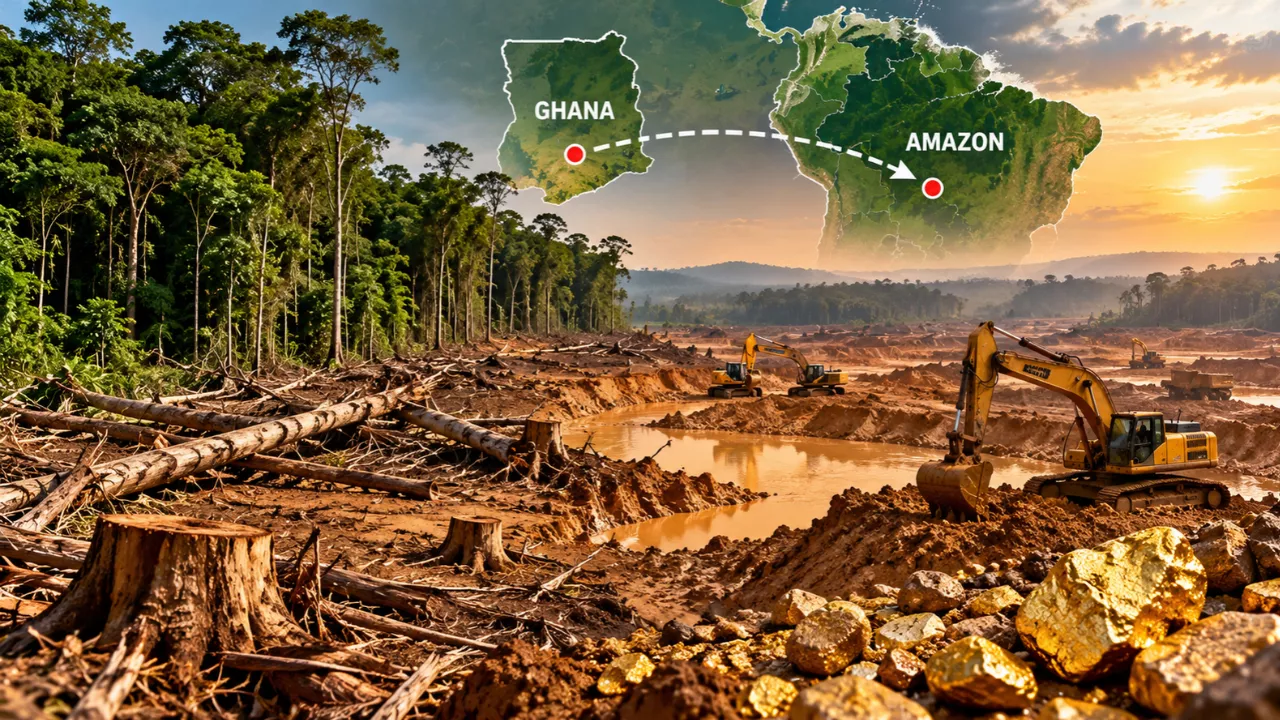
Gold has been breaking price records, and the effects reach well beyond jewellery counters and central bank vaults. The gold boom is fuelling tree loss in some of the world’s most important forests, from Ghana’s cocoa-belt reserves to the river basins of the Amazon. When gold gets more valuable, digging for it in a forest becomes more profitable, and people with few other options move in.
Why a Rising Gold Price Puts Forests at Risk
Mining is not usually the first thing people think of when they hear “deforestation,” but gold has become the biggest mineral-related driver of forest loss. Researchers at the University of Vienna link gold to roughly 3,520 square kilometres of forest destruction between 2000 and 2019. Campaign group Fern reports that gold-related clearing spiked when prices rose in 2012, and that the price roughly doubled between 2025 and 2026 amid geopolitical instability.
The mechanism is simple. A higher price makes marginal sites worth working, so miners push deeper into forest, along riverbanks and into protected land. Because much of this mining is informal and unregulated, there is rarely any environmental assessment or land restoration. The forest is cleared, the soil is turned over, and the land is left degraded.
Ghana: Galamsey and a Million Hectares Lost
In Ghana, small-scale illegal mining is known locally as “galamsey.” An investigative project by the Pulitzer Center notes that the country has lost more than one million hectares of forest over the past two decades, with illegal gold mining a central cause. A study by MIT, NASA and Ghanaian institutions that mapped artisanal mining using satellite imagery found that about half of the mining footprint it measured appeared between 2014 and 2017.
The damage is not limited to trees. Mining pollutes rivers that communities use for drinking water and farming, which is why a civil-society coalition has campaigned so loudly on the issue. Ghana’s government announced in 2025 that it would end mining in forest reserves, a step conservation groups welcomed. Whether it holds will depend on enforcement, not announcements.
The Amazon: Satellite Evidence Linking Price to Clearing
The Amazon offers some of the clearest evidence of the price-to-forest link. A well-known Duke University-led study of Madre de Dios in Peru found that deforestation at two mining sites rose about six-fold between 2003 and 2009, with roughly 7,000 hectares cleared as gold climbed about 18% a year. The same research tied rising gold prices to a sharp increase in mercury imports, since almost all of Peru’s imported mercury goes to artisanal gold mining.
More recent monitoring points the same way. Fern says close-range satellite data from the Amazon shows deforestation tracking the doubling of the gold price, and that Indigenous communities report violent clashes with illegal miners over territory.
Gold-Driven Tree Loss at a Glance
| Region | What is happening | Key finding |
|---|---|---|
| Global | Gold has become the leading mineral driver of deforestation | About 3,520 km² of forest destroyed, 2000–2019 (University of Vienna) |
| Ghana | Illegal small-scale mining (galamsey) spreads into forests and rivers | More than 1 million hectares of forest lost over two decades |
| Ghana | Artisanal mining footprint expands rapidly | About half of mapped mining appeared in 2014–2017 |
| Peruvian Amazon (Madre de Dios) | Informal mining follows the gold price | Roughly six-fold rise in deforestation at two sites, 2003–2009 |
| Other hotspots | Forests affected by gold mining | Russia, Brazil, Suriname, Peru, Indonesia and Myanmar, per Fern |
What Could Slow the Damage
There is no single fix, but proposals from civil-society groups share a common thread: make gold’s journey from forest to market traceable. Realistic steps include:
- National traceability systems so buyers can see where gold was mined
- Binding agreements between producer and consumer countries on illegal gold
- Tougher declaration rules to make gold smuggling harder
- A shared global standard requiring refiners to disclose their sourcing
- Support for the poverty that pushes small-scale miners into illegal supply chains
Consumers and investors have a smaller but real role. Asking jewellers and financial firms about sourcing, and favouring recycled or certified gold, adds pressure on supply chains to clean up.
Frequently Asked Questions
Does gold mining really cause deforestation?
Yes. Research ties gold to more forest loss than any other mineral since 2013, and satellite studies repeatedly show clearing rising when prices rise.
Which countries are most affected?
Fern lists Russia, Brazil, Suriname, Ghana, Peru, Indonesia and Myanmar among the countries whose forests are most affected by gold mining.
Is Ghana doing anything about illegal mining?
In 2025 the government announced a ban on mining in forest reserves. Civil society groups say enforcement and a multi-stakeholder approach will determine whether it works.
Can buyers avoid gold linked to forest loss?
Not perfectly, but recycled gold and refiners that publish their sourcing reduce the risk. Better traceability rules are what would make this easier.
Over €390 Million for 135 Climate and Environment Projects Through the EU LIFE Programme!