
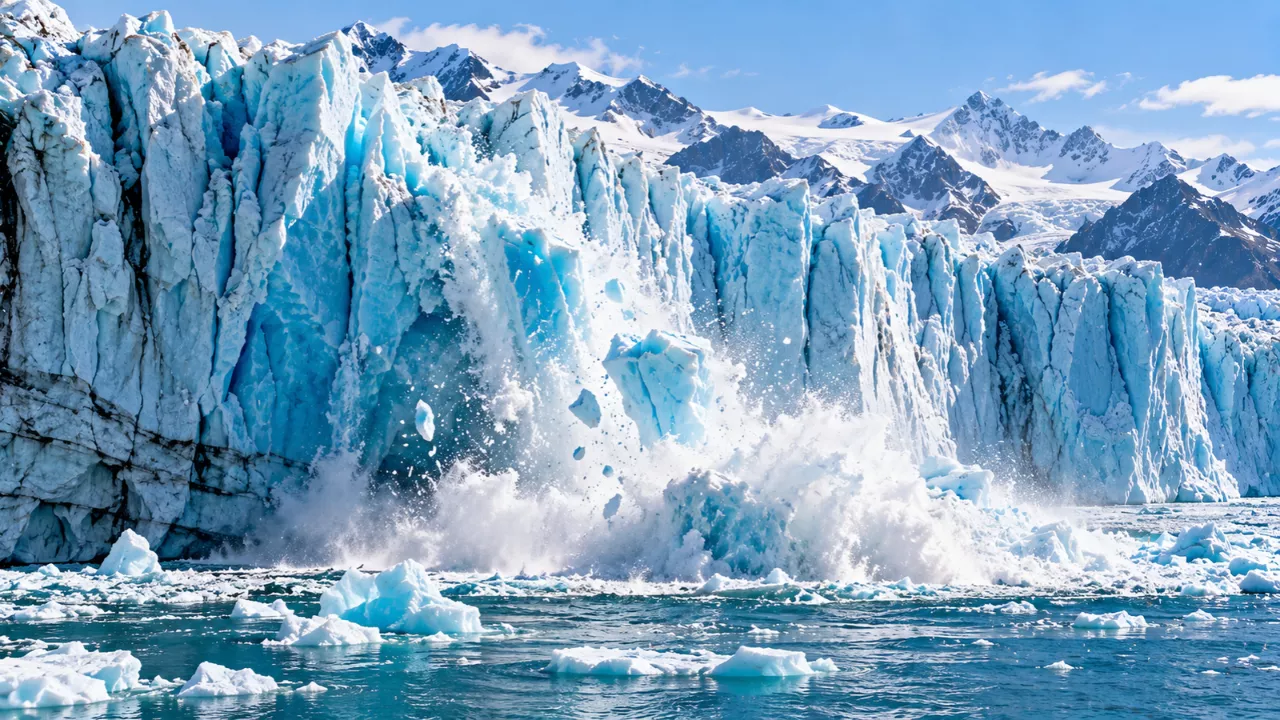
When a glacier meets the ocean, it often ends in a towering wall of ice. For more than a decade, scientists have argued about what happens when those walls get too tall. A new study based on satellite data now offers the clearest answer yet. Glacier ice cliffs can collapse quickly, but they tend to do it in fits and starts rather than in one unstoppable slide. That finding matters for anyone trying to understand how fast the sea could rise.
What Are Glacier Ice Cliffs, and Why Do They Matter?
An ice cliff forms where a glacier or ice sheet ends abruptly at the sea. It happens when the floating ice shelf that once held the glacier back breaks away and leaves a steep face of solid ice. Ice cliffs are found around Antarctica and Greenland, and they are among the places where ice sheets lose mass most directly.
The concern is simple. If ice cliffs collapse faster than expected, ice sheets could shed ice into the ocean faster than current projections suggest. That is why a theory called marine ice-cliff instability (MICI) has drawn so much attention and debate.
The Marine Ice-Cliff Instability Theory, Explained
The theory grew out of a 2012 study by glaciologists Jeremy Bassis and Catherine Walker. They asked why ice cliffs above the waterline are rarely taller than about 100 meters. Their answer was that taller ice cannot support its own weight and crumbles.
The theory then took a worrying step. When a cliff breaks off, it exposes the ice behind it, and on many glaciers that ice is thicker and taller still. If that new cliff is also too tall to stand, it fails too, and the pattern repeats. In the worst case, this runaway cycle would eat steadily into an ice sheet. Some model studies have linked this process to as much as a meter or more of global sea level rise by 2100, though those figures are heavily debated.
What the Satellite Data Actually Found
Until recently, most evidence for ice-cliff behavior came from computer simulations or studies of single glaciers. The new research, published in the journal Science under the title “Empirical constraints on ice-cliff calving,” takes a different approach. A team led by researchers at the Woods Hole Oceanographic Institution, with MIT and University of Michigan scientists, analyzed 15,330 satellite observations of ice cliffs around Earth’s ice sheets. The measurements came largely from laser altimetry, which times laser pulses bouncing off the ice to work out its height.
The headline results:
- Tall cliffs can break apart quickly. The researchers say current ice-sheet models may underestimate how fast this can happen.
- The retreat tends to be short-lived. Tall cliffs thin out as they collapse and settle into shorter, more stable ones.
- Height is not the only factor. Water depth, ice thickness, how fast the ice is thinning, and cracking in the ice all play a role.
- The data do not show a self-sustaining, runaway collapse. The results support some parts of the theory but not the most extreme version.
In short, the ice behaves more like a series of bursts and pauses than a continuous avalanche. As Bassis put it, the rapid retreat documented so far appears short-lived, with glaciers eventually re-stabilizing.
What Helps Ice Cliffs Stay Standing
The satellite record shows that several things can slow or stop a collapse. Scientists now consider these factors alongside cliff height:
| Factor | How it affects an ice cliff |
|---|---|
| Cliff height | Taller cliffs are more likely to fail, and the collapse rate rises sharply with height |
| Water depth | Deeper water pushes back against the cliff face and helps hold it up |
| Ice thinning | As the glacier thins, the cliff gets shorter and more stable |
| Ice mélange | A slushy mix of icebergs and frozen seawater can brace a cliff against the ocean |
| Bed shape | The terrain under the ice decides whether newly exposed cliffs are taller or shorter |
| Crevasses | Cracks weaken the ice and can speed up breakup |
This is why researchers say models that rely mostly on cliff height are incomplete. Getting the seabed shape and the thinning rate right is central to making better projections.
What This Means for Sea Level Rise
This is reassuring in one respect and cautionary in another. The study suggests that the most dramatic “runaway collapse” scenarios are less likely than some worst-case models implied. But it also suggests that ice can be lost faster than some models assume during each collapse episode. Both points can be true at once, and both need to be built into future models.
The research does not say ice sheets are safe. Ice shelves are still thinning and breaking up in a warming climate, and each loss exposes more cliffs. What the data offer is a more realistic picture of how those cliffs behave. Better physics means more reliable projections, and that helps coastal planners prepare for what is actually likely.
Frequently Asked Questions
What does “collapse in fits and starts” mean for glaciers?
It means ice cliffs tend to break apart in rapid bursts and then pause, instead of retreating continuously. After a burst, the glacier thins and the cliff often becomes short enough to stabilize.
How tall can an ice cliff get before it collapses?
Earlier research put the limit at about 100 meters above the waterline. The satellite study found the tallest cliffs sit right around that height, with one measured at 127 meters. Height is not the only factor, though, and conditions like water depth and surrounding ice can change the outcome.
Does this mean sea level rise is less of a threat?
Not necessarily. The findings make the most extreme runaway scenarios look less likely, but ice cliffs can still break up faster than some models assumed. Long-term sea level rise still depends heavily on how much the planet warms.
How do scientists measure ice cliffs from space?
They use satellite laser altimetry, which fires laser pulses at the ice and times their return to calculate surface height. NASA’s ICESat-2 satellite does this over the polar regions, and its repeat passes let researchers watch cliffs change over time.
Doomsday Glacier Is Melting Faster Than Scientists Expected-They didn’t realize how ‘aggressively’
1 thought on “Why Glacier Ice Cliffs Collapse in Fits and Starts, According to Satellite Data!”
Comments are closed.