
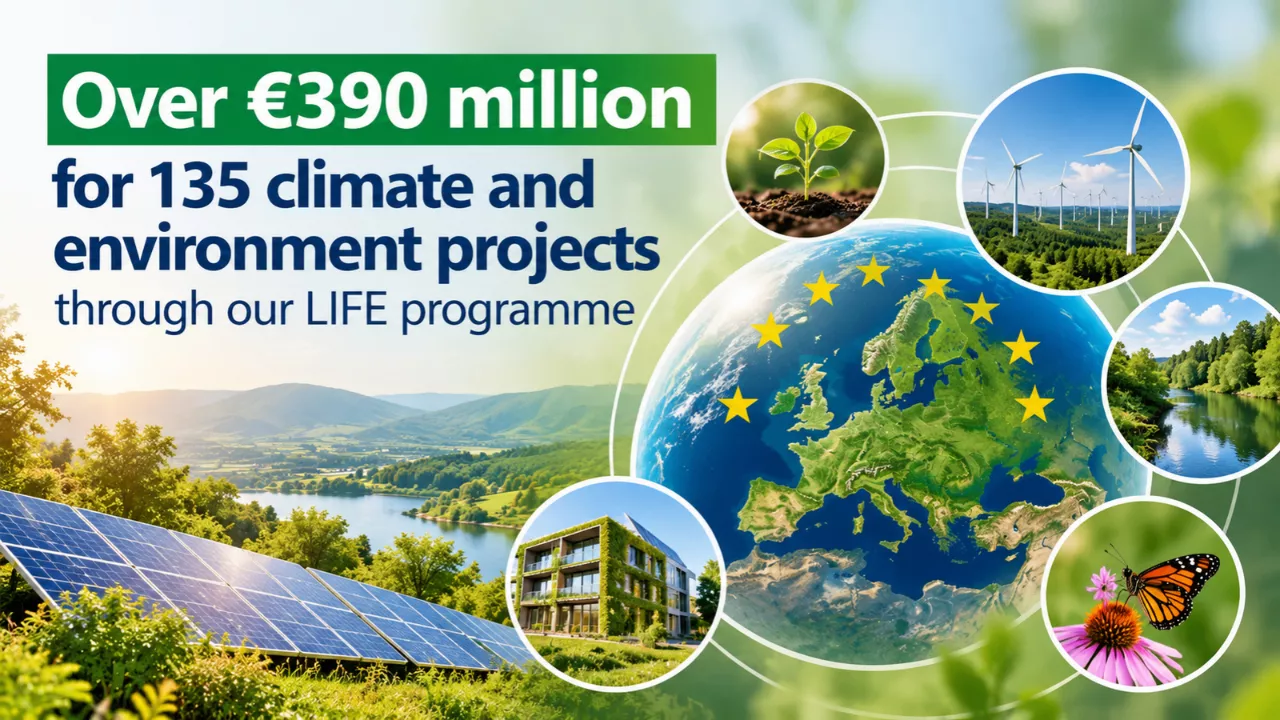
On 19 October 2026, the European Commission announced more than €390 million for 135 new projects under the EU LIFE programme, its dedicated fund for environment and climate action. The projects span coastal dunes, endangered wildlife, wildfire recovery and district heating. This article explains where the money is going, who is involved and what it means for people on the ground.
What the EU LIFE Programme Is and Why This Round Matters
LIFE has existed since 1992 and has co-financed more than 6,700 environmental and climate projects across the EU and associated countries. It is not a giant infrastructure fund. It pays for practical, local work: restoring a habitat, testing a cleaner industrial process, helping a city turn an energy plan into something banks will finance.
This round stands out for its scale of competition. The 135 winners were chosen from a record 1,095 applications under the 2025 call, so roughly one in eight proposals succeeded. The EU contribution covers a little over half of the €579 million total investment these projects need. The rest comes from national and local authorities, businesses and other partners, so the headline figure pulls in considerably more money than the Commission itself spends.
Where the €390 Million Goes: Funding by Priority Area
The money is split across four strands, which gives a quick picture of EU priorities.
| LIFE strand | Projects | Total investment | EU contribution |
|---|---|---|---|
| Nature and biodiversity | 29 | Over €223 million | Over €151 million |
| Circular economy and quality of life | 36 | Nearly €163 million | Nearly €91 million |
| Climate resilience and mitigation | 26 | Over €102 million | Over €61 million |
| Clean energy transition | 44 | Over €91 million | Nearly €87 million |
Two patterns stand out. Nature projects take the largest share of money, while clean energy has the most projects, each with a very high EU co-financing rate. That suggests many small, targeted grants aimed at helping local authorities and organisations get energy projects ready for investment.
Projects Worth Watching
The portfolio is varied, and the individual projects are easier to relate to than the totals. Examples include:
- LIFE SAVE Desman (Spain, €17.6 million): protecting the Pyrenean desman, a small semi-aquatic mammal.
- LIFE SOS (Finland, €11.3 million): conservation of the Saimaa ringed seal.
- LIFE for Jurinea (Czechia, €10.7 million): rescuing the rare sand jurinea plant.
- LIFE for VULTURES (Romania, €7.6 million): protecting several vulture species.
- LIFE COCON (Belgium, €9.2 million): restoring coastal dunes.
- CARENA LIFE (Germany, €10 million): nature-based carbon removal techniques.
- LIFE POSTFIRE (€5.9 million): helping Mediterranean regions recover after wildfires.
Together they cover all 27 EU Member States plus Iceland, Moldova, Montenegro, North Macedonia and Ukraine. That reach shows how LIFE extends beyond EU borders where environmental problems do not stop at them.
Why Climate Resilience and Clean Energy Funding Matters
Wildfires, floods and heat now directly affect homes, farms and public budgets, so resilience work such as flood-risk reduction and post-fire restoration is no longer a niche concern. On the energy side, many municipalities have ambitious plans but lack the staff and money to turn them into bankable projects. Several grants in this round, including district heating and cooling investment planning, target that gap. The strongest results from LIFE usually come when a small grant gets a good idea to the point where larger investors will back it.
What This Means for Applicants and Everyday Readers
For organisations, the numbers are a reminder that LIFE is competitive: the 135 successful projects came from over a thousand proposals. Strong applications usually have a clear local problem, measurable results and a plan to continue after funding ends. For everyone else, the practical effect is quieter than a policy headline, such as a restored wetland, a cleaner heating network or a protected species that holds on. The programme’s total budget for 2021–2027 is €5.43 billion, managed by the European Climate, Infrastructure and Environment Executive Agency (CINEA).
Frequently Asked Questions
How much funding did the EU LIFE programme announce?
More than €390 million for 135 new projects, announced on 19 October 2026.
How many projects applied, and how many were selected?
A record 1,095 applications were submitted under the 2025 call, and 135 were selected.
Which areas receive the most money?
Nature and biodiversity receives the most, with over €151 million from the EU for 29 projects. Clean energy has the most projects, at 44.
Does the EU pay for the full cost of these projects?
No. The EU contribution is a little over half of the €579 million total investment needed, and the rest comes from partners such as governments, businesses and organisations.
New National City Architects Network Launched to Connect Local Government Designers!
1 thought on “Over €390 Million for 135 Climate and Environment Projects Through the EU LIFE Programme!”
Comments are closed.