
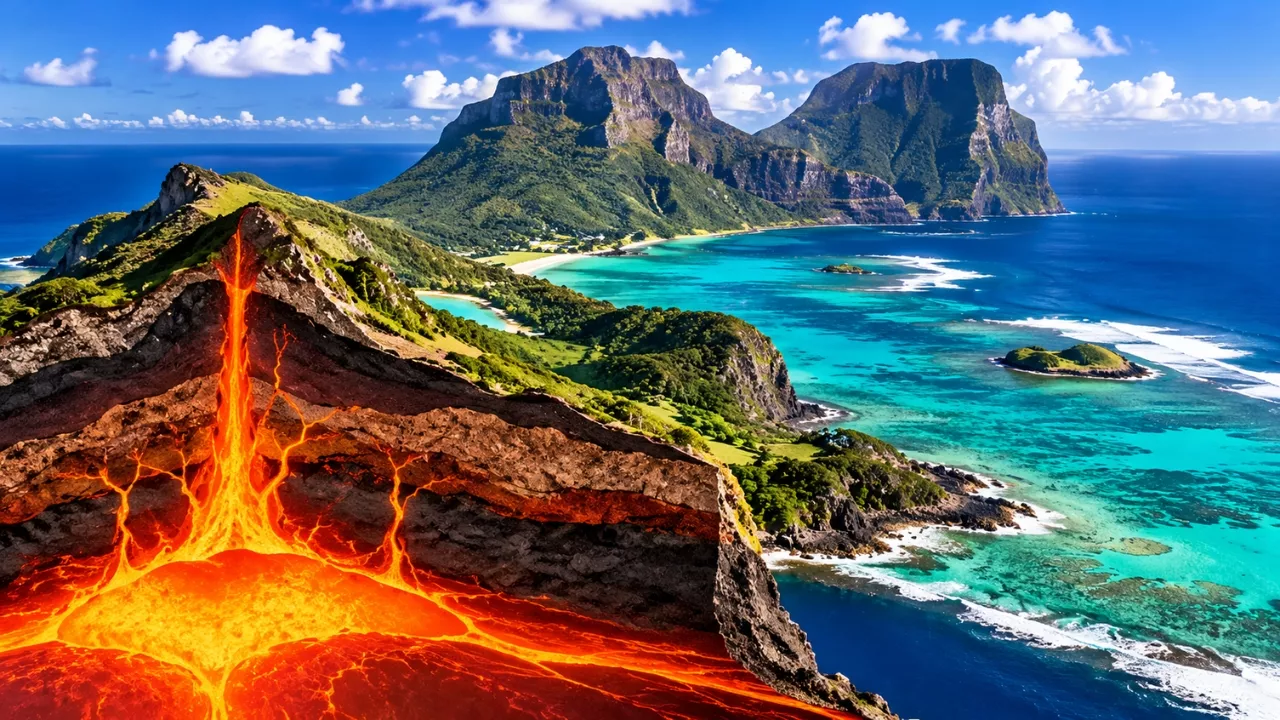
Lord Howe Island looks like a place that was always meant to be a paradise: jagged green peaks, coral reefs and a lagoon, about 600 kilometres off Australia’s east coast. What most visitors don’t see is the story beneath the waterline. The island’s volcanic origins are now clearer thanks to a study in the journal Gondwana Research, led by Dr Ben Mather of the University of Melbourne. It suggests that two parallel chains of undersea volcanoes were built by a single hotspot, and that the plume feeding it split in two on its way up.
Why Lord Howe Island’s Volcanic Origins Are Unusual
Lord Howe Island is the eroded remnant of an extinct shield volcano, and its mountains were built from lava flows almost 7 million years old. The southern end, with Mt Lidgbird and Mt Gower, is where that ancient volcano is easiest to read in the landscape. Nearby Ball’s Pyramid, the world’s tallest volcanic sea stack, is another exposed fragment of the same larger structure.
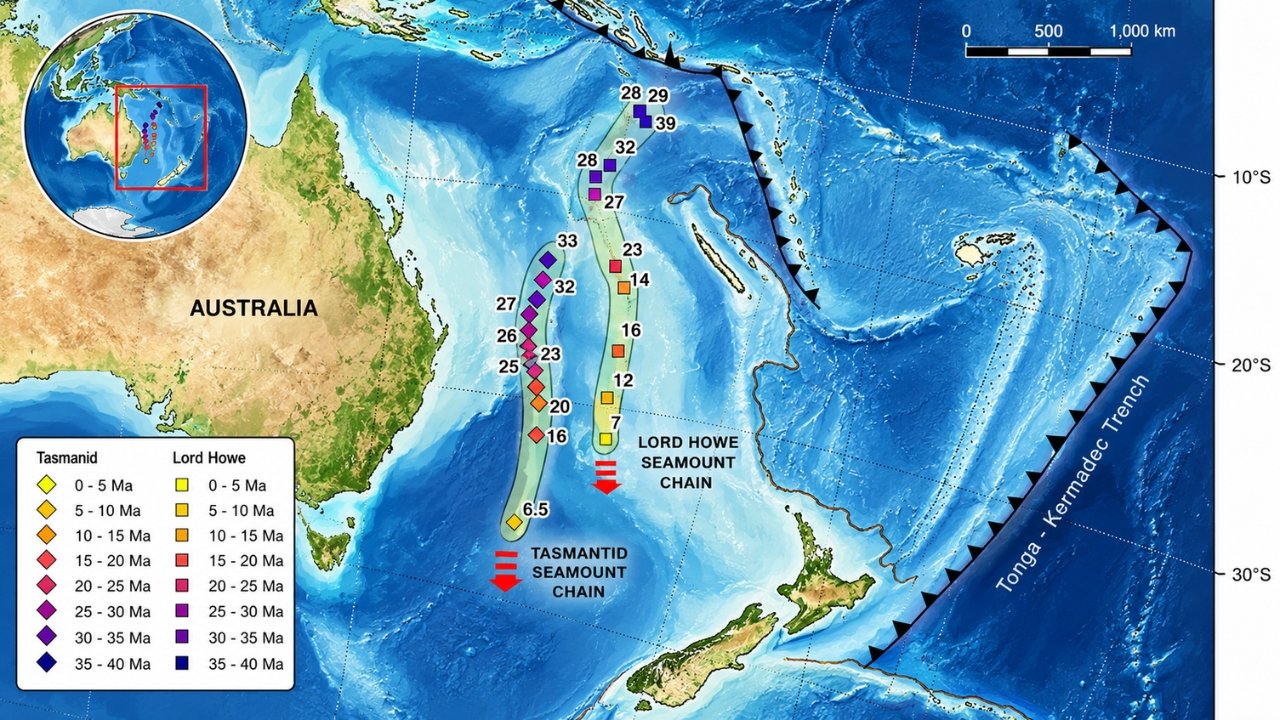
The island is also the southern end of the Lord Howe seamount chain, a line of mostly submerged, extinct volcanoes stretching about 1,500 km. Running alongside it is a second line, the Tasmantid chain, which has stayed less than 1,000 km away for millions of years. Two long volcanic tracks sitting side by side in the middle of a tectonic plate is rare, and that puzzle is what this research set out to solve.
How a Hotspot Builds a Chain of Volcanoes
A hotspot works a bit like a blowtorch held under a moving sheet of metal. A plume of super-heated rock rises from deep inside the Earth and melts its way through the plate above. Lava builds up on the seafloor into a seamount, and the Australian plate then drifts slowly north, carrying that volcano away. A new one forms over the hotspot, and the process repeats. For the Lord Howe chain, the plate has been moving over the hotspot for more than 40 million years. Because plumes stay roughly fixed while plates slide over them, scientists use hotspot tracks to reconstruct how continents have moved.
The Twin Plume Idea: Splitting Around an Obstacle
Dr Mather’s team built a 3D numerical model to test how one plume could produce two chains. In the model, the rising plume meets a slab of old seafloor that sank roughly 500 km into the mantle at an ancient subduction zone. The plume can’t pass through the slab, so it divides and finds gaps on either side. The researchers say the reconstructed position of that sunken slab beneath the Tasman Sea matches what the model predicts.
Rock samples add a second line of evidence. Lava from both chains is chemically near identical at any given age, which would be unlikely if two unrelated plumes from different patches of deep mantle were responsible. In short:
- One deep hotspot fed both chains.
- The plume split on meeting a sunken slab, rather than rising as a single straight pipe.
- Matching lava chemistry supports a shared source.
Lord Howe vs Tasmantid Chains at a Glance
| Feature | Lord Howe seamount chain | Tasmantid seamount chain |
|---|---|---|
| Overall character | Mostly submerged, extinct volcanoes | Mostly submerged, extinct volcanoes |
| Length | About 1,500 km | Runs parallel, less than 1,000 km away |
| Above-water features | Lord Howe Island and Ball’s Pyramid | Not highlighted in the research summary |
| Proposed origin | One branch of a split plume | The other branch of the same plume |
| Lava chemistry | Near identical to Tasmantid at matching ages | Near identical to Lord Howe at matching ages |
| Recent eruption volumes | Appear to be declining | Appear to be increasing |
Why This Matters Beyond One Island
The findings challenge the textbook picture of a plume as a straight vertical pipe. Dr Mather describes plumes as dynamic and capable of changing as they meet obstacles deep in the mantle. That affects how scientists read the past: if a single plume can leave two tracks, counting volcanic chains is not a reliable way to work out where tectonic plates once sat. He also suggests the same process might explain other paired tracks elsewhere, such as at Yellowstone in the United States.
There is a long-range forecast too. Eruption volumes suggest the Lord Howe chain is fading while the Tasmantid chain is growing, so the Lord Howe chain may eventually stop, millions of years from now. Dr Mather says dual chains can’t be sustained forever. Nobody on the island needs to worry: new volcanoes in these chains form about 5 million years apart.
What Scientists Still Need to Work Out
The result is not the final word. Dr Karin Orth of the University of Tasmania called the modelling “very elegant” but noted that it needs more data, especially for regions such as the Coral Sea and the area near New Guinea, where understanding is limited. She compared the work to detective work, and the model will be refined as evidence improves. Dr Mather’s team plans further studies, including high-resolution seafloor imaging and more rock sampling. Better knowledge of where undersea volcanoes may form could also help with shipping safety, tsunami prediction and understanding how the ocean floor interacts with the atmosphere.