
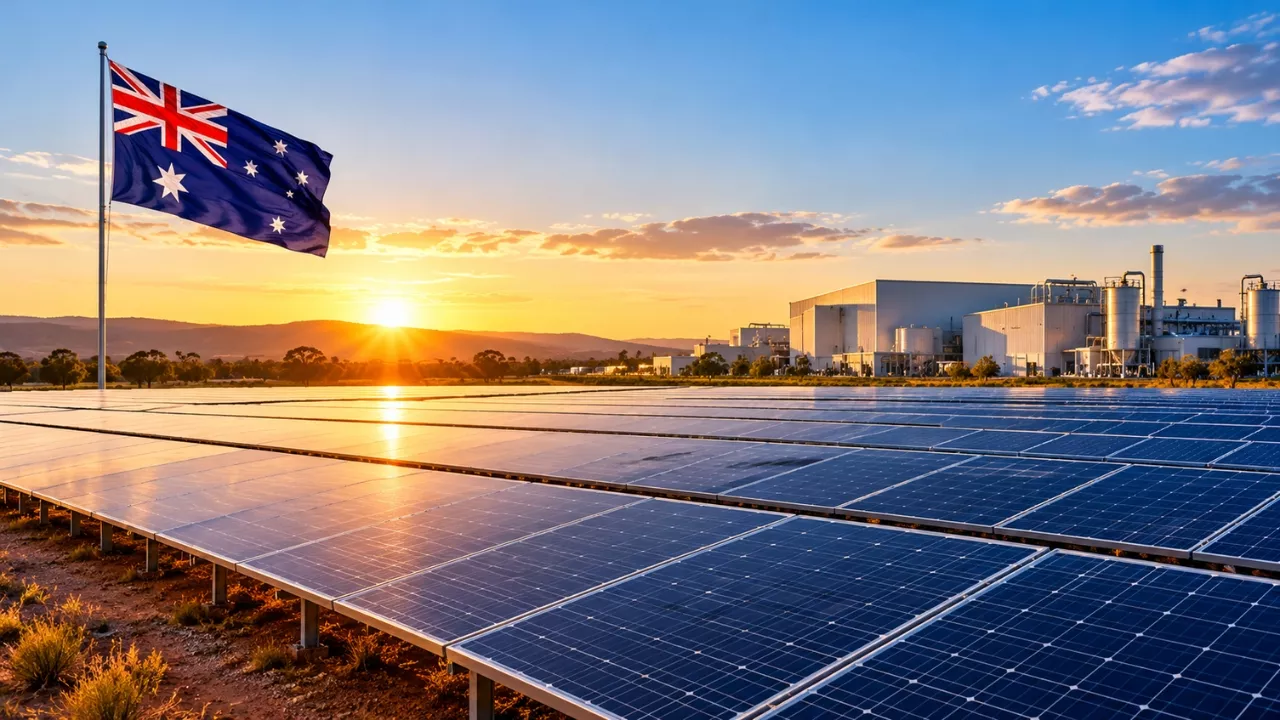
Australia has more rooftop solar per person than almost anywhere, yet nearly every panel on those roofs is made overseas. That gap is why Australian-made solar panels keep returning to the policy conversation. This week the Australian Renewable Energy Agency (Arena) said it still believes the country can reach its aspirational target of 1 gigawatt (GW) of annual module manufacturing. It also hinted that a new local manufacturer could be on the way.
The comments came as Arena opened round three of its $850 million Solar Sunshot program, with another $250 million available as production subsidies and grants. This round shifts the focus from cells and modules to cheaper, more innovative ways of building solar projects. Arena’s solar investment lead, Dan Sturrock, was clear that the agency has not given up on local panel production.
Where Australian Solar Manufacturing Stands Today
Adelaide-based Tindo Solar has been the country’s only commercial solar module maker since it was founded in 2011. It is now ramping up production at a new Adelaide facility. When the 2025 funding was announced, federal energy minister Chris Bowen said the support could help Tindo serve around 10 per cent of domestic demand.
A second contender is taking shape in New South Wales. A company led by respected solar researcher Zhengrong Shi plans to build the Hunter Valley Solar Foundry, a 500 MW-a-year plant making Sunman’s lightweight panels. It is also meant to offer production capacity to other manufacturers. Sturrock says construction is expected to start next year, and that it will become the new competitor producing modules at scale against Tindo.
Snapshot: The Players Shaping Local PV Manufacturing
| Company / Project | Location | Role | Funding mentioned | Status |
|---|---|---|---|---|
| Tindo Solar | Adelaide, SA | Existing module maker | $34.5 million Sunshot grant (2025) | Scaling from 20 MW to 180 MW a year |
| Hunter Valley Solar Foundry (Zhengrong Shi) | Hunter Valley, NSW | Planned 500 MW-a-year plant, Sunman lightweight panels | Over $150 million Sunshot, plus $20 million from NSW | Construction targeted for next year |
| SunDrive | Sydney / UNSW spin-out | Cell technology (copper metallisation) | $25.3 million via Advancing Renewables Program | Backed for technology, but reportedly no longer pursuing module manufacturing |
| Unannounced project | Not disclosed | Possible third manufacturer | Not disclosed | “Watch this space,” says Arena |
Why Reaching 1 GW Is Harder Than It Sounds
Add Tindo’s 180 MW target to the Hunter Valley plant’s 500 MW and you get roughly 680 MW a year. That is a meaningful step, but still short of 1 GW, which is why a third project matters. Sturrock said the agency always hoped to reach a gigawatt and still hopes to get there.
The obstacle is price. Cheap, abundant Chinese panels make competition fierce, and progress has been slower than many hoped. Tindo itself pitched a panel “gigafactory” in 2024, saying it could be done for $90–100 million within two years given the right federal support. That has not happened yet, and the plan has shifted to a staged ramp-up.
Balancing Taxpayer Money With Realistic Timelines
Sturrock described Arena as a custodian of taxpayer dollars and said it takes that responsibility seriously. He also said Arena has to stay flexible, because markets, competition and regulations change. Companies will not hit every success factor they set out at the start, so the agency weighs what really matters as projects evolve.
For readers watching public spending on clean energy, this is a useful reality check. Funding does not guarantee a factory, and a company changing course is not always a failure. SunDrive’s bid with Trina for a 1.2 GW plant in Western Sydney was unsuccessful, yet Arena kept backing its copper-based technology, which aims to replace silver and cut cell costs. SunDrive hopes to reach commercial-scale sales over the next six months, and Arena expects real commercial traction within 12 months.
What This Means for Households and Installers
Local panels are unlikely to change rooftop prices in the short term. Even so, there are good reasons to watch this space:
- Supply security: A domestic source reduces dependence on a single region for a key piece of energy infrastructure.
- Skills and jobs: Factories in South Australia and New South Wales would build engineering and manufacturing expertise.
- Technology edge: Lightweight panels and lower-cost cell methods could suit niches that standard imports do not.
- Competition: Arena says the market has room for several producers, and more than one local maker keeps everyone honest.
If you are comparing quotes today, check whether the panel is Australian-made, what warranty is offered and who stands behind it locally. As volumes grow, expect more installers to offer local options.
Frequently Asked Questions
Who makes solar panels in Australia right now?
Tindo Solar in Adelaide is currently the country’s only solar module manufacturer, a position it has held since 2011.
What is the Solar Sunshot program?
It is an $850 million Arena funding scheme that supports Australian solar manufacturing through production subsidies and grants. Round three adds $250 million and focuses on lower-cost construction methods.
How big could local solar manufacturing become?
Arena’s aspirational target is 1 GW a year. Tindo’s planned 180 MW and the Hunter Valley Solar Foundry’s planned 500 MW fall short of that, which is why Arena is pointing to a possible third project.
Will Australian-made panels be cheaper?
Not necessarily. Imported panels remain very cheap, and the main case for local production is supply security, jobs and new technology rather than lower prices today.
Clearer Rules, Cautious Capital: What Brazil’s New Curtailment Rules Mean for Utility-Scale Solar!
1 thought on “Can Australia Build Its Own Solar Panels? Inside the Push for Australian-Made Solar at Gigawatt Scale..”
Comments are closed.