
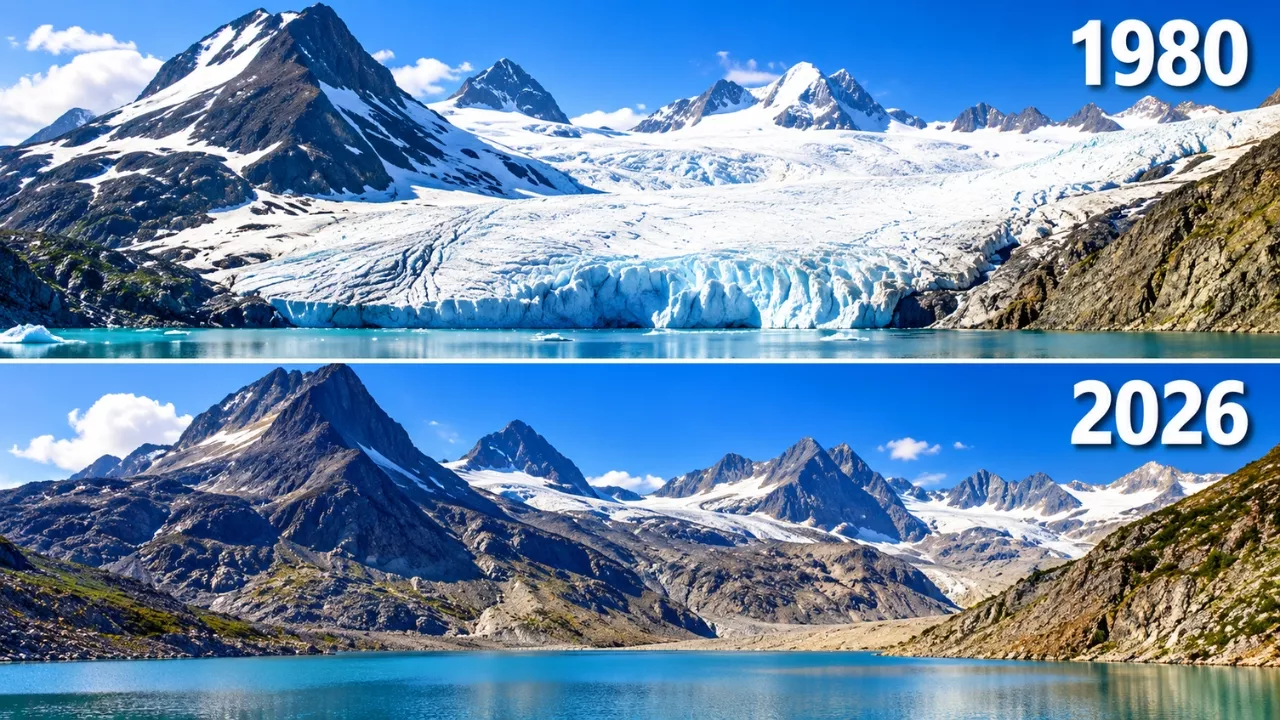
Europe’s glaciers are not all disappearing at the same speed—but many are now shrinking faster than they can rebuild. The most vulnerable are small, low-altitude glaciers in the Alps, the Pyrenees, and parts of Central Europe, where warm summers and thin winter snowpacks leave too little ice accumulation to offset melting.w
Why this matters now
Glaciers are natural freshwater reservoirs: they store winter snow and release meltwater gradually through dry summer months. As they shrink, downstream communities may initially see more runoff, but water availability eventually declines once the glacier’s long-term ice reserve is exhausted.
Recent measurements underline how quickly the balance has shifted. Swiss monitoring reported that Switzerland lost about 3% of its remaining glacier ice volume in 2025—roughly 1.4 cubic kilometres—after a low-snow winter and heat waves in June and August.
What is driving the melt?
The main driver is rising temperature, but glacier survival depends on a seasonal equation: winter snow gain versus summer melt. In the Alps, hotter summers are increasingly outpacing snow accumulation, while reduced snow cover exposes darker ice earlier in the year, accelerating melting.
Air quality also plays a subtle role. Since the 1980s, lower atmospheric aerosol pollution has allowed more solar radiation to reach Earth’s surface, reducing a form of “masking” that had partly offset warming in earlier decades.
Which European glaciers are most at risk?
Glaciers exist across the Alps—Switzerland, France, Italy, Austria, Germany and Slovenia—as well as in the Spanish Pyrenees, Norway, Sweden and Iceland. But their future varies sharply with altitude, size, latitude and local climate.
| Glacier type / region | Main vulnerability | Outlook |
|---|---|---|
| Small, low-altitude Alpine glaciers | Little winter snow, strong summer heat, early ice exposure | Highest risk of near-term disappearance; examples include low-elevation Swiss glaciers such as Pizol. |
| Large high-altitude Alpine glaciers | Still have accumulation zones above roughly 3,500–4,000 m, but are losing volume | More resilient, yet continuing to retreat after low-snow winters and hot summers. |
| Austrian, Italian and Slovenian glaciers | Often smaller and more exposed to warming | Particularly exposed; Slovenia, Germany and Spain are identified as at risk of losing their last glaciers. |
| Norwegian, Swedish and Icelandic glaciers | Generally larger and located farther north, with cooler summers | Better positioned than Alpine glaciers, but still recorded significant net losses in 2025. climate.copernicus+1 |
| Pyrenean glaciers | Very small ice masses and warmer marginal climate | Among Europe’s most fragile remaining glaciers. |
Switzerland: a warning signal
Switzerland holds some of the Alps’ largest ice reserves, so its glaciers may take longer to vanish than smaller Austrian glaciers. But the country has become a clear indicator of Alpine-wide stress: it lost about 5% of glacier volume in the year referenced by the Blick report and nearly 20% over five years, while WSL’s 2025 bulletin separately reported a further 3% annual loss.
That difference reflects different reporting periods and measurement framings, but both point in the same direction: Swiss glaciers are losing volume much faster than they can regenerate.
What happens to water, nature and tourism?
The consequences extend beyond dramatic images of retreating ice. The IPCC warns that glacier retreat, shifting snowlines and changing runoff can increase risks for biodiversity, freshwater ecosystems, agriculture, hydropower, tourism and mountain infrastructure.
For Alpine communities, the practical effects may include less reliable summer streamflow, changing hazards such as rockfalls or floods, and pressure on winter tourism as snow reliability declines. The exact impact varies locally, but the underlying trend—less stored ice and snow—is consistent across much of Europe.
Can Europe still save its glaciers?
Some ice loss is already locked in because glaciers respond slowly to climate conditions. However, the scale of future loss still depends heavily on emissions: the IPCC projects that glaciers will continue losing mass through the 21st century, with much larger losses under high-emission pathways than under strong mitigation.
In practical terms, protecting glaciers means reducing greenhouse-gas emissions, preserving snow and ice where feasible, improving mountain-water planning, and preparing communities for a future with less predictable meltwater. These steps cannot preserve every small glacier, but they can influence how much ice Europe retains by the end of the century.
Europe will not lose every glacier overnight, but the smallest and lowest glaciers are already approaching a point of no return. The larger high-altitude glaciers have more time—but only if snowfall and cold conditions become more favourable than they have been in recent years.
Is the Disrupted Climate Still Predictable? What We Know, What We Don’t, and Why It Matters!
1 thought on “Europe’s Vanishing Glaciers: Why Some May Disappear Within Our Lifetime..”
Comments are closed.