
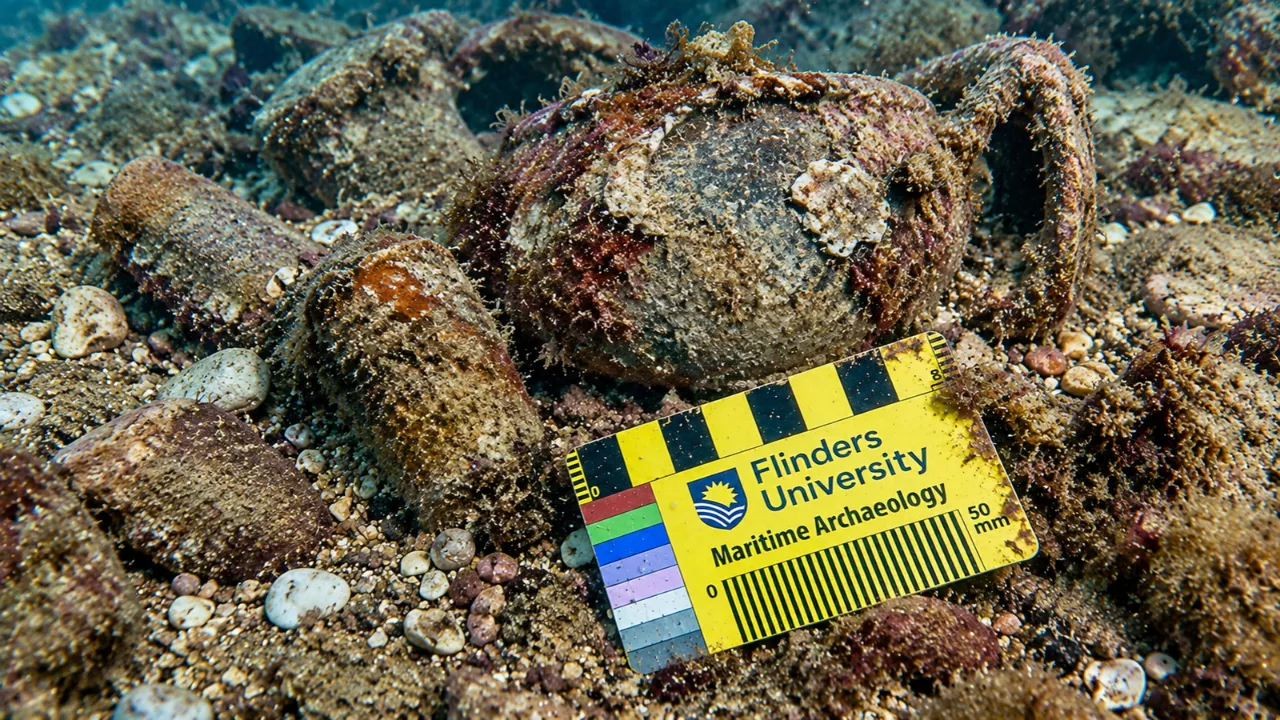
Long before the Indian Ocean crept over the continental shelf, people were living on land that now sits under the sea. New research has documented submerged sites off Australia’s northwestern coast where First Peoples once camped, gathered water and made stone tools. The sites went under at least 9,000 years ago, and the artefacts themselves may be considerably older. The work centres on Murujuga, a World Heritage-listed region in Western Australia, and it adds to what is described as Australia’s oldest known underwater archaeological record.
What Researchers Actually Found
The team identified two distinct parts of this lost landscape. One site includes a freshwater spring with stone tools. Analysis showed the toolmakers used stone from an island roughly 14 miles away, which points to people moving materials over long distances. The other site is a rocky hill overlooking a river channel, the kind of vantage point a community might use to watch the land below. Together they suggest people used different places in different ways, rather than living in a single spot.
Why a Freshwater Spring Matters
In a dry landscape, a reliable water source anchors everything else. A spring would have drawn people, animals and trade routes toward it, which is why finding tools beside one is so informative. Stone sourced from a distant island also hints at planned travel or exchange. Earlier survey work at Flying Foam Passage, another Murujuga spring site, produced similar evidence of preserved stone artefacts lying on the seabed, so this is part of a growing pattern rather than a one-off find.
Key Facts at a Glance
| Detail | What We Know |
|---|---|
| Location | Off Australia’s northwestern coast, Murujuga (Dampier Archipelago), Western Australia |
| Age | Submerged at least 9,000 years ago; artefacts may be older |
| Site types | Freshwater spring with stone tools; rocky hill above a river channel |
| Tool material | Stone sourced from an island about 14 miles away |
| Research partners | Flinders University, University of Western Australia, James Cook University, University of York, Murujuga Aboriginal Corporation |
| Lead researcher | Professor Jonathan Benjamin, Flinders University |
| Publication | Quaternary Science Reviews |
A Partnership Built on Country
One of the most notable parts of this project is how it was done. Murujuga Aboriginal Corporation Rangers trained as scientific divers and worked alongside archaeologists to locate and document the sites. Their knowledge of Sea Country is central, not supplementary. Vincent Adams, director of the Corporation, noted that the Ngarda-Ngarli people have cared for Murujuga for at least 50,000 years, and that learning how ancestors used the land helps protect it for future generations. That framing shows how Indigenous custodianship and scientific method can strengthen each other.
Why Protecting Underwater Heritage Is Hard
Submerged heritage often falls through legal gaps. Researchers involved in earlier Murujuga work have pointed out that some international frameworks cover underwater sites only after a certain age threshold of human presence, and that submerged Aboriginal landscapes do not always fit neatly into existing rules. Challenges include:
- Sites are hard to see, because artefacts blend into the seabed after thousands of years.
- Diving and survey conditions are demanding and expensive.
- Heritage protection laws were largely written with shipwrecks in mind.
- Researchers say many more sites likely remain undiscovered along Australia’s tropical shelf.
Frequently Asked Questions
How old are the submerged sites off Australia’s northwestern coast?
The sites were submerged at least 9,000 years ago. The artefacts could be considerably older than that.
Who made the discovery?
Archaeologists from Flinders University, the University of Western Australia, James Cook University and the University of York worked with Murujuga Aboriginal Corporation Rangers, who trained as scientific divers.
Why was the island stone significant?
Tools at the spring site were made from stone from an island about 14 miles away. That shows people moved materials across the landscape rather than using only what was at hand.
Where was the research published?
The scholarly article appears in Quaternary Science Reviews.
Europe’s Vanishing Glaciers: Why Some May Disappear Within Our Lifetime..