
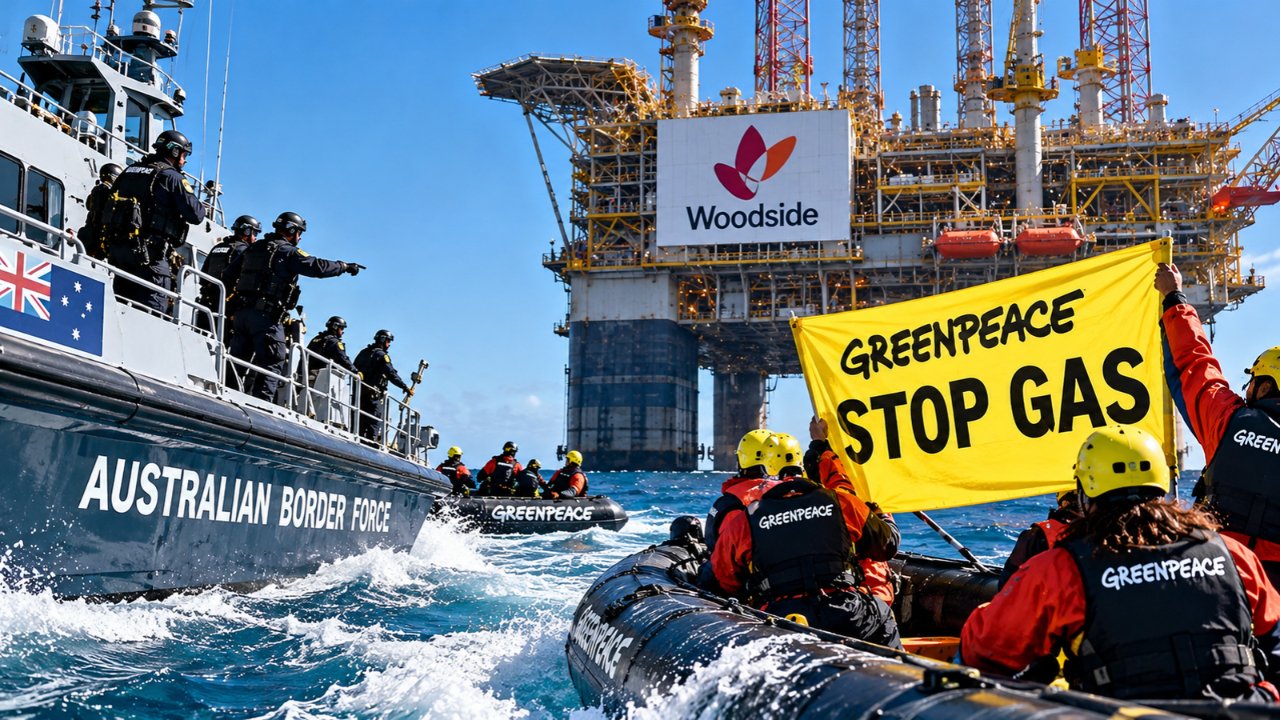
Greenpeace activists occupied a floating production unit at Woodside’s Scarborough gas project off Western Australia, prompting Woodside to pause pre-commissioning work and drawing a coordinated response from the Australian Border Force and police agencies. The protest highlights the growing friction between offshore fossil-fuel development, climate activism, and maritime security.
What happened at Scarborough
Four Greenpeace Australia Pacific activists scaled the 70,000-tonne semi-submersible Floating Production Unit (FPU) early on Saturday, displaying banners reading “Stop Woodside’s Dirty Gas.” Greenpeace said two activists remained overnight; by Sunday afternoon, two people were reported in police custody after a police helicopter landed on the platform.
Woodside said the FPU’s operations were “safely paused” following what it described as unauthorised access, temporarily halting pre-commissioning activities. The company characterised the action as a disruption to a project that was around 98% complete.
Australian Border Force response
The Australian Border Force (ABF) said it was aware of protest activity at offshore infrastructure off the WA coast and was working with Commonwealth and Western Australian partner agencies to respond. By Sunday, it had not provided a detailed operational update.
The response illustrates why offshore protests are treated differently from land-based demonstrations: they involve remote infrastructure, specialised access, maritime safety risks, and overlapping federal and state responsibilities. The ABF’s role is therefore coordinated with police and other agencies rather than operating as a standalone response
Why Greenpeace targeted Woodside
Greenpeace said the action was aimed at Woodside’s proposed Browse gas project, which the group says could involve up to 57 wells near Scott Reef—a remote coral system and foraging area for endangered pygmy blue whales. The protest at Scarborough was therefore presented as opposition to the wider expansion of Woodside’s gas operations, rather than solely to the Scarborough field itself.
Woodside has not been reported in the available coverage as accepting Greenpeace’s environmental characterisation. Its public position in the incident focused on safety, the pause in operations, and the unauthorised nature of the access.
Scarborough project at a glance
| Detail | Reported information |
|---|---|
| Operator | Woodside Energy |
| Location | Carnarvon Basin, roughly 375 km off the Pilbara coast of Western Australia industry.gov+1 |
| Infrastructure | Semi-submersible Floating Production Unit moored in about 950 m of water |
| Estimated gas resource | About 11.1 trillion cubic feet of gas (2C, 100%) |
| Planned output | Up to 8 million tonnes of LNG annually for export, plus up to 225 terajoules per day for domestic supply |
| Protest impact | Pre-commissioning activities paused after activists accessed the FPU sbs.com+1 |
| Protest demand | Halt Woodside’s proposed Browse expansion and protect Scott Reef |
Why this protest matters
The incident is significant because it temporarily stopped work at a major offshore gas project and created a visible test of how Australia responds to climate activism at sea. It also puts two competing public interests in sharp focus: the economic and energy-security case for large LNG developments, and environmental concerns about emissions, marine ecosystems, and new fossil-fuel expansion
For readers assessing the story, the key distinction is between the Scarborough project, where the protest occurred, and the Browse project, which Greenpeace says is its central concern. Reporting the two as interchangeable would miss the activists’ stated rationale.
What may happen next
Authorities are likely to focus on safety verification, investigation of the access method, and any potential charges arising from the occupation. Woodside will also need to confirm when pre-commissioning can safely resume, while Greenpeace is expected to continue campaigning against Browse and drilling near Scott Reef.
The broader issue remains unresolved: offshore gas projects can proceed under Australian regulation while still facing intense public, legal, and political scrutiny over climate and marine impacts. This protest shows that scrutiny is increasingly arriving not only in courtrooms and planning processes, but at the infrastructure itself.