
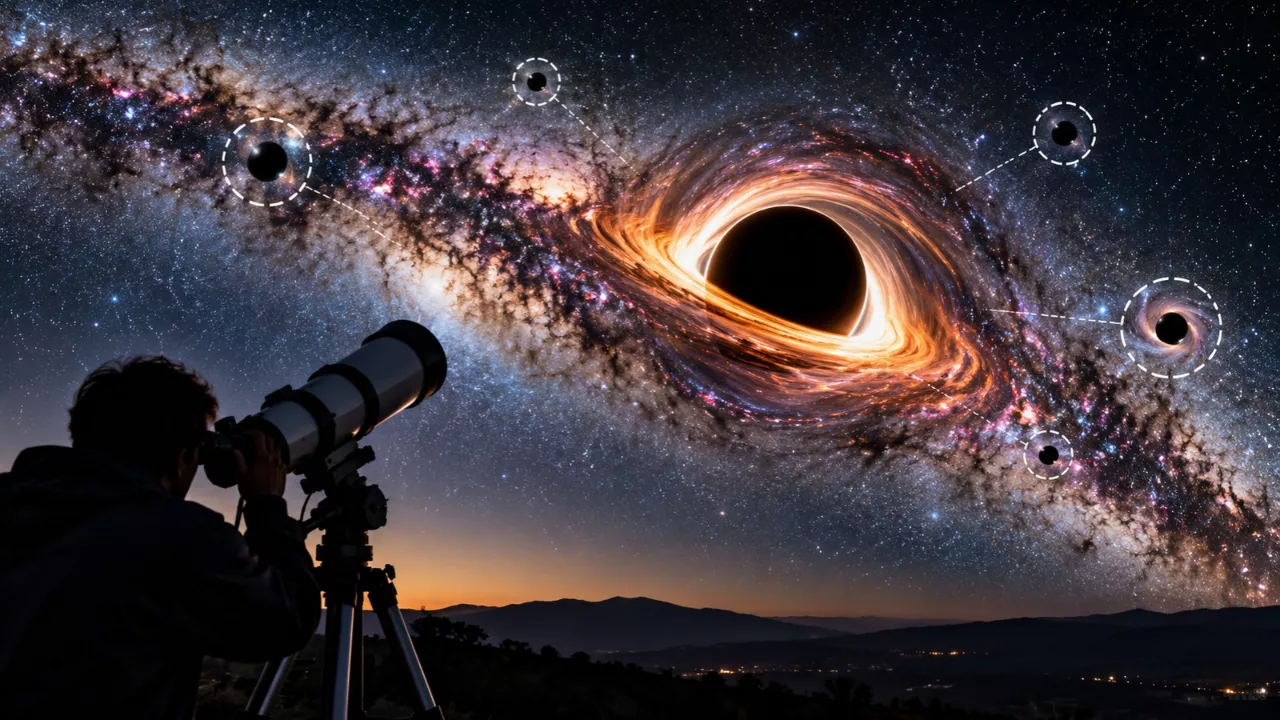
Our galaxy has an unusual accounting problem. Astronomers estimate that over its roughly 13-billion-year history, the Milky Way has produced more than 10 million black holes, yet only about 70 have been confirmed. The missing black holes in the Milky Way are not lost in any dramatic sense. They are simply very hard to see. A team of U.K. astronomers has now opened the search to the public, and you don’t need a telescope or a physics degree to take part.
Why So Many Black Holes Remain Hidden
A black hole forms when a star roughly 20 times heavier than our Sun runs out of fuel and collapses. What remains has gravity so strong that not even light escapes it, so the object gives off nothing for telescopes to catch directly. Astronomers usually find black holes through their effects on something nearby, such as a companion star. That is why a galaxy holding millions of them has yielded only a few dozen confirmed finds.
How a Black Hole Acts Like a Cosmic Magnifying Glass
Massive stars often form in pairs. Sometimes one star explodes as a supernova and becomes a black hole while its partner survives, and the two keep orbiting each other. If that pair happens to line up with Earth, the black hole periodically passes in front of its companion. Its gravity bends and magnifies the star’s light, so the star briefly looks brighter. This effect, called gravitational lensing, is the signature volunteers are asked to look for.
Black Hole Hunters: The Citizen Science Project Behind the Search
The project, called Black Hole Hunters, runs on the Zooniverse platform and is led by astronomers in the U.K., including Adam McMaster of the University of Southampton. Volunteers examine light-curve graphs from NASA’s Transiting Exoplanet Survey Satellite (TESS). The satellite’s main job is finding planets around other stars, but it tracks tiny, continuous changes in starlight, which also suits spotting lensing events.
Here is what makes the project practical for newcomers:
- No expertise is required, and volunteers are shown examples of the patterns to look for.
- Each graph is shown to several volunteers, and their answers are combined so individual mistakes average out.
- Automated software does a first sweep of millions of stars, but flares and natural stellar pulsations can fool it, which is where human eyes help.
- The crowdsourced shortlist tells astronomers which stars deserve expensive follow-up telescope time.
Black Hole Hunters at a Glance
| Detail | What We Know |
|---|---|
| Estimated black holes produced by the Milky Way | More than 10 million |
| Confirmed so far | About 70 |
| Launched on Zooniverse | October 2021 |
| Volunteers to date | Nearly 23,000 |
| Classifications completed | More than 12 million |
| Main data source | NASA’s TESS satellite |
| Earlier search | SuperWASP ground-based survey data (2004 to 2016), results expected soon |
| Planned future data | ESA’s Euclid mission and NASA’s Nancy Grace Roman Space Telescope |
What Comes Next in the Hunt
The team has already run a similar search on archival SuperWASP data, and those results are still being analysed. They also plan to widen the hunt with data from Euclid and the Roman Space Telescope. McMaster expects potentially thousands of new discoveries, which is why the project wants as many volunteers as possible. For anyone curious about space, this is one of the few chances to contribute to real research rather than just read about it.
Frequently Asked Questions
How many black holes are in the Milky Way?
Astronomers estimate the galaxy has produced more than 10 million over its history, but only about 70 have been found so far.
Do I need a science background to join Black Hole Hunters?
No. The task is pattern recognition, and the project shows volunteers examples of what to look for.
Why can’t computers find the missing black holes on their own?
Algorithms handle the first screening, but stellar flares and natural pulsations in stars can trigger false positives. Human volunteers help sort real signals from imitations.
What happens after volunteers flag a signal?
Astronomers use the shortlist to choose stars for follow-up observations, such as checking whether an unseen companion is tugging on the star.
Shanghai Grand Opera House: How Snøhetta Turned a River Bend into a Stage for the City!
1 thought on “Millions of Missing Black Holes in the Milky Way: Your Laptop Could Help Find Them…”
Comments are closed.