
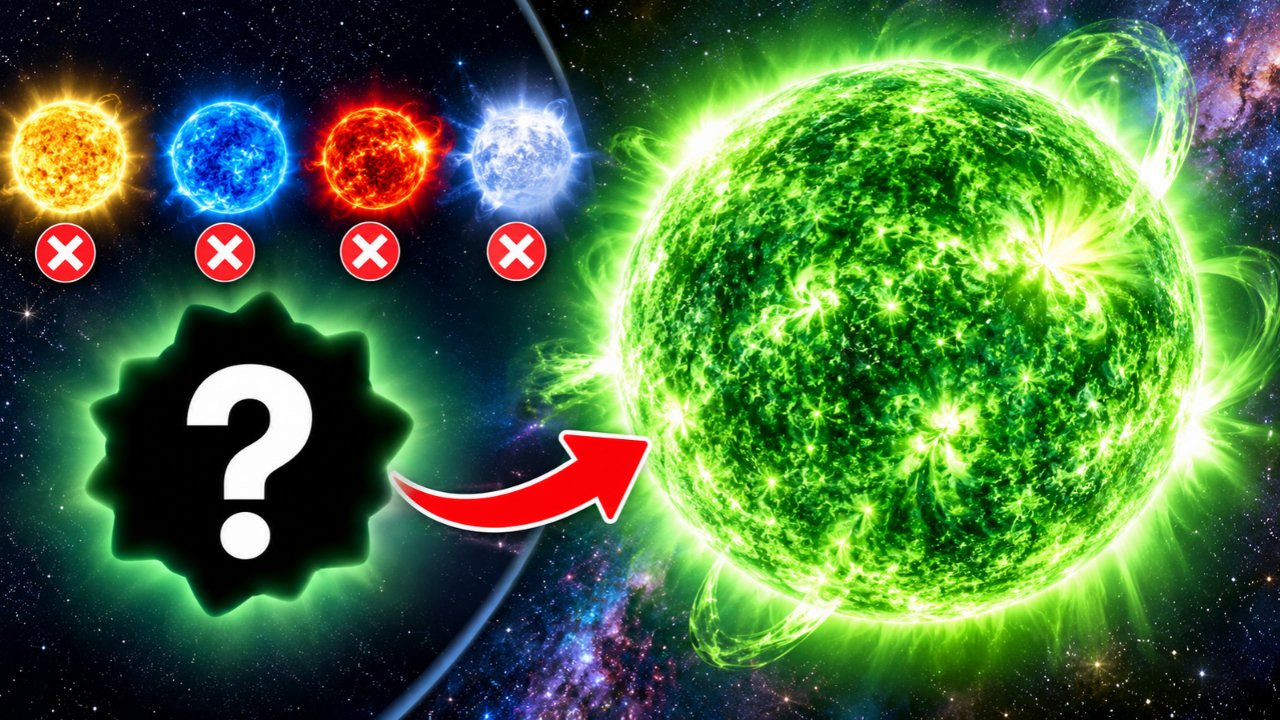
For years, astronomers repeated a favorite fact at public talks: you will never see a green star. Stars glow white, yellow, orange, red or blue, but never green. That line has now needed an update. In October 2026, researchers led from the University of Warwick reported the first credibly identified green star, and the story behind it is stranger than the headline.
Why a Green Star Was Considered Impossible
Most stars behave like “perfect radiators,” so their color is set almost entirely by temperature. Cooler stars look orange or red, mid-range stars like our Sun look white to yellowish, and the hottest look pale blue.
Green sits in the middle of that range. A star hot enough to peak in green light also pours out plenty of red and blue, and our eyes blend the mix into white. Hence the old rule. A green star would need something other than temperature to shape its light.
What Makes This Green Star Different
The star is a white dwarf called WD J1330+6435, the dense remnant left when a Sun-like star dies. Its surface sits at roughly 4,000 °C, and its atmosphere is polluted with elements such as calcium, lithium and sodium. These are thought to come from rocky material from planets that once orbited it.
The key is sodium. In the star’s extremely dense atmosphere, sodium absorbs light across a broad band of yellow, orange and red wavelengths. With those removed, what reaches us is a ghostly chartreuse green.
- Dense atmosphere: squeezes and broadens absorption lines so they affect a wide slice of the spectrum
- Planetary debris: supplies the metals that do the absorbing
- Moderate temperature: keeps the star from glowing too blue or too white
A Palette Beyond White: Other Colorful Stars
The green star was not the only surprise. Researchers modeled how a range of white dwarfs would look to the human eye and found a much wider palette than “white” suggests.
| Star type | Typical color | What drives the color |
|---|---|---|
| Hot star | Pale blue | Very high surface temperature |
| Sun-like star | White to yellow | Moderate temperature |
| Cool star | Orange to red | Low surface temperature |
| WD J1330+6435 (white dwarf) | Chartreuse green | Sodium absorbing yellow, orange and red light |
| WD J1011+2845 (white dwarf) | Salmon pink | Carbon molecules distorting the light |
The salmon-pink star, WD J1011+2845, sits only about 48 light-years away and may be the reddest star ever recorded.
Can You See a Green Star Yourself?
Not through a backyard telescope, and this is the part many headlines skip. White dwarfs are far too faint to see with the naked eye. The green star lies roughly 326 light-years away.
The colors come from calculation, not photography. The team took each star’s spectrum, the “fingerprint” of its light split by wavelength, and ran it through a human-vision model to predict how it would look from close range. Outside astronomers, such as Penn State Scranton’s Agnès Kim, have noted that the work uses existing data and may not transform our understanding of white dwarfs. They still called the approach intriguing and the result a delight.
What the Discovery Means for Astronomy
A single green star is a curiosity, but it points to something bigger. Atmospheres polluted by planetary debris leave measurable fingerprints, so these stars act as chemical snapshots of destroyed planetary systems. The team hopes more are out there, and even a handful of additional chartreuse white dwarfs would turn a one-off into a class of objects.
It is also a reminder that “never” is a risky word in science. The old rule was right about ordinary stars and wrong about extraordinary ones.
Frequently Asked Questions
Is the green star visible to the naked eye?
No. It is a faint white dwarf hundreds of light-years away. Its green color was calculated from its spectrum.
What is the green star called?
Its designation is WD J1330+6435.
Why is the star green?
Sodium in its dense atmosphere absorbs yellow, orange and red light, leaving a chartreuse glow. The sodium likely came from rocky debris of former planets.
Does this mean our Sun could turn green?
No. The Sun is a different type of star with a very different atmosphere. This effect belongs to dense, planet-polluted white dwarfs.
Millions of Missing Black Holes in the Milky Way: Your Laptop Could Help Find Them…