
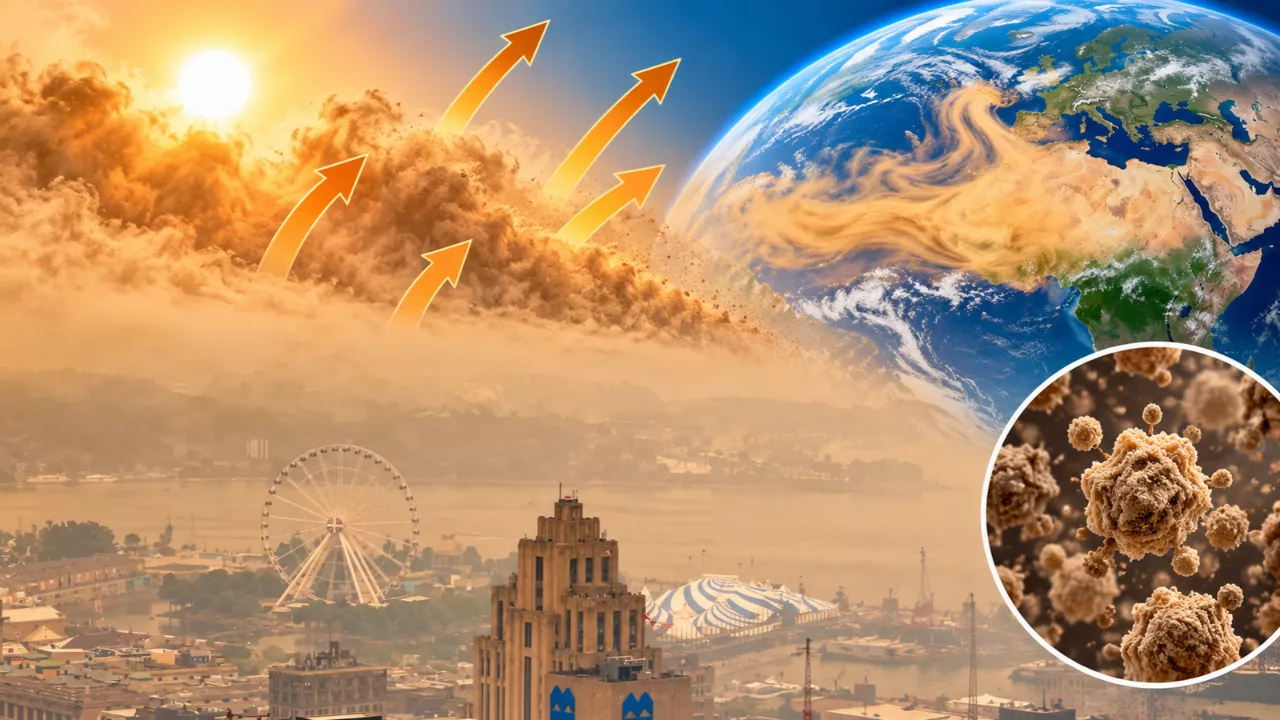
When a dusty haze turns the sky orange or leaves a fine film on a parked car, it is easy to treat it as a nuisance and nothing more. Yet dust in the air is one of the quieter forces shaping the climate. Each year, winds lift enormous quantities of mineral particles from deserts and dry land and carry them across oceans and continents. Along the way they reflect sunlight, absorb heat, change how clouds form and even feed distant ecosystems. Understanding how dust in the air affects the climate helps explain why it remains one of the harder pieces of the climate puzzle.
What Is Airborne Dust, and Where Does It Come From?
Mineral dust is made of tiny rock and soil particles, so small they can stay aloft for days or weeks. The biggest sources are the world’s dry regions, especially the Sahara and the deserts of Asia, including the Gobi and Taklamakan. Dust is lifted when strong winds sweep across loose, bare ground. Droughts, dry lake beds and farmland left exposed can add to the supply.
It helps to separate dust from other airborne particles. Soot from fires and sulfate particles from burning fuels behave differently because they come from combustion. Mineral dust is natural in origin, although human land use can increase how much of it ends up in the air.
Does Dust Warm or Cool the Planet?
Dust does both, depending on the situation. Light-colored dust scatters incoming sunlight back toward space, which cools the surface below. Darker, iron-rich dust absorbs sunlight and also traps some heat radiating up from the Earth, which warms the surrounding air. Particle size, altitude and the brightness of the surface underneath all shift the balance.
A major 2023 scientific review in Nature Reviews Earth & Environment estimated that when every interaction is added up, dust has a slightly cooling effect on the global energy budget, about −0.2 watts per square metre. The uncertainty range is wide, large enough that the true figure could land on either side of zero. The same review found that global dust loading has risen by roughly 55% since pre-industrial times, largely because of increases in Asian and North African sources. That increase has acted as a small brake on greenhouse warming, though it is nowhere near strong enough to cancel it.
The Hidden Ways Dust Shapes Weather, Snow and Oceans
The direct effect on sunlight is only part of the story. Dust takes part in several other processes that matter for climate:
- Cloud formation: Dust particles can act as seeds for ice crystals and water droplets, changing how long clouds last and how much sunlight they reflect.
- Snow and glacier darkening: When dust settles on snow, it makes the surface darker, so it absorbs more sunlight and melts faster.
- Ocean fertilization: Dust carries nutrients such as iron, which can feed plankton far from land. Plankton absorb carbon dioxide, linking dust to the carbon cycle.
- Regional weather: Dust layers heat the air at certain altitudes, which can alter local temperature patterns and winds.
| Dust pathway | What happens | Typical climate effect |
|---|---|---|
| Scattering sunlight | Light-colored particles reflect sunlight to space | Cooling |
| Absorbing sunlight and heat | Darker particles trap energy in the air | Warming |
| Cloud interaction | Particles influence droplet and ice formation | Varies by cloud type |
| Dust on snow and ice | Darker surface absorbs more sunlight | Warming and faster melt |
| Nutrient delivery to oceans | Iron and other nutrients feed plankton | Possible carbon uptake |
Why Dust Is Still a Climate Wildcard
Dust is difficult to pin down because its effects pull in opposite directions and vary from place to place. The same plume might cool the surface and warm the air above it, or behave differently over a bright desert than over a dark ocean. Scientists also note that most climate models do not fully capture the historical rise in dust, which can bias projections. Future dust levels are uncertain too. Changes in rainfall, wind and vegetation could make some regions dustier and others less so, and model results on this disagree widely.
For anyone following climate news, the takeaway is balanced. Dust is not a hidden fix for global warming, and it is not a major driver of it either. It is a real but uncertain player that researchers are working to measure more precisely.
What Dust Means for Your Health and Daily Life
Dust matters beyond climate. Fine particles can irritate the lungs and worsen asthma and other respiratory conditions, so dust storms are a public health concern as well as a climate one. On days with heavy dust, you can take a few simple steps:
- Check your local air quality reports before outdoor exercise.
- Keep windows closed during dust events and use a clean air filter indoors if you have one.
- Wear a well-fitted mask if you must be outside in heavy haze.
- People with asthma or heart or lung conditions should follow their doctor’s guidance.
Frequently Asked Questions
Does dust in the air cause global warming?
No. Dust is not a main cause of global warming. Current estimates suggest it has a small net cooling effect overall, though the uncertainty is large.
Is dust in the atmosphere increasing?
According to a 2023 scientific review, global dust loading has risen by about 55% since pre-industrial times, mainly due to more dust from Asia and North Africa.
How does dust affect snow and glaciers?
When dust lands on snow or ice, it darkens the surface. A darker surface absorbs more sunlight, which speeds up melting.
Can dust help the ocean absorb carbon?
Possibly. Dust can deliver iron and other nutrients to ocean waters, which may boost plankton growth. Plankton take up carbon dioxide, but the size of this effect is still being studied.