
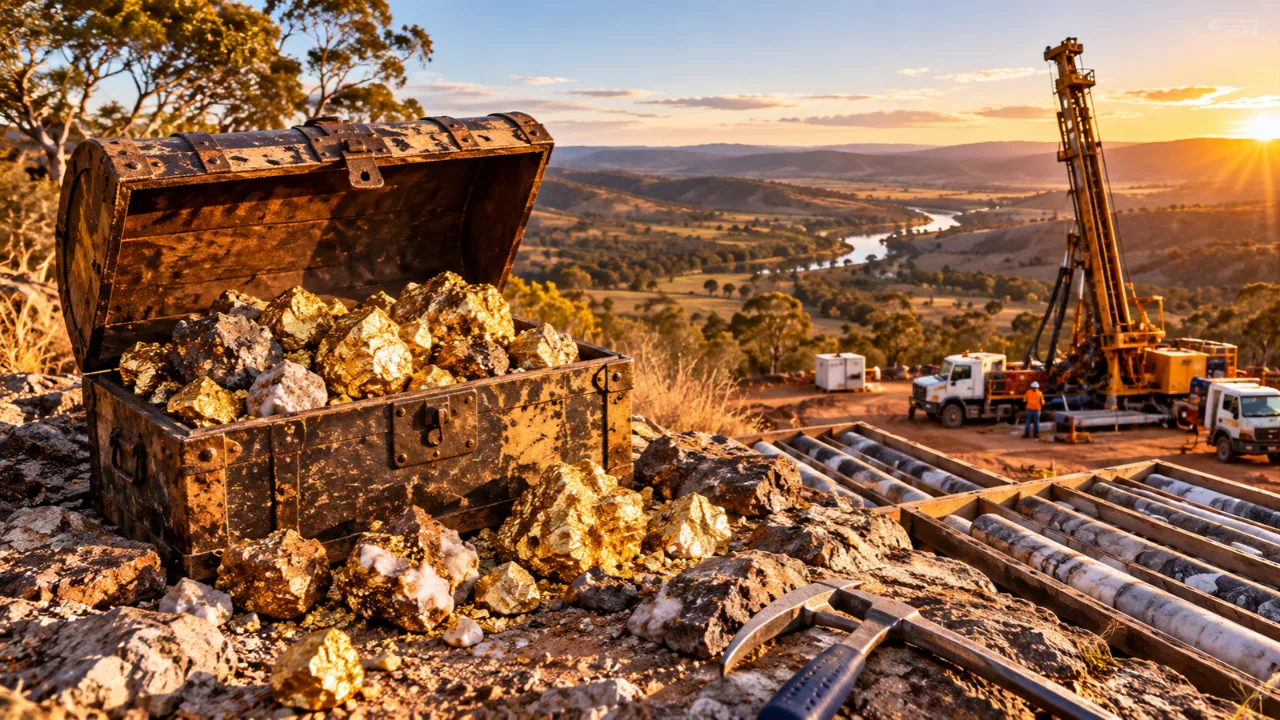
Drive through the central west of New South Wales and the landscape looks like farmland, rolling hills and small towns. Underneath it sits some of the most productive gold and copper geology in Australia. Lachlan Fold Belt mining is attracting a fresh round of explorers, and the reasons go beyond the usual commodity-price excitement. The region has a long track record, a proven discovery model and, for now, relatively few companies drilling compared with other mining jurisdictions.
What Is the Lachlan Fold Belt, and Why Does It Matter?
The Lachlan Fold Belt is a large geological province running through central and southern NSW, extending into Victoria. Its best-known feature is the Macquarie Arc, an ancient volcanic system that created conditions for large porphyry copper-gold deposits. The most famous of these is Cadia, near Orange, which is regularly counted among Australia’s biggest gold producers and is also a major copper producer.
The region’s mining story began long before modern exploration. Australia’s first payable goldfield, at Ophir near Orange, dates to 1851. At Hill End in 1872, the 290-kilogram Holtermann specimen was found, one of the largest gold-bearing specimens ever recorded. This is a place where miners have been looking for more than 170 years.
Why Are Mining Hopefuls Returning Now?
For years, parts of NSW were treated as a “mature” region where the big discoveries had already been made. That view changed when explorers found large new porphyry systems on ground that earlier generations had walked over. Alkane Resources’ Boda discovery is the example most often cited. It showed that deeper, buried targets could still be found with modern geophysics and drilling.
Several factors are keeping new companies interested:
- Proven geology: The belt hosts multiple world-class deposits, which lets explorers use known deposit models as templates.
- Strong commodity appeal: Copper and gold both attract investor and corporate attention.
- Infrastructure and access: Roads, rail, power and skilled labour are far closer than in remote frontier regions.
- Fragmented ground: Many tenements have been held by small players, and that has made consolidation deals attractive. In May 2026, for instance, ASX-listed Koonenberry Gold agreed to acquire the Gundagai Gold-Copper Project to expand its Lachlan position.
Lachlan Fold Belt at a Glance
| Feature | What It Means for Explorers |
|---|---|
| Primary metals | Copper and gold, with silver, zinc and lead in some volcanic-hosted systems |
| Key geological setting | Macquarie Arc, including the Molong and Junee-Narromine belts |
| Typical deposit styles | Porphyry copper-gold, epithermal gold-silver, volcanogenic massive sulphide (VMS), orogenic gold |
| Landmark operations | Cadia (near Orange), Cowal, Northparkes, Tomingley |
| Notable discovery story | Boda porphyry, which reopened debate on the region’s remaining potential |
| Main exploration challenge | Thick soil and rock cover, which hides targets and needs geophysics and deeper drilling |
| Typical company profile | ASX-listed juniors, often partnering with or sold to larger producers |
What Exploration Really Looks Like on the Ground
Finding a deposit is rarely dramatic. The process starts with soil and rock-chip sampling, followed by geophysical surveys that map magnetic and gravity patterns below the surface. Only then does a rig arrive. Many early drill holes return nothing economic, which is normal in this business. An explorer who reports an interesting intercept has taken one step on a long road. A resource estimate, feasibility work, environmental approvals and construction usually come years later.
Landholders and local communities are part of that road too. In the NSW central west, farmland, water and mining often share the same ground, so access agreements and community relationships can matter as much as the geology.
The Risks Behind the Excitement
A busy region is not a guaranteed payoff. Anyone following Lachlan Fold Belt mining news, as an investor or a local, should keep a few realities in mind:
- Most exploration projects never become mines.
- Junior explorers rely on raising capital, so weak markets can slow drilling quickly.
- Approvals, environmental conditions and land-access negotiations add time and cost.
- Metal prices move, and a project that looks viable at one price can look marginal at another.
This is general information, not financial advice. Anyone considering investing in exploration companies should read company announcements and seek licensed advice.
FAQs
What is the Lachlan Fold Belt?
It is a major geological province in central and southern NSW known for large copper and gold deposits, including Cadia near Orange.
Why are explorers focusing on it now?
Recent discoveries showed the region still has undiscovered deposits, and its infrastructure and established mining industry make exploration more practical than in remote areas.
Does exploration activity mean a new mine is coming?
Not necessarily. Exploration is the earliest stage, and only a small share of projects progress to resource definition, approval and production.
What metals are found there?
Mainly copper and gold, with silver, zinc and lead present in some volcanic-hosted deposits.
Whyalla Blast Furnace Closure: Could Australia Go Years Without Homegrown Structural Steel?