
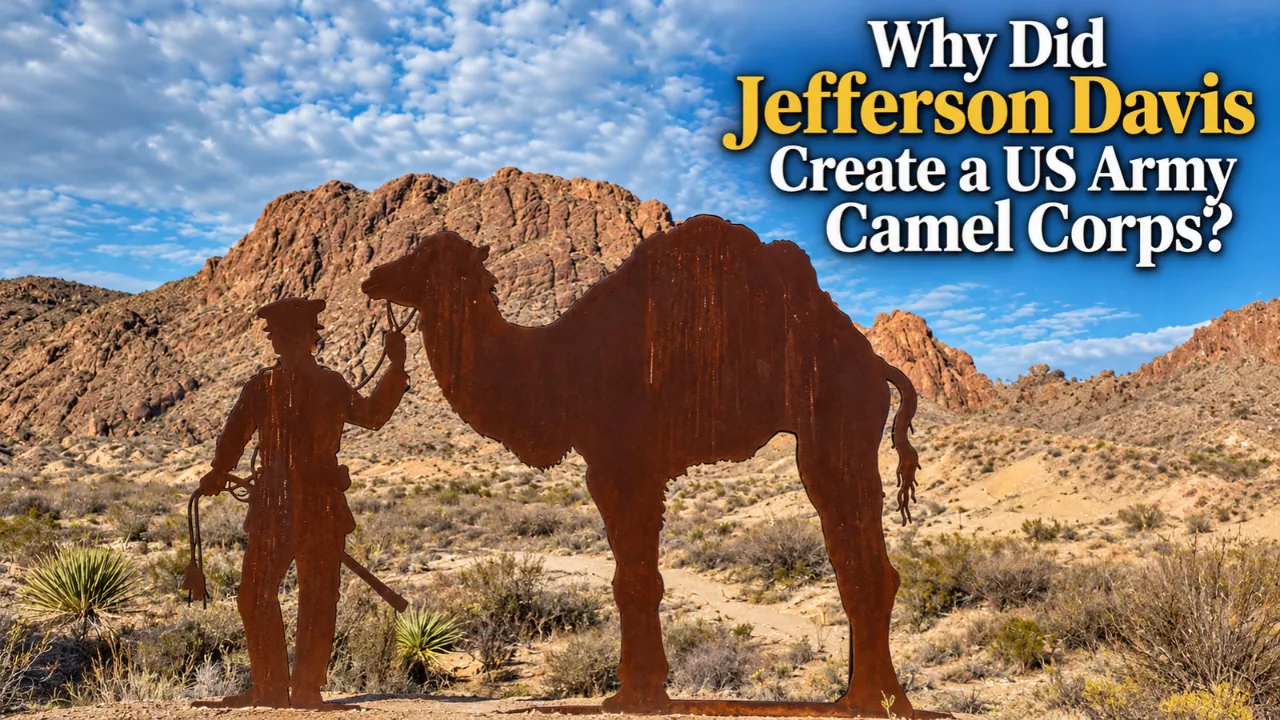
Camels in Texas sound like a tall tale, but the US Army Camel Corps was a real government program. It was driven in large part by Jefferson Davis, who served as Secretary of War under President Franklin Pierce. In the 1850s the United States had just gained enormous stretches of arid land, and the Army had no reliable way to supply the forts scattered across it. Davis saw an answer in an animal built for deserts. Understanding why he pushed so hard for it tells us a lot about how the young country wrestled with its own geography.
The Logistics Problem Behind the Camel Corps
After the Mexican-American War, the western border of the United States moved far into dry, rugged country. The Army needed posts there, but getting food, tools and ammunition to them was slow and expensive. Horses and mules struggled with long stretches without water, and wagon trains lost animals along the way.
Major Henry C. Wayne proposed using camels, which can go for long periods without water and carry heavy loads over harsh ground. Davis, then a senator on the Military Affairs Committee, took an interest. His first push did not succeed. Once he became Secretary of War in 1853, he had the authority to make the case directly to the president and Congress.
How Davis Won Funding for the Experiment
Davis argued that camels were a practical answer to a transport problem, not a novelty. In 1855, Congress approved $30,000 for the project. The effort was shared between the Army and the Navy. Wayne handled buying the animals in the Mediterranean and Middle East, while naval officer David Dixon Porter, who had spent part of his youth in that region, helped oversee the voyage. The ship used for the trip, the USS Supply, was fitted with stalls, ventilation and harnesses to keep the animals steady in rough seas.
Quick Facts at a Glance
| Detail | What Happened |
|---|---|
| Early proposal | Major Henry C. Wayne urged the War Department to try camels (late 1840s) |
| Key champion | Jefferson Davis, Senate Military Affairs chairman, then Secretary of War (1853–1857) |
| Funding | $30,000 approved by Congress in 1855 |
| Ship | USS Supply, refitted as a floating camel barn |
| First shipment | 33 camels loaded, with a calf born during the voyage |
| Home base | Camp Verde, Texas |
| Famous field use | Edward Beale’s wagon road survey, 1857–58 |
| End of the program | Disrupted by the Civil War |
How the Camels Performed in the Field
The results were mixed. In testing, the camels proved poor cavalry mounts. They were slow to maneuver, needed more care than horses, and many soldiers disliked riding them, with motion sickness a common complaint. The animals could also be bad-tempered and unpleasant to be around.

As pack animals, however, they impressed. During Edward Beale’s survey of a wagon road across the Southwest, the camels carried heavy loads over difficult ground and kept going on less water than mules. Reports from the expedition were largely positive, and Beale was a vocal supporter of the animals.
What worked and what did not:
- Strengths: heavy loads, low water needs, endurance over rough desert terrain
- Weaknesses: poor fit for cavalry, unfamiliar to soldiers, tension with horses and mules, higher care demands
- Biggest gap: few Army handlers had any experience with camels
Why the Camel Corps Ended
The project lost its biggest supporter when Pierce’s term ended in 1857 and Davis left the War Department. A few years later the Civil War began, and Davis became president of the Confederacy. Camp Verde, where the herd was kept, fell into Confederate hands. The camels were neglected and scattered, and many were later sold off or released. Without a champion in Washington, the Army never made the program permanent. Over time, railroads and other technology made the case for camels weaker still.


Legacy: Camels, Drivers and Desert Myths
The Camel Corps left behind more folklore than infrastructure. Stories of wandering “feral” camels in the Southwest persisted for decades, and some of the handlers, such as the camel driver known as Hi Jolly, became local legends. Today, the experiment is remembered as a bold but short-lived attempt to solve a real problem with an unconventional tool.
FAQs
Why did Jefferson Davis want camels in the US Army?
He believed camels could carry supplies to remote desert forts more efficiently than horses or mules, which struggled in dry conditions.
How much did the Camel Corps cost?
Congress approved $30,000 in 1855 to purchase and transport the first group of camels.
Did the US Army Camel Corps work?
Partly. Camels were useful as pack animals but unsuitable for cavalry, and the Civil War ended the program before it could be fully tested.
What happened to the camels after the Civil War began?
Confederate forces took over their base in Texas, and the animals were later sold or released, which fed decades of stories about wild camels in the Southwest.
Why Two Thirds of Home Movers Now Want Solar Panels, Batteries and Heat Pumps