
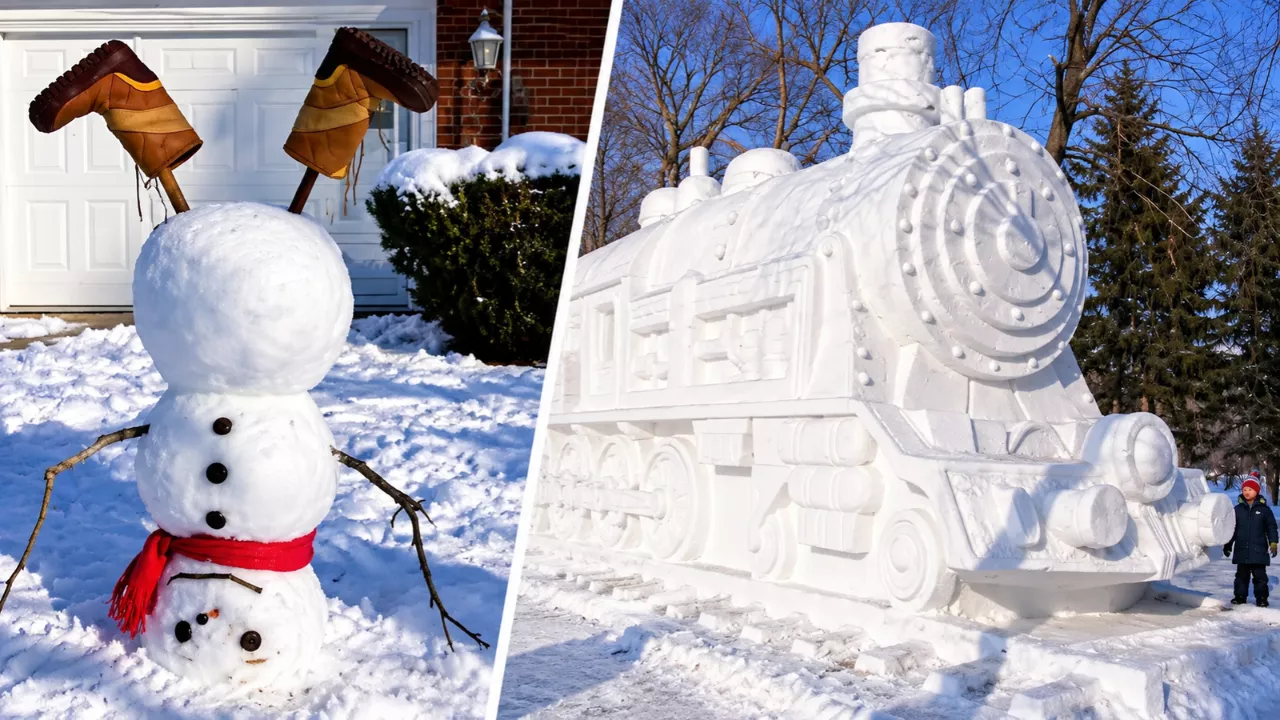
A classic snowman is three balls of snow and a carrot. The best snow sculptures do something different: they give the snow a situation. One snow figure pushes a wheelbarrow packed with tiny snow children. Another aims a hairdryer at a snowman with its branch arms raised. A third has planted its head in the drift, boots pointing at the sky.
Nobody needs a caption for these scenes. A familiar prop, a recognisable pose and a little exaggeration let you read the whole story in a glance. That is why playful snow art spreads so easily online, and why people stop to laugh when they see it in real life.

The Wheelbarrow Full of Snow Babies
The “snow babies” scene works because it borrows an everyday object. A real wheelbarrow becomes a crowded pram. The larger figure grips the handles in mittens and wears a patterned scarf, with a sweep of straw-like hair. The small passengers have pointed noses and twig arms, so they read as a family at once.
The humour comes from contrast: a heavy garden tool carrying a load of tiny, cheerful faces among bare winter trees. Scale does the storytelling. A big figure next to small ones suggests care, chaos and a slightly overloaded parent, with no words at all.

The Hairdryer Hold-Up and Other Tiny Dramas
The hairdryer scene is the sharpest joke of the group. One snowman wears a mask and a hat and points a hairdryer like a pistol. The other stands with both branch arms raised. There is a second layer too: a hairdryer is the one household appliance that actually threatens snow.


Other scenes in the same spirit rely on posing:
- The headstand: a snowman upside down, brown boots in the air, with the carrot nose nearly at ground level.
- The party aftermath: a snow figure in black sneakers sliding head-first off a pallet bench, a flowerpot on its head, empty bottles scattered in the snow.
- The break: a long-limbed figure sitting on a park bench, which looks like a person until you notice the snow.
- The watchers: rounded snow creatures with glowing blue, purple and white eyes, waiting in a field at dusk.
Props and posture do most of the work. You can usually tell what has happened before you notice the face.

Not Every Snow Sculpture Is a Joke
One of the scenes is deliberately quiet. A snow portrait has leaves for eyes and lips, a crown of dry vines and a single rosebud lying across its body. Placed among the jokes, it shows how far the medium stretches. Snow can be silly, eerie or tender, depending on what the maker adds to it.
Then there is the scale at the far end. A full-size steam locomotive made of snow stood at the Harbin International Ice and Snow Sculpture Festival in China in January 2009, with a visitor beside its wheels for scale. The festival was first held in 1985 and was inspired by the traditional ice lanterns of Heilongjiang, which were carved from ice and lit with candles. A backyard snow scene and a festival locomotive have the same idea at different sizes: give the snow a story.

Quick Guide: What Makes Each Scene Work
| Scene | Key props | What drives the story |
|---|---|---|
| Wheelbarrow of snow babies | Real wheelbarrow, scarf, twig arms | Big-and-small contrast reads as family |
| Hairdryer hold-up | Mask, two hats, a hairdryer | A household object used as a “weapon” |
| Boots-first headstand | Brown boots, carrot nose | Upside-down pose reverses the classic snowman |
| After the party | Sneakers, flowerpot, bottles | Small details imply a whole night out |
| Glowing-eyed creatures | Coloured light, dusk setting | Lighting changes mood from cute to eerie |
| Harbin snow locomotive | Boiler, chimney, huge wheels | Sheer scale and craft |
Tips for Making Your Own Playful Snow Scene

You do not need a festival budget. A few habits help most:
- Start with the story, not the snowman. Decide the joke first, then pick the pose and props.
- Use real objects. A wheelbarrow, a bench or a flowerpot gives instant context and scale.
- Choose snow that packs. Wet, heavy snow near freezing holds shape far better than dry powder.
- Exaggerate one thing. Extra-long arms, boots in the air or glowing eyes give the scene a clear focal point.
- Think about the audience. Put it where passers-by will see it from a distance, and photograph it in soft evening or low winter light.
- Keep it kind. Playful scenes land best when nobody is the butt of the joke.
FAQs
What are snow sculptures?
Snow sculptures are artworks made by shaping packed snow, from small backyard figures to huge festival pieces. They can be comic scenes, portraits or detailed structures.
What kind of snow is best for sculpting?
Wet, slightly sticky snow near freezing is easiest to pack and shape. Very cold, dry powder tends to crumble.
How do you give a snowman personality?
Change the pose and add props. Boots in the air, a hairdryer, a scarf or a wheelbarrow can say more than a face can.
Where is the Harbin Ice and Snow Sculpture Festival held?
It takes place in Harbin, in China’s Heilongjiang province, and was first celebrated in 1985.