
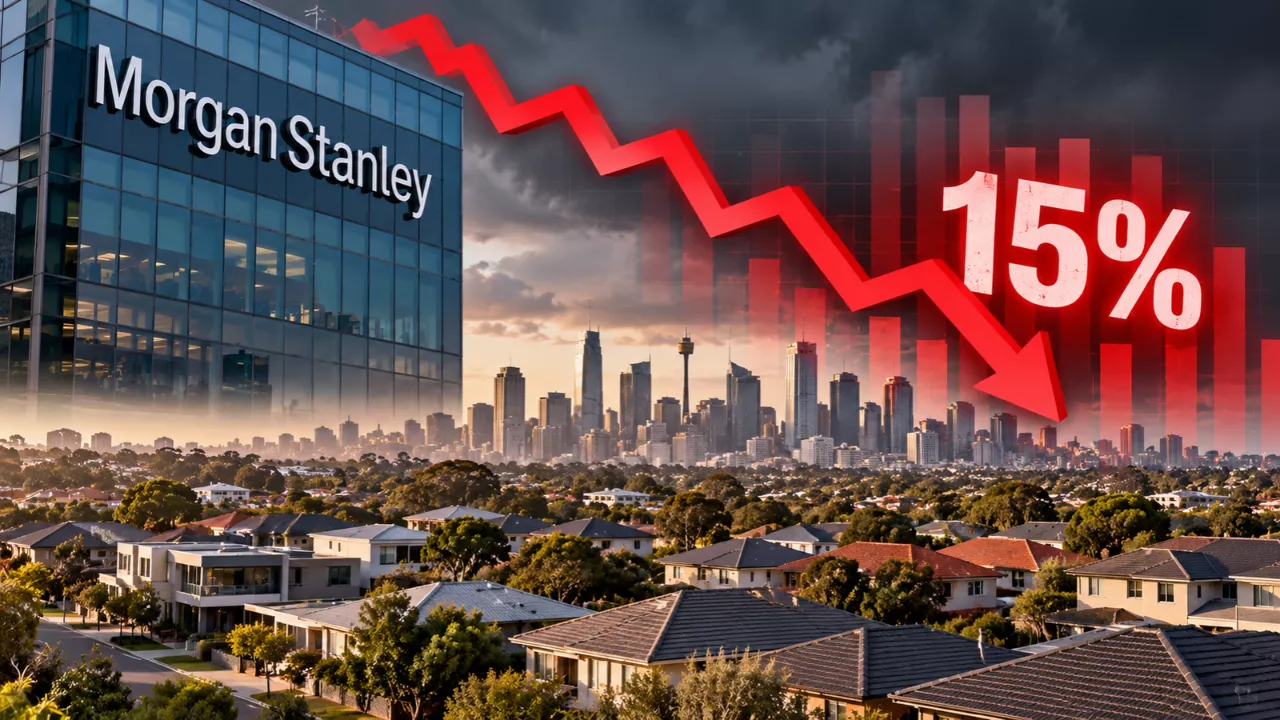
Morgan Stanley has lifted its forecast for the Australian property downturn, and the new numbers have people talking. The investment bank now expects national home values to fall 10% to 15% from their peak, up from the 5% to 10% it predicted after the May federal budget. Its economists say the reason is simple: “the backdrop has worsened.” If you own a home, are saving for a deposit, or have a mortgage to refinance, this Morgan Stanley house price forecast is worth understanding in plain terms, without panic.
Why Morgan Stanley Raised Its House Price Forecast
The bank’s original call came after the May budget changed tax settings for property investors, including negative gearing and capital gains tax. At the time, a 5–10% fall was considered out of step with the market. Since then the data has largely backed it up. National prices are already down about 5.2% from their March peak, so the lower end of the first forecast has effectively been reached.
What worries the analysts is the direction of travel. Weakness is spreading across more regions, turnover has dropped sharply, and unsold stock is building. Higher interest rates and softer investor demand are compounding each other. Morgan Stanley’s view is that the market has not yet worked through the full effect of those changes.

What Is Driving the Slowdown in Home Values
No single factor explains this downturn. Several pressures are landing together, and each makes the others harder to shake off.
- Tax changes for investors: Investors in established homes make up a meaningful share of buying demand, so changes to their returns affect the whole market.
- Higher borrowing costs: Rate rises have cut how much buyers can borrow, which pulls prices down.
- Falling sales volumes: Fewer transactions mean sellers must cut their asking prices to attract a buyer.
- Rising unsold stock: More homes sitting on the market gives buyers negotiating power.
- Wider regional weakness: The softness is no longer confined to the most expensive suburbs.
Morgan Stanley’s Scenarios at a Glance
The bank links its outcome to what the Reserve Bank of Australia does next. The table below summarises the main scenarios in broad terms.

| Scenario | Likely effect on national home values | What would trigger it |
|---|---|---|
| RBA stays on hold near term | Low double-digit decline (around 10–12%) | Rates remain steady, with no further tightening |
| Further rate rises in line with market pricing | Closer to the top of the range (around 15%) | The RBA tightens again |
| Original forecast after the May budget | 5–10% decline | Tax changes plus higher rates |
| Expected timing of a bottom | Late 2027 | No recovery signals before the second half of 2027 |
These are forecasts, not guarantees. A call like this depends on assumptions about rates, jobs and credit that can shift quickly.
How Serious Is a 15% Fall for Homeowners?
A fall of this size would be the steepest correction in roughly four decades, so it deserves attention. Context helps, though. Prices rose strongly in the years before this downturn, and most borrowers hold a solid equity cushion. The Reserve Bank’s October Financial Stability Review tested a uniform 20% fall in prices from current levels and found only around 5% of mortgages would move into negative equity. That is a useful reminder that a falling market is not the same as a financial crisis.
The real strain falls on recent buyers with small deposits, borrowers on tight budgets, and anyone forced to sell in a weak market. If you plan to stay in your home for years, a paper loss matters far less than your ability to keep making repayments comfortably.


Practical Steps to Take Now
Nobody can time the bottom of a property cycle, so it is better to focus on what you can control. These steps are general in nature, and your own situation may call for something different.
- Stress-test your budget against a further rate rise, so repayments stay manageable if borrowing costs climb.
- Build a buffer in an offset account or savings, which can cover surprises if income or expenses change.
- Avoid forced selling where possible, since selling under pressure is what turns a paper loss into a real one.
- If you are buying, use the current conditions to negotiate, compare carefully and avoid stretching to your maximum borrowing limit.
- Speak to a licensed mortgage broker or financial adviser before making major decisions, because this article is general information and not personal advice.
Frequently Asked Questions
Is Morgan Stanley saying house prices will definitely fall 15%?
No. The bank forecasts a 10–15% peak-to-trough decline. The outcome closer to 15% depends on the Reserve Bank raising rates further, while a steady rate outlook points to a low double-digit fall.
How much have Australian home prices already fallen?
According to Morgan Stanley, national prices are down about 5.2% from their March peak, with weakness spreading across regions.
When could the housing market recover?
Morgan Stanley does not expect a turnaround before the second half of 2027, with a bottom forecast around late 2027. It says it has not yet seen the signals that usually mark the end of a downturn.
Should I sell my house now?
That depends on your finances, your plans and how long you intend to stay. Forecasts alone are not a reason to sell. A licensed financial adviser can look at your full situation.
Goan Oyster Shell Windows: The Story Behind Goa’s Glowing Panes!