
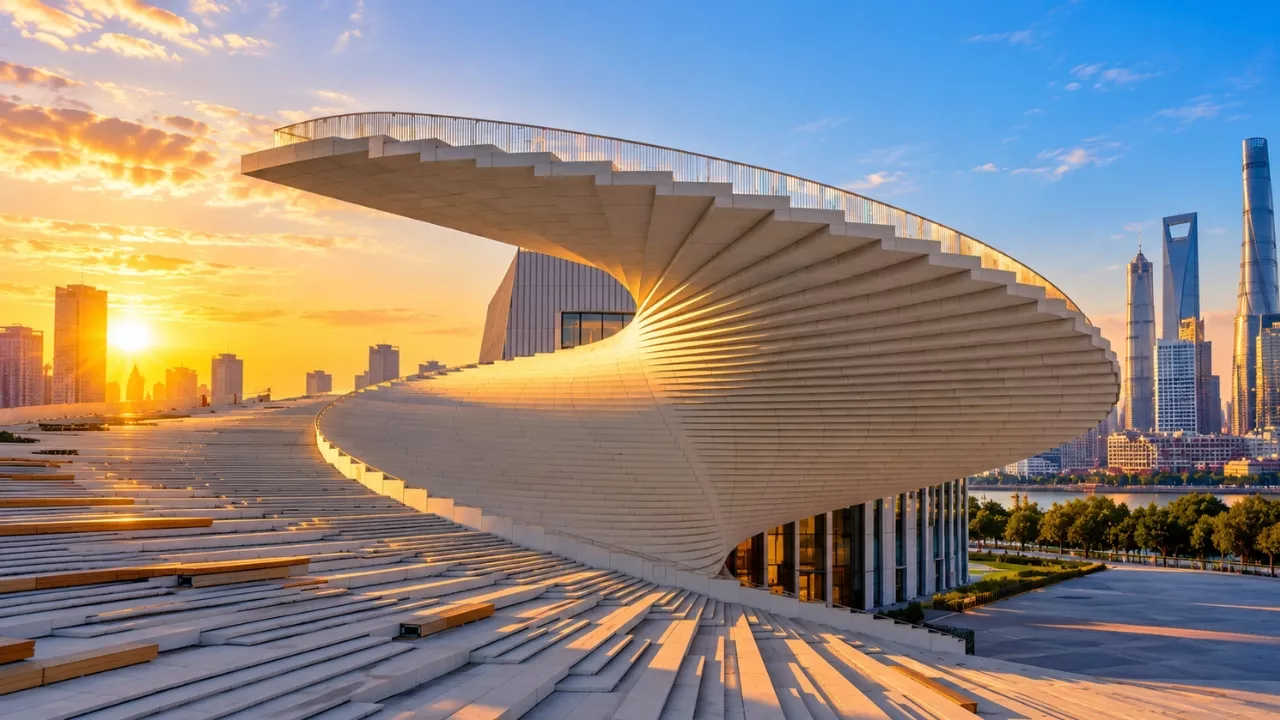
The Shanghai Grand Opera House is now complete, and it may be one of the most talked-about cultural buildings of 2026. Designed by the Norwegian studio Snøhetta with local partners, it sits on a curve of the Huangpu River and is meant to be used by the whole city, not only by ticket holders. Here is what has been built, why it matters, and what visitors can expect.
Why the Shanghai Grand Opera House Matters to the City
Shanghai already has famous skylines and busy theatre districts. The Shanghai Grand Opera House adds something different: a large civic landmark placed along the river as part of a wider cultural masterplan. The masterplan aims to strengthen the city as a hub for culture, commerce and innovation.
The project has taken years. Snøhetta’s design won an international competition, and in 2019 the studio was commissioned as part of a consortium with East China Architectural Design & Research Institute (ECADI), Theatre Projects and Nagata Acoustics. That team carried the building from first concept to completion. The original target was 2025, but large performing arts buildings rarely run to the first schedule, and the final result reflects that extra care.
Design Ideas Behind Snøhetta’s Spiralling Form
Snøhetta describes the building as a dialogue between monumentality and movement. Rather than a closed box, the form spirals and opens outward, and a radial layout extends from the building into the surrounding site so that architecture and landscape read as one.
The roof is one of the most interesting choices. It is conceived as an accessible public landscape, which matches the studio’s long-held view that civic buildings should invite people in. Snøhetta has taken this approach before, most famously at the Norwegian National Opera and Ballet in Oslo, where visitors walk up and over the building. Shanghai continues that thinking on a larger scale.
The design also came from close collaboration with ECADI across architecture, landscape and interior design. That partnership helps the building feel rooted in Shanghai rather than imported.
Key Facts at a Glance
| Detail | What We Know |
|---|---|
| Building | Shanghai Grand Opera House |
| Lead architect | Snøhetta |
| Consortium partners | ECADI, Theatre Projects, Nagata Acoustics |
| Commissioned | 2019, after an international competition |
| Location | Convex bank of the Huangpu River, Houtan area, Shanghai |
| Main auditorium | Around 2,000 seats |
| Acoustic design | Nagata Acoustics |
| Programme | Opera, orchestral, contemporary and experimental works |
| Planned opening | 17 October 2026 |
| Opening season | 82 performances across 47 productions |
Acoustics, Auditoriums and the Performance Experience
A great opera house is judged by how it sounds. The main hall seats roughly 2,000 people and was developed with Nagata Acoustics, a specialist firm in concert hall acoustics, with the aim of meeting international standards for opera and large productions. Theatre Projects contributed theatre planning, covering stage and audience layout.
The building holds more than one auditorium. That flexibility lets the programme range from traditional opera and orchestral repertoire to experimental work, which matters for attracting younger and first-time audiences as well as regular opera-goers.
What this means for visitors:
- Productions of different scales can run side by side.
- Smaller, contemporary shows get a proper home instead of being squeezed into a grand hall.
- The public roof and riverside setting make a visit worthwhile even without a ticket.
What Visitors Can Expect Next
The opening season is ambitious, with 82 performances across 47 productions planned from the start. If you are planning a trip, check the official programme and booking channels before travelling, as schedules and ticketing details can change.
For architecture lovers, the building is best seen from several angles: from the river, from the roof, and from inside the foyer spaces where the sweeping geometry is most obvious. For the city, its real success will be measured over the coming years by whether locals use it daily, not just on opening night.
Frequently Asked Questions
Who designed the Shanghai Grand Opera House?
Snøhetta led the design, working in a consortium with ECADI, Theatre Projects and Nagata Acoustics.
Where is the Shanghai Grand Opera House located?
It stands on the convex bank of the Huangpu River in Shanghai’s Houtan area.
How many seats does the main auditorium have?
The main hall has around 2,000 seats, and the building also contains additional performance spaces.
When does it open to the public?
The opening was planned for 17 October 2026, launching a season of 82 performances across 47 productions. Please confirm current dates and tickets with the official venue.
House With a Red Addition: A Czech Pigsty-Turned-Cabin Gets a New Chapter.