
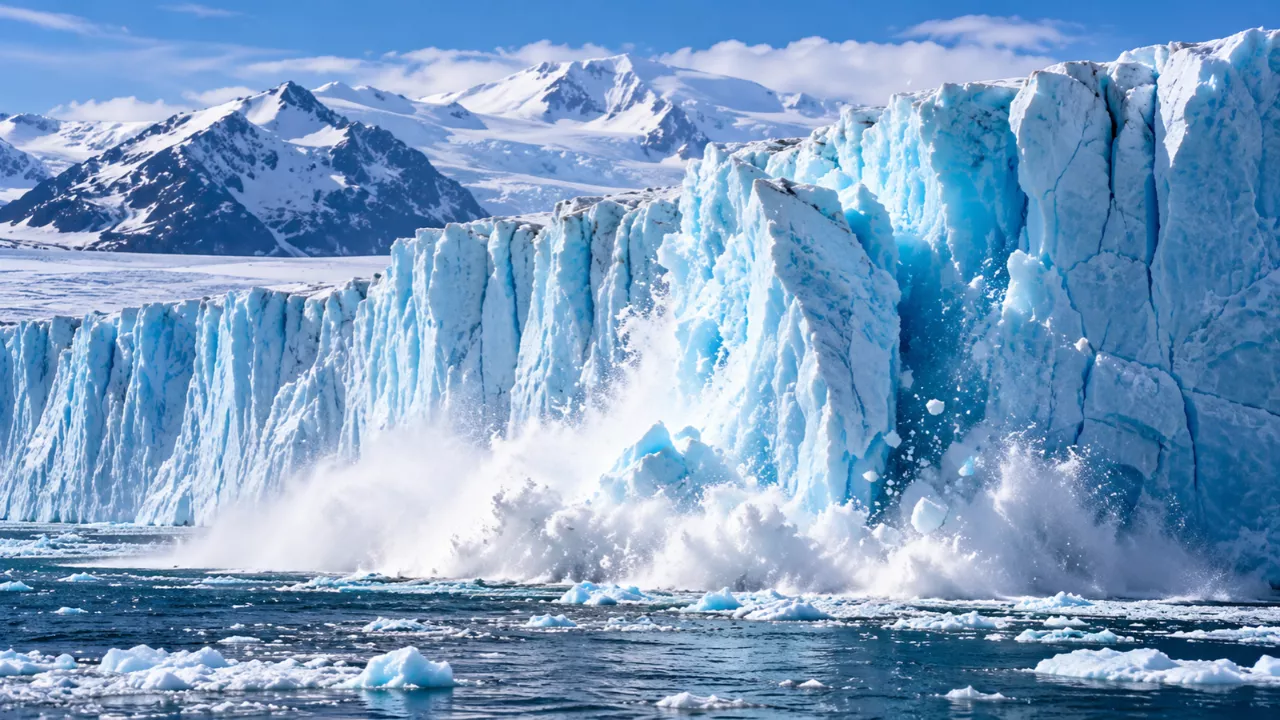
Scientists have long known that the Doomsday Glacier, formally Thwaites Glacier in West Antarctica, was losing ice. A study reported in mid-October 2026 suggests the melting is more aggressive than earlier models showed. Using a new ice sheet model, the researchers estimate the glacier could add up to 1.2 inches (about 3 cm) to global sea level by 2100. That is roughly double previous estimates.
The number sounds small, but it covers only this century and only one glacier. The real concern is what the finding says about how well we understand the processes at the glacier’s edge.
Why Is Thwaites Called the “Doomsday Glacier”?
The nickname comes from what its collapse would do to the oceans. Thwaites is about 120 km (roughly 80 miles) wide, making it the widest glacier on Earth. It also acts as a keystone for the West Antarctic Ice Sheet, much of which rests on bedrock below sea level. The ice sits on a bed that slopes downward toward the interior of the continent, which leaves it exposed to warm ocean water.
Glaciologists chose the nickname for the stakes, not as a forecast. A full collapse is not expected in the coming decades, but it could unlock further ice loss from its neighbours.
| Fact | Detail |
|---|---|
| Location | West Antarctica (Amundsen Sea sector) |
| Width | About 120 km (~80 miles), the widest glacier on Earth |
| Sea-level potential if it fully collapsed | About 65 cm (25 inches) |
| Potential if the wider West Antarctic Ice Sheet were lost | About 3.3 metres |
| Share of current global sea-level rise | Around 4% |
| New study’s projection for 2100 | Up to 1.2 inches (about 3 cm), roughly double earlier estimates |
| Outflow speed | Roughly doubled over the past 30 years |
What Did the New Study Find at the “Grounding Line”?
The key is the grounding line, the point where ice lifts off the seabed and begins floating as an ice shelf. Models have traditionally treated it as a sharp boundary. The researchers report that satellite data shows it is actually a grounding zone, sometimes miles wide.
A zone that wide gives warm ocean water more room to creep beneath the ice, melting it from below. This process is hard to see because it happens under hundreds of metres of ice and seawater. Once the new model accounted for the wider zone, its melt projections rose sharply. The earlier estimates were not careless. The grounding line is simply a hard place to observe and to represent in a computer model.
Why Does a Few Centimetres Matter?
Context matters here, and so does restraint. Up to 1.2 inches from one glacier by 2100 is not a flood warning for next year. But a few centimetres of added sea level raises the risk of coastal flooding during storm surges, and it adds to everything else already driving the oceans upward, such as melting elsewhere in Antarctica, Greenland and warming seawater.
The larger lesson is about uncertainty. If a core process was underestimated by half, forecasts for later centuries could shift too. Researchers working on the glacier have said it is set to retreat further and faster through the 21st and 22nd centuries. Cutting greenhouse gas emissions remains the main way to slow that loss.
What This Means for Coastal Communities
Sea-level rise does not arrive evenly, and the places most exposed tend to be low-lying deltas, island nations and big port cities. The practical takeaways are:
- Treat projections as ranges, not promises. Studies like this one narrow the range over time.
- Watch for model updates. Planners use these numbers for flood defences, insurance and infrastructure, so upward revisions matter.
- Remember the timescale. The biggest changes would unfold over centuries, which leaves time to act on emissions.
- Keep individual studies in perspective. One paper refines the picture, and the scientific community will test it against other models and measurements.
Frequently Asked Questions
Is the Doomsday Glacier about to collapse?
No. Scientists say a full collapse is unlikely in the next few decades. The new study is about faster melting this century, not imminent failure.
How much sea-level rise could Thwaites cause by 2100?
The new model suggests up to 1.2 inches (about 3 cm), about twice earlier estimates. A complete collapse would eventually raise global sea level by around 65 cm.
What is a grounding zone?
It is the stretch where glacier ice transitions from resting on the seabed to floating on the ocean. The study found this is often a zone miles wide rather than a thin line, letting warm water reach farther beneath the ice.
Can the melting be stopped?
Not quickly. Cutting greenhouse gas emissions can slow long-term ice loss, but the ocean already holds heat that will keep acting on the glacier for years.
Europe’s Vanishing Glaciers: Why Some May Disappear Within Our Lifetime..