
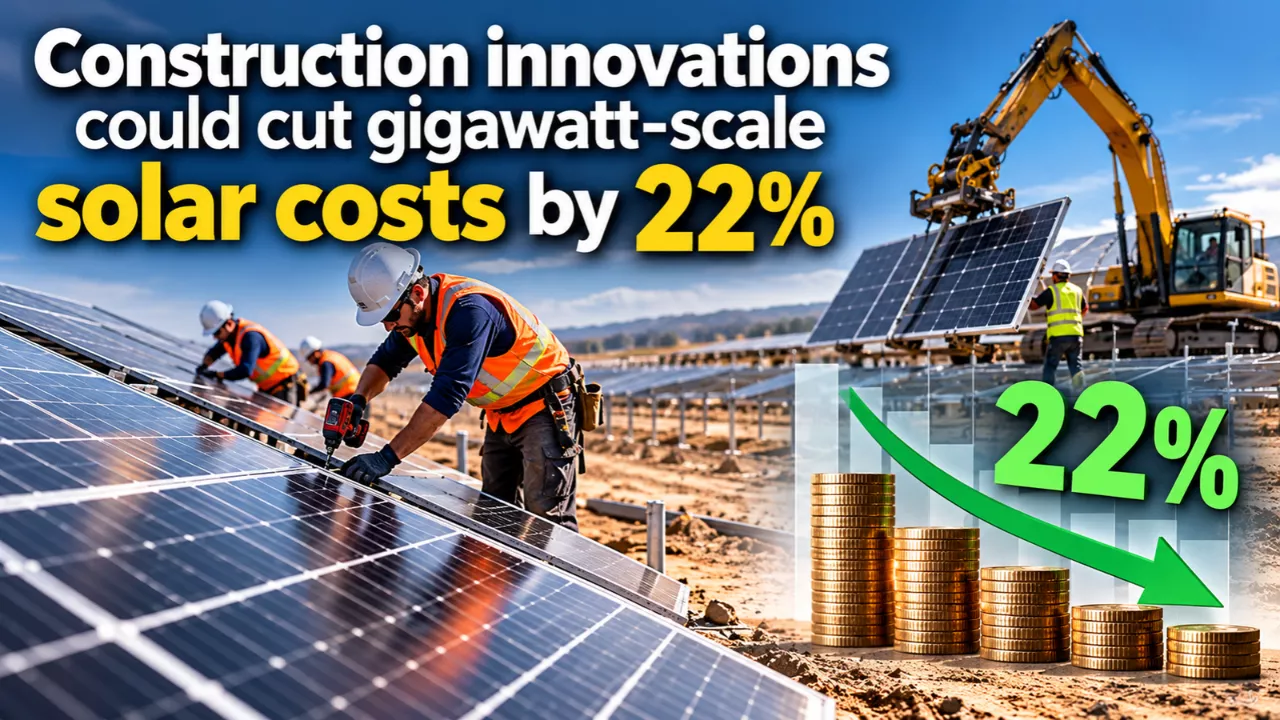
Solar panels have become far cheaper over the past decade, but building a solar farm at gigawatt scale is still a slow, labour-heavy job. Thousands of piles go into the ground, millions of modules are bolted into place, and every delay adds to the bill. New research from Lightsource bp suggests the cheapest gains may now come from how plants are built rather than from the panels themselves. Its NextGen Solar Programme found that combining four construction innovations could cut direct installation costs by around 22% and installation time by up to 30%, compared with standard practice. For developers, investors and anyone following the energy transition, that matters, because lower build costs make solar cheaper to finance and quicker to deliver.
Why Building Gigawatt-Scale Solar Is Harder Than It Looks
Large solar farms are not simply bigger versions of small ones. At gigawatt scale, construction becomes a logistics challenge. Crews have to drive huge numbers of foundation piles, mount frames, fit modules and run cabling across a site that can cover thousands of acres.
Lightsource bp’s technical team notes that demand for solar is rising, while construction methods built for smaller projects limit how fast and how economically large plants can be delivered. In some cases, that constraint affects whether a project makes commercial sense at all. The NextGen programme was set up to ask a practical question: which proven or emerging techniques could change that?

The Four Innovations Behind the 22% Saving
The programme looked at four areas of change. Each tackles a different slow or costly part of the build.
- Automated foundation piling: GPS-guided rigs replace manual pile driving. The analysis estimates installation time savings of up to 12.5%, along with more consistent results and a lower injury risk for site workers.
- Steel-frame solar panels: A frameless-style design that uses steel in place of aluminium, which the company is exploring as an alternative.
- Press-fit, bolt-free module installation: Panels click into position instead of being fixed with clamps and bolts, simplifying the most repetitive job on site.
- On-site pre-assembly: Components are put together before final installation, so less fiddly work happens out in the field.
Combined with automated piling and a new module design, bolt-free installation alone has the potential to reduce installation time by up to 30%.
What the Numbers Show at a Glance
| Innovation | What changes on site | Reported benefit |
|---|---|---|
| Automated piling | GPS-guided rigs replace manual pile driving | Up to 12.5% less installation time |
| Steel-frame panels | Steel replaces aluminium in the panel design | Under assessment; cost figures not disclosed |
| Bolt-free modules | Panels press-fit into place without clamps | Up to 30% less installation time when combined with piling and new module design |
| On-site pre-assembly | More assembly completed before final installation | Contributes to combined savings |
| All four combined | A redesigned construction workflow | About 22% lower direct installation costs; up to 30% faster build |
The 22% figure applies to direct installation costs, not the total cost of a solar project. Land, grid connection, financing and panels themselves sit outside that number, so the saving should be read as a meaningful reduction in one large part of the budget rather than the whole.
From Modelling to Real-World Proof
It is worth being clear about where this research stands. The results come from an investigation phase, based on an assessment of newly developed offerings from suppliers in China, Europe and North America, with a focus on automation and new installation methods. Lightsource bp describes the approach as still at the development stage, intended for large-scale projects from 2028 onwards.
The next step is validation. The company plans trials in Australia and the United States on active projects, testing automated piling systems, robotic module placement and advanced cable harnessing. The aim is to confirm cost, time and safety assumptions and to support the technical assessment and bankability that lenders look for. Initial results are targeted within the next 18 months. Until those trials report back, the figures are best treated as promising estimates, not guaranteed outcomes.


What This Could Mean for Solar’s Future
If the trials confirm the findings, the effects could be wide. Faster construction means projects start generating power sooner and tie up capital for less time. Automation can reduce reliance on scarce skilled labour and improve site safety. Lower build costs can also help projects clear the commercial hurdles that currently hold some of them back.
Several questions remain open. Steel replacing aluminium in module frames needs to prove itself on durability and supply. Bolt-free fixing has to show it holds up over decades of wind, heat and vibration, which is what lenders will want evidence for. Still, the direction is clear: as panel prices stabilise, the next wave of savings in solar is likely to come from smarter construction.
Frequently Asked Questions
How much could construction innovations reduce solar farm costs?
Lightsource bp’s research indicates that combining four innovations could cut direct installation costs by around 22% and installation time by up to 30% compared with current standard practice.
What are the four innovations?
Automated foundation piling, steel-based frameless panel design, press-fit bolt-free module installation, and on-site pre-assembly.
Is this technology available now?
Not yet at scale. The approach is at the development stage and is intended for large projects from 2028 onwards, with real-world trials planned in Australia and the United States.
Does a 22% saving mean solar electricity will be 22% cheaper?
No. The saving applies to direct installation costs only. Panels, land, grid connection and financing are separate, so the effect on the final cost of electricity will be smaller.
Solar Panel Cooling With Aluminium Fins and Recycled Plastic Bags Lifted Output by 11.6% in the Lab…