
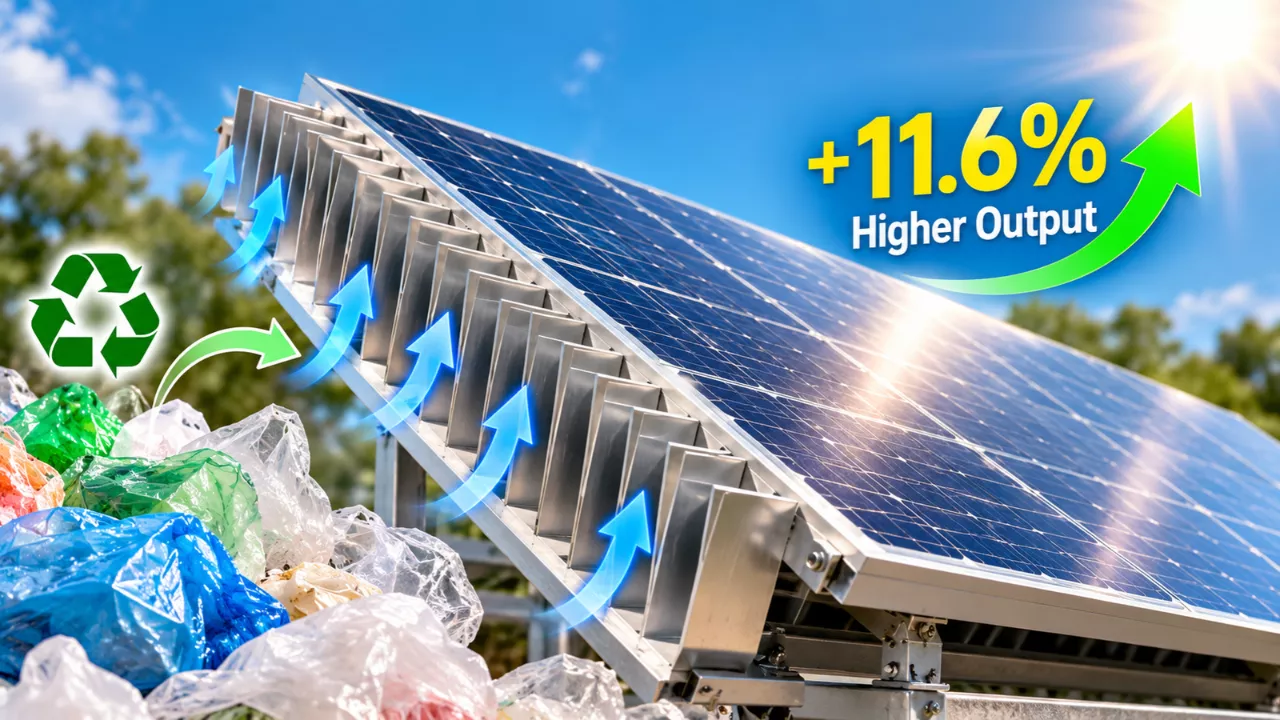
Anyone who has touched a rooftop solar panel on a hot afternoon knows it gets very hot. What many people don’t realise is that this heat works against the panel. The more intense the sunshine, the hotter the cells run, and the less electricity they deliver per unit of light. This is why solar panel cooling has become an active research topic, and why one laboratory experiment has drawn attention. It paired perforated aluminium fins with folded, discarded plastic bags and recorded an 11.6% rise in output power under simulated sunlight.
The result is promising, but it needs to be read carefully. The test was done indoors, and the aluminium did most of the work. Below is what the researchers did, what the numbers show, and what has to happen before this idea could reach a real rooftop.
Why Heat Reduces Solar Panel Output
Photovoltaic modules are rated under standard test conditions of 25°C cell temperature and 1,000 watts per square metre of irradiance. Real panels rarely stay at 25°C once the sun is strong. As temperature climbs, voltage drops and so does peak power, a relationship known as the negative temperature coefficient. For commercial silicon modules, the loss is small per degree but adds up over a long, hot day.

That creates an odd trade-off. Panels need strong sunlight to generate power, yet strong sunlight heats them enough to cut into their own performance. Removing excess heat is therefore one of the more direct ways to get more electricity from panels you have already installed.
How the Aluminium Fin and Plastic Bag Experiment Worked
The experiment drew on a 2019 study published in the International Journal of Photoenergy by Ammar Alkhalidi, Mohamad K. Khawaja and Abdel Ghaffar Al Kelany. The team tested a panel under a halogen-lamp simulator, first as a baseline and then with cooling additions fitted to the back.

The design relied on three ideas:
- Perforated aluminium fins on the rear of the panel, which increase surface area for heat exchange while letting air pass through the holes.
- Repurposed plastic, including folded plastic bags and ground high-density polyethylene (HDPE), tested alongside the fins.
- Fully passive operation, with no fans, pumps or extra electricity.
The perforated pattern was chosen because it kept weight down and improved airflow, both of which matter if a system is ever scaled up.
What the Results Show
The best-performing setup combined aluminium fins with folded plastic bags. At 1,000 W/m², it raised output power by 11.6% and lowered panel temperature by 22.7% compared with an unmodified panel.

| Configuration | Output power change | Notes |
|---|---|---|
| Unmodified panel | Baseline | Tested under halogen-lamp simulator |
| Aluminium fins only | +11.5% | Passive, perforated rear fins |
| Fins + ground HDPE | Gain recorded, below the best result | Repurposed plastic variant |
| Fins + folded plastic bags | +11.6% | Best result, temperature down 22.7% |
The most honest reading of this table is that aluminium fins delivered nearly all of the benefit. Folded plastic bags added roughly 0.1 percentage points over fins alone. So the plastic is better seen as a way to reuse waste material without hurting performance than as a major efficiency booster. That is still a useful finding for anyone interested in low-cost, circular-economy solar upgrades.
What Still Needs Proving Before Real-World Use
A halogen simulator gives steady, repeatable light. A real roof does not. Wind, humidity, dust, cloud and seasonal temperature swings all change how well heat leaves a panel, and the lab setup could not fully capture them. Several practical questions are also open:
- How well do the fins and plastic hold up over years of sun exposure and weather?
- How much maintenance does the system need, especially with dust and debris?
- What does installation cost compared with the extra electricity generated?
- Does the gain hold on large arrays, not just a single test panel?
Until outdoor trials answer these, the 11.6% figure should be treated as a lab result and not a promise for rooftop systems.
What This Means for Homeowners and Solar Installers
For now, this is a research finding and not a product you can buy. Still, it points toward something practical: airflow behind the panel matters. Good mounting practices that leave a gap for air to circulate, and attention to how heat builds up in hot climates, are sensible considerations when planning an installation. Anyone considering a cooling add-on should wait for outdoor data and ask installers for real field performance numbers instead of lab figures.
The broader takeaway is encouraging. Small, passive, low-tech additions may recover meaningful output from panels that are already working, and reusing waste materials along the way is a bonus.
Why Two Thirds of Home Movers Now Want Solar Panels, Batteries and Heat Pumps
2 thoughts on “Solar Panel Cooling With Aluminium Fins and Recycled Plastic Bags Lifted Output by 11.6% in the Lab…”
Comments are closed.