
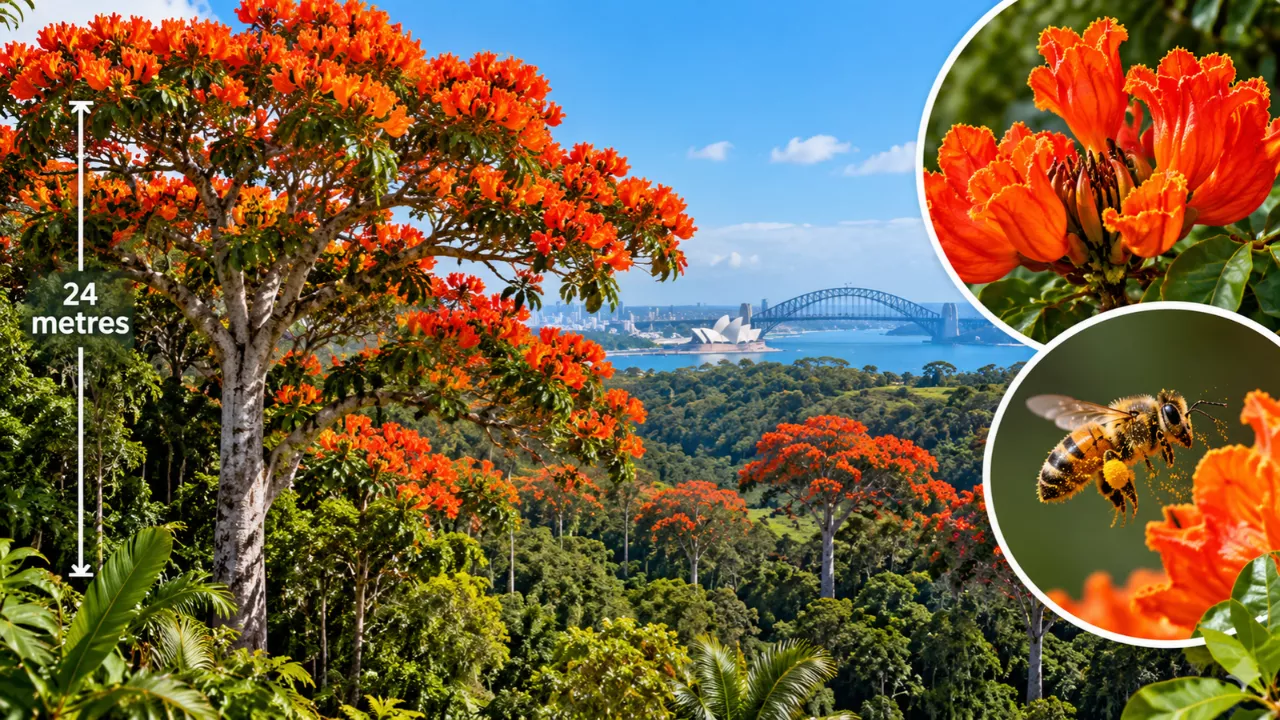
Drive along almost any road in coastal Queensland in winter and you will spot it: a tall tree lit up with clusters of fiery orange-red flowers. The African tulip tree (Spathodea campanulata) was brought to Australia as an ornamental, loved for exactly that display. Decades later, the same tree has escaped gardens and street plantings and is now classed as a serious environmental weed. It grows tall, spreads fast along creeks and forest edges, and its flowers have been linked to the deaths of native stingless bees.
Why Australians Planted the African Tulip Tree in the First Place
The tree is native to tropical West and Central Africa, and its appeal is obvious. The flowers are large, roughly 10 to 12 cm long, and borne in bold clusters at the branch tips. In warm, humid climates the tree grows quickly, gives shade, and flowers heavily, which made it a favourite for parks, streets and backyards across tropical and subtropical regions.
The trouble is that a tree built for easy growth is also built to spread. Its long seed pods split open and release huge numbers of papery, wind-carried seeds. Those seeds settle along roadsides, waterways and disturbed bushland, where seedlings take hold quickly.
How the African Tulip Tree Invades Rainforests and Waterways
Disturbed ground is the tree’s opening. Storm damage, cleared edges, creek banks and roadside verges all give seedlings a start. Once established, the tree can reach heights of around 24 metres and shade out the slower-growing native plants beneath it, shifting the makeup of the forest over time.
It is recognised as a significant environmental weed in Queensland, the Northern Territory and Christmas Island, and a potential “sleeper weed” in northern New South Wales. It also appears on the Global Invasive Species Database’s list of 100 of the world’s worst invasive alien species. Cutting it down is not always a quick fix: stumps tend to resprout and send up suckers unless they are treated properly.
| Feature | What to know |
|---|---|
| Scientific name | Spathodea campanulata |
| Native range | Tropical West and Central Africa |
| Flowers | Orange-red, tulip-shaped, 10–12 cm long, in clusters |
| Seed pods | Up to about 30 cm long, releasing papery seeds |
| Typical habitat when invasive | Roadsides, creek lines, forest margins, disturbed bushland |
| Impact on wildlife | Linked to deaths of native stingless bees |
| Queensland status | Category 3 restricted matter under the Biosecurity Act 2014 |
| Other hazard | Prone to falling in storms, which can damage property |
Why Native Stingless Bees Are at Risk
This is the part that worries ecologists most. Australian researchers have found dead native bees inside the blooms. Studies from the University of Queensland have pointed to compounds in the nectar that can paralyse and kill them. Researchers have also discussed whether the flower’s structure may trap bees, though the nectar toxicity is the more widely reported explanation.
The concern goes beyond individual bees. Foragers that carry toxic nectar back to the hive may put the colony at risk, and native stingless bees are valuable pollinators for both bushland and some crops. Losing them quietly weakens the ecosystems the tree is crowding into.
What Landholders and Councils Are Doing, and What You Can Do
Councils in Queensland have started acting. Fraser Coast Regional Council, for example, removed 158 African tulip trees from its parks and gardens, and offers residents a free native seedling for each tree they remove from their own land. Priority is often given to trees close to native bee habitat.
If you have one on your property, a sensible approach looks like this:
- Check your local council or state biosecurity guidance first, since rules differ by region.
- Do not give away, sell or deliberately spread the plant or its seeds where it is restricted.
- Have large trees removed by a qualified arborist, as they can drop heavy limbs.
- Treat stumps and regrowth so suckers do not return.
- Replace it with native, bee-friendly species suited to your area, such as banksias, paperbarks and lilly pillies in many coastal regions.
- Report trees growing in bushland or on public land to your council.
Frequently Asked Questions
Is the African tulip tree illegal in Australia?
It depends on where you live. In Queensland it is a Category 3 restricted matter, meaning it must not be distributed or released into the environment without authorisation. Check your own state or council rules before planting, selling or removing one.
Are African tulip tree flowers really toxic to bees?
Reports from Australian researchers and government agencies indicate the flowers are harmful to native stingless bees, and dead bees are often found in the blooms. Researchers are still working out exactly how the harm occurs.
Can I just cut the tree down myself?
Small seedlings can be pulled, but large trees are better left to professionals. Stumps often resprout, so follow-up treatment is important.
What can I plant instead?
Native flowering trees suited to your region are the best choice. Local councils and native plant nurseries can recommend bee-friendly species that thrive in your soil and climate.
Can a Hibiscus Plant Be Grown Indoors? Your 2026 Home gardening Growing Guide!!
1 thought on “Australia planted African tulip trees- Why This Beautiful Garden Tree Is Harming Native Bees!”
Comments are closed.