
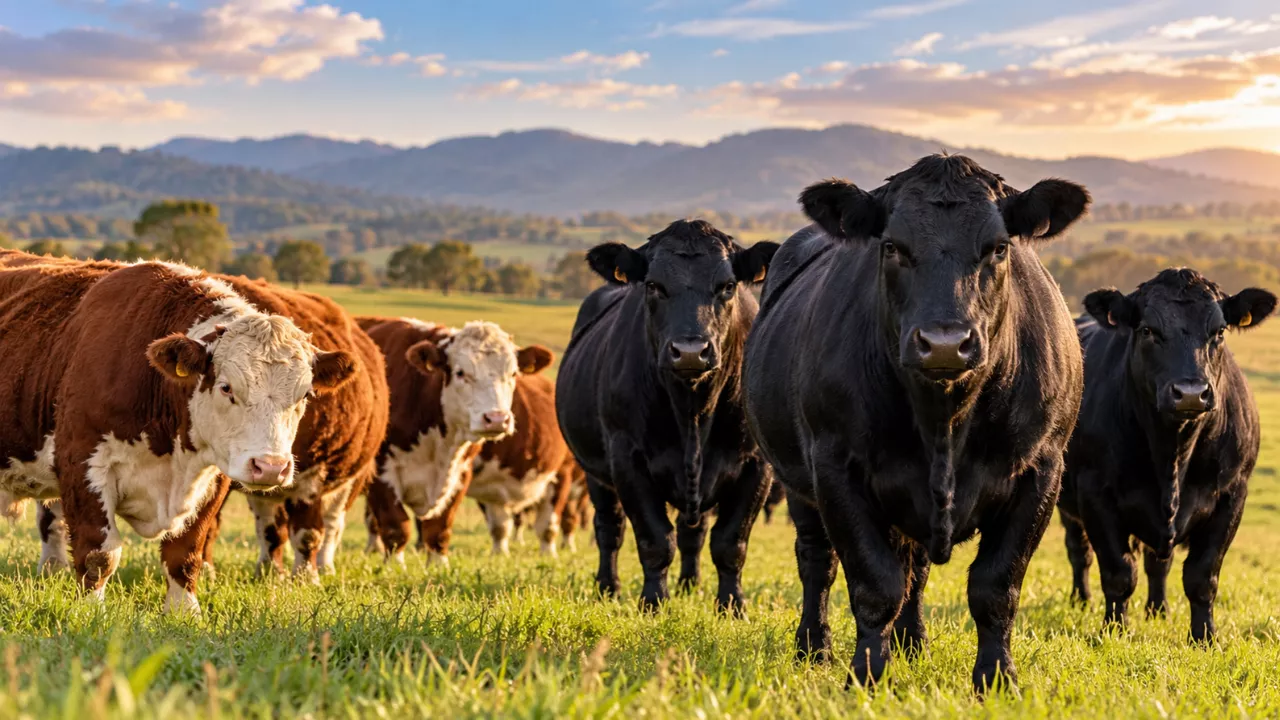
For generations, brown-and-white Hereford cattle were the face of Australian beef. Today, black Angus cattle fill the paddocks, the saleyards and the premium menu boards. The shift wasn’t random. Hereford cattle lost ground to Angus because of a strong brand identity, buyer preferences overseas and some very effective marketing. Even long-time Hereford breeders are making the switch. After about six decades with the breed, Stephen and Jodi Peake of north-west New South Wales are selling their Hereford herd to focus on Angus and Wagyu.
Why Hereford Cattle Are Losing Ground to Angus
Herefords arrived in Australia roughly 200 years ago and were the backbone of the beef industry for most of that time. Angus took the lead by becoming easy to recognise and easy to sell, with a clear label for buyers and a dependable premium for producers. Herefords never built an equivalent brand story at the same scale. Market analyst Charles Boog notes that Australia doesn’t require breed to be recorded at saleyards, so the clearest picture comes from a patchwork of survey and auction data. That patchwork consistently points the same way.
From a Quarter of the National Herd to a Minority Breed
In 1990, government farm survey data showed Herefords as the country’s most popular breed, at just over a quarter of the national herd. Angus sat at just over 4 per cent. Thirty-five years later the positions have flipped. A recent Meat & Livestock Australia survey found Angus led national herd growth between 2023 and 2025, adding an estimated 1.76 million head.

| Indicator | Hereford | Angus |
|---|---|---|
| Share of national herd, 1990 | Just over 25% | Just over 4% |
| Bulls sold at auction, 2025 | 1,780 | 11,328 |
| Herd growth, 2023–2025 | Cow numbers up about 26% over the last two to three years (breed society estimate) | Up an estimated 1.76 million head |
| Return per head at auction | Lower | Higher, per AuctionsPlus data |
The two growth figures aren’t directly comparable. One is a breed society’s estimate of breeding cows, and the other is a national herd survey. Even so, the gap in demand for bulls is hard to ignore.
How Marketing Built the Angus Brand
Angus Australia’s Brad Hine describes the breed’s rise as partly a marketing story, and three pieces stand out:

- A verified label (1995): Angus Australia introduced guidelines for “Verified Angus Beef”, which requires at least 75 per cent Angus content and no dairy characteristics.
- Japanese demand: Exports to Japan grew strongly through the 1990s, and that market paid a premium for black cattle.
- Fast-food exposure: McDonald’s sold premium Angus-branded products around the world from 2009 until June this year, which made the breed a household name.
The financial signal matters as much as the branding. Sale data from AuctionsPlus shows farmers now earn more per head on Angus, and producers follow the money.
What One Breeder’s Exit Says About the Industry
The Peakes’ story shows that the shift isn’t about poor cattle. They spent years refining their genetics, broke weight-gain records with their steers, and once sold a prize bull for more than $60,000. As they approach retirement, they’ve chosen to concentrate on Angus and Wagyu. Stephen Peake says Angus “tick a lot of boxes” for both consumers and producers, and that every breed has its day in the sun. Their decision reflects a business reality more than a loss of faith in Herefords.
Is There Still a Future for Hereford Cattle?
Herefords Australia says the story isn’t over. Chief executive Hamish Chandler says membership has stabilised over the past five years. He also reports that Hereford cows in the national breeding herd have risen by around 26 per cent in the last two to three years, and he expects advances in genetic research to keep the breed relevant.
Agricultural consultant Alastair Rayner doesn’t expect any single breed to dominate the way Herefords once did. He expects today’s mix to hold, with a possible rise in tropically adapted cattle. The MLA survey supports that view, with Santa Gertrudis and Droughtmaster the second and third fastest-growing herds.
What Producers Should Weigh When Choosing a Breed
The practical lesson is to start with your own conditions rather than the trend of the moment. Rayner’s advice is to work out what you need and then find the breed that fits. Useful questions include:
- Which market are you selling into, and does it pay a premium for a particular breed or label?
- Does your climate and country suit the breed, particularly in hot northern regions?
- How do recent auction returns per head compare for the breeds you’re considering?
- Are you breeding for the long term, with genetics you can improve, or selling on a shorter cycle?
Frequently Asked Questions
Are Hereford cattle disappearing in Australia?
No. Their share of the national herd has fallen sharply since 1990, but Herefords Australia reports stable membership over five years and a rise of about 26 per cent in Hereford breeding cows over the last two to three years.
Why is Angus more popular than Hereford?
Angus benefited from a verified beef label, a premium from export markets such as Japan, McDonald’s Angus-branded products, and stronger auction returns per head.
What is Verified Angus Beef?
It’s a labelling program introduced by Angus Australia in 1995. Beef must contain at least 75 per cent Angus content and have no dairy characteristics.
Which cattle breeds are growing fastest besides Angus?
In the MLA survey, Santa Gertrudis and Droughtmaster were the second and third fastest-growing herds.
Heavy Rain and Hail Damage Crops Just Before South Australia’s Record Harvest!
1 thought on “Hereford Cattle Fall Out of Fashion as Angus Takes Over!”
Comments are closed.