
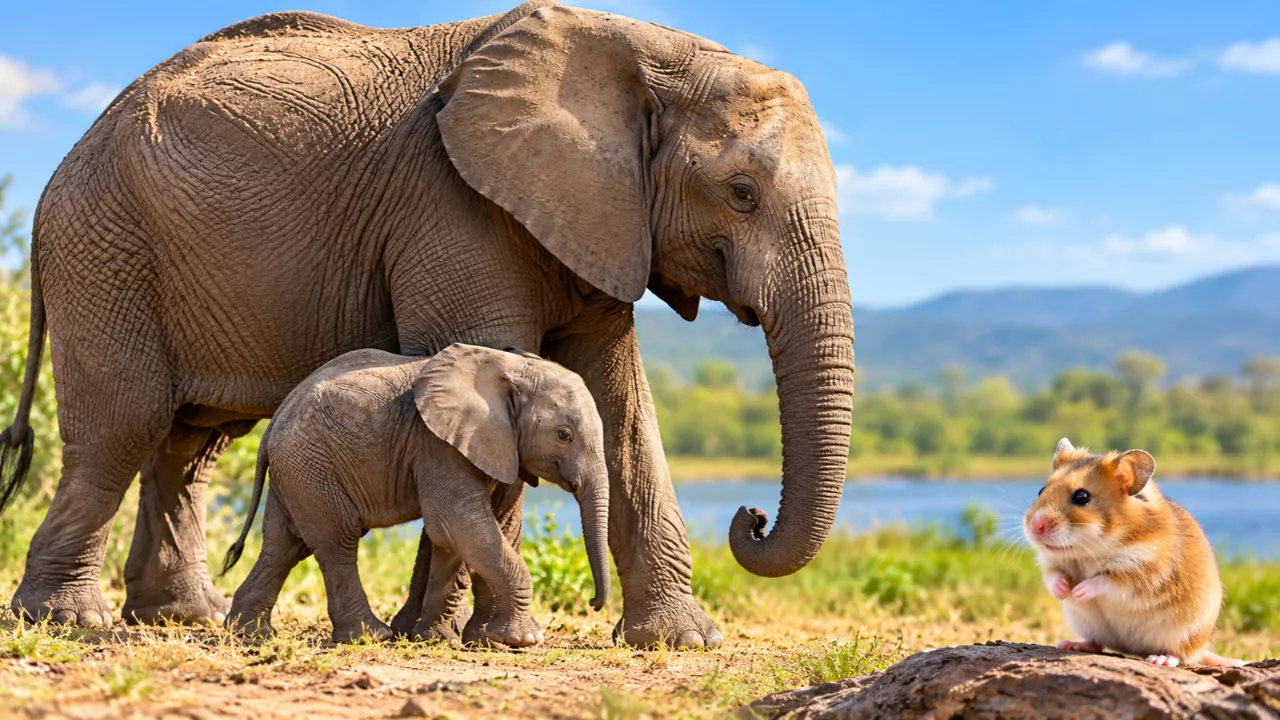
Imagine carrying a pregnancy for nearly two years, and compare that with a mother hamster who delivers in about two weeks. The gestation period of an elephant is the longest of any land mammal, at roughly 18 to 22 months. The Syrian hamster is among the shortest, at around 16 days. The gap looks absurd, but it follows a clear biological logic. Body size, brain development, lifespan and survival strategy all shape how long a mother carries her young.
What Is a Gestation Period, and How Different Can It Be?
Gestation is the time between conception and birth. It varies enormously among mammals. Tiny marsupials such as opossums are born after under two weeks, while giraffes and elephants take well over a year. Humans sit in the middle at around 40 weeks.
Elephants hold the record among land mammals. African elephants carry a calf for about 22 months, and Asian elephants for roughly 18 to 22 months. Syrian hamsters give birth after about 15 to 18 days. Dwarf hamster species run slightly longer, usually 18 to 21 days. Hamsters are therefore far at the short end, but not alone there.

Why the Gestation Period of an Elephant Is So Long
Size is the first clue. A newborn elephant weighs about 100 kg and must be built to function almost immediately. Growing that much tissue, including a large and complex brain, takes time, and the pregnancy cannot be rushed without risking a weak or underdeveloped calf.
Elephants are also precocial, meaning the young are born well developed. A calf can usually stand within an hour or so and follow the herd soon after. This matters because elephants live in open landscapes where a newborn that cannot move is vulnerable to predators and to being left behind.

Elephants follow a “slow life” strategy too. They live for decades, reach maturity late, and typically raise one calf at a time with years of care and learning from the herd. For such animals, investing heavily in one well-developed offspring pays off better than producing many quickly.
How a Hamster Pulls Off a 16-Day Pregnancy
Hamsters use the opposite approach, a “fast life” strategy. They are small, short-lived and heavily preyed upon in the wild, so they reproduce quickly and in numbers. A hamster litter often has 6 to 12 pups.
The pups are born altricial: hairless, blind, and only a couple of grams in weight. They depend completely on the mother, who keeps them warm and nursed in a burrow. Much of their development happens after birth rather than before, which is why the pregnancy can be so short. Pups are typically weaned at around three weeks old.

Side-by-Side: Gestation Periods Across Animals
| Animal | Typical gestation | Newborn condition | Typical litter |
|---|---|---|---|
| African elephant | ~22 months | Precocial, ~100 kg, walks within hours | 1 |
| Asian elephant | ~18–22 months | Precocial, mobile soon after birth | 1 |
| Giraffe | ~15 months | Precocial, stands within an hour | 1 |
| Horse | ~11 months | Precocial, stands quickly | 1 |
| Human | ~9 months (40 weeks) | Altricial, long dependency | 1 |
| Dog | ~2 months | Altricial | 4–8 |
| Mouse | ~3 weeks | Altricial, hairless | 5–10 |
| Syrian hamster | ~16 days | Altricial, hairless, blind | 6–12 |
Figures are typical averages and vary by species, breed, and individual.

The Key Factors Behind the Difference
Several biological factors work together to set gestation length:
- Body size: Larger mammals generally have longer pregnancies, though the relationship is not perfectly proportional.
- Developmental stage at birth: Species that give birth to mobile, well-developed young need more time in the womb.
- Brain complexity: Elephants have large brains and strong social learning, so more brain development happens before birth.
- Lifespan and maturity: Long-lived animals tend to reproduce slowly, while short-lived animals reproduce fast.
- Litter size: Many small offspring can be produced quickly, but a single large calf demands a long, steady pregnancy.
- Predation and environment: Where newborns must flee danger quickly, longer gestation is favoured. Where young are hidden in burrows, shorter gestation works.
Gestation length is not a flaw or a luxury. It is a finely tuned part of each species’ survival strategy.
Frequently Asked Questions
How long is the gestation period of an elephant?
About 22 months for African elephants and roughly 18 to 22 months for Asian elephants, the longest of any land mammal.
How long is a hamster pregnant?
Syrian hamsters carry their young for about 16 days. Some dwarf hamster species take around 18 to 21 days.
Does a longer gestation mean a smarter animal?
Not directly. Longer pregnancies often go with larger, more developed brains at birth, but intelligence depends on many other factors, including social learning after birth.
Why are baby hamsters born so undeveloped?
Hamsters are altricial. Their pups are born tiny, hairless and blind, and finish developing in the nest under the mother’s care, which lets pregnancy stay brief.