
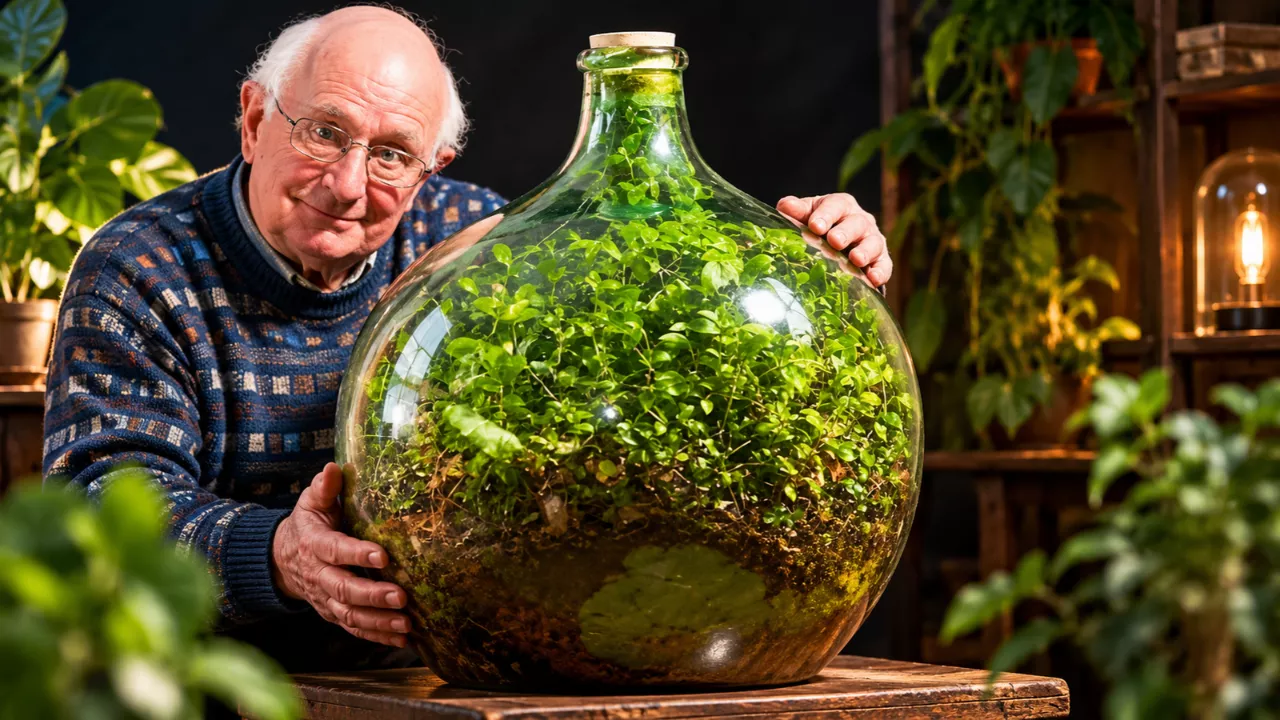
In 1960, a British engineer named David Latimer lowered a spiderwort sprout into a large glass carboy, added a small splash of water, and sealed it shut. That single curious experiment became the most famous sealed bottle garden in the world. It reportedly grew into a dense green mass that filled the glass, with almost no help from its owner.
The story keeps resurfacing online, and it’s easy to see why. It’s quiet, slightly absurd, and oddly hopeful. Nothing about it requires special equipment. It simply shows how much a plant, some soil, microbes, and sunlight can do when left alone. This article covers what happened, why it works, and what it does and doesn’t prove.
The Story Behind the World’s Most Famous Sealed Bottle Garden
Latimer, a retired electrical engineer from Cranleigh, Surrey, started the bottle on Easter Sunday 1960. He has described it as an act of idle curiosity. Bottle gardens were a popular fad at the time, and he wanted to see what would happen if he stoppered one completely.
He put some compost into a 10-gallon glass carboy and used a length of wire to lower a young spiderwort (Tradescantia) inside. He added roughly a quarter pint of water and sealed it. Twelve years later, in 1972, he opened it once, gave it another small drink, and closed it again. By his own account it has stayed sealed since then.
He kept it in the hallway of his home, about six feet from a window, and turned it now and then so the plant grew evenly toward the light. He never pruned it. He once sent a photo to BBC Radio 4’s Gardeners’ Question Time, and news coverage in 2013 introduced the bottle to a worldwide audience. He said he hoped to pass it to his children or, failing that, donate it to the Royal Horticultural Society.

Key Facts at a Glance
| Detail | What was reported |
|---|---|
| Owner | David Latimer, retired electrical engineer |
| Location | Cranleigh, Surrey, England |
| Started | Easter Sunday, 1960 |
| Container | Roughly 10-gallon glass carboy |
| Plant | Spiderwort (Tradescantia) |
| Starting materials | Compost and about a quarter pint of water |
| Last opened | 1972, for one small top-up of water |
| Light source | Indirect daylight from a nearby window |
| Maintenance | Occasional rotation; no pruning |
| Widely reported thriving | 2013 press coverage, at over 50 years |
Accounts vary slightly on small details, such as the exact amount of water and whether the plant began as a seed or a sprout. Most reports describe a young spiderwort lowered in on a wire.
How a Sealed Bottle Garden Actually Works
A closed bottle can’t exchange air or water with the outside world, but it still receives something important: light. That energy powers a small, repeating cycle.
- Photosynthesis: The leaves use light and carbon dioxide to make sugars and release oxygen.
- Transpiration and condensation: Water vapor from the plant and soil condenses on the glass and runs back down, so the bottle effectively “rains” on itself.
- Respiration: The plant and soil microbes use oxygen and release carbon dioxide.
- Decomposition: Fallen leaves rot at the bottom, and microbes turn them back into nutrients the roots can absorb.
None of this is magic. It’s the same logic as a forest floor in miniature. Matter circulates inside the glass, while light is the one thing that comes in from outside. The system doesn’t create energy from nothing, and that’s why a dark corner would eventually spell its end.

Why Spiderwort Was a Smart Choice (and Why Luck Mattered Too)
Spiderworts are tough, fast-growing houseplants that tolerate indoor light and humid conditions well. That makes Tradescantia a sensible candidate for a closed container, but it doesn’t guarantee success. Many sealed bottles fail from too much water, too little light, mold, or a plant that outgrows its balance.

It’s fair to say this bottle benefited from a good combination of plant, light level, soil, and starting water. It’s also fair to say this is one famous success, and we hear far less about the many sealed bottles that didn’t last. Treat it as a remarkable example, not a promise that any jar will run for decades.
What You Can Learn If You Want to Try Your Own
You don’t need a 10-gallon carboy to experiment. A few practical principles apply to almost any closed terrarium:
- Start small on water. Soil should be barely damp, not wet. Excess moisture invites mold and rot.
- Choose tolerant plants. Hardy, humidity-loving species cope better than succulents or desert plants.
- Give bright, indirect light. Direct sun can overheat the glass and cook the plant.
- Rotate occasionally. Turning the container keeps growth even, just as Latimer did.
- Be patient and observe. If condensation is constant and heavy, the jar is too wet; if the glass stays clear and leaves crisp, it may be too dry.
Expect trial and error. The charm of the Latimer bottle is that it rewards curiosity more than skill.
Frequently Asked Questions
Is David Latimer’s bottle garden really sealed?
According to Latimer and the press coverage, it was sealed in 1960 and opened only once, in 1972, for a small top-up of water. It has been closed ever since, as far as reported.
How does a plant survive in a sealed bottle without fresh air or water?
Water recycles through evaporation and condensation, while decomposing leaves supply carbon dioxide and nutrients. Light from outside drives photosynthesis, so the plant keeps feeding itself.
Can any plant be grown in a sealed bottle garden?
No. Hardy, humidity-tolerant plants like spiderworts and some ferns do best. Plants that need dry soil or strong sun usually struggle in closed containers.
Is the bottle still alive today?
It was widely reported as thriving in 2013, and the story has circulated for years since. I couldn’t find a recent, independently verified update, so it’s best to treat its current condition as unconfirmed.
Kentucky Christmas Trees Fish Habitat: How 5,000 Discarded Trees Became Underwater Shelter!
1 thought on “The Sealed Bottle Garden That Has Outlived Decades of Neglect: David Latimer’s Spiderwort Experiment!”
Comments are closed.