
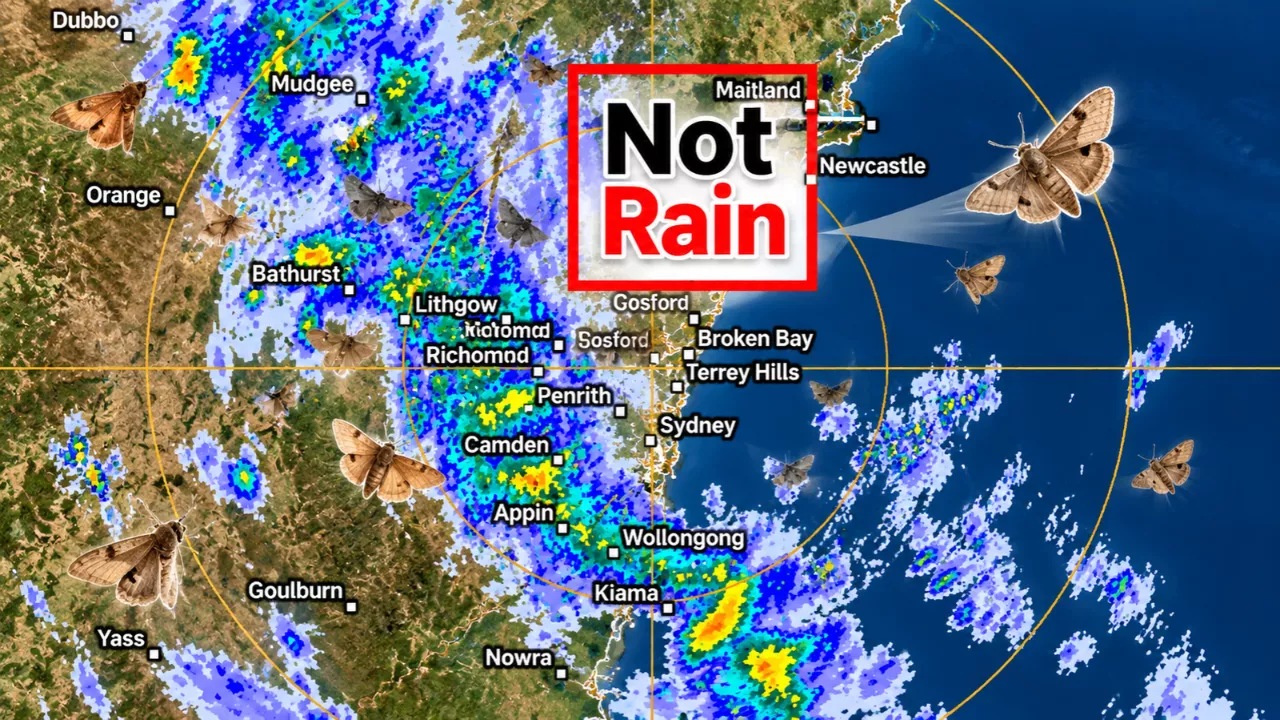
You open your weather app, see a green blob drifting toward your suburb, and brace for a downpour. An hour later the ground is bone dry and the only thing falling from the sky is a few confused moths bumping into your porch light. If this has happened to you lately, you are not imagining things. Moth swarms on weather radar are a real, well-documented effect, and spring is the season when they are most likely to show up in New South Wales.
Why Moth Swarms Show Up on Weather Radar
A weather radar sends out a pulse of energy and listens for what bounces back. It doesn’t “see” rain as such. It detects anything in the air that reflects the signal, then displays the strength of the echo as colours on a map. Raindrops are the usual target, but they are not the only one. CSIRO researchers note that insects, birds and bats flying at height can all appear on radar, and that radars can scan the airspace up to about 3,000 metres above the ground every 15 minutes.
When a very large number of insects fly together, the combined echo can look a lot like light rain or drizzle. That is why a dense migration can paint a convincing but entirely dry “rain cloud” on your screen. The effect is not unique to moths. Meteorologists in Southern California once traced a radar blob roughly 10 miles wide to a swarm of ladybugs, and the UK Met Office has been fooled by flying ants on clear, sunny days.

Why NSW Is Seeing So Many Moths Right Now
The likely culprit in eastern Australia at this time of year is the Bogong moth. Each spring, a new generation leaves breeding grounds across southern Queensland, NSW and western Victoria and begins a long journey towards the Australian Alps. Zoos Victoria’s Moth Tracker program says this migration runs from September to December, so a surge in sightings in late October is right on schedule.
Strong westerly winds can also push big numbers towards the coast, which is why Sydney, the Illawarra and the Central Coast sometimes see far more moths than usual. Canberra researchers have said the swarms can continue into early November and that the moths are simply passing through on their way to the mountains, where they shelter over summer. They are not interested in your wardrobe.

Rain Echo vs Insect Echo: How to Tell the Difference
You don’t need a meteorology degree to spot the signs. Here is a simple comparison of what to look for.
| Clue | Real rain | Insect swarm (like moths) |
|---|---|---|
| Timing | Moves with a front or storm system | Often appears at dusk or after dark, when moths take flight |
| Ground reports | Rain gauges and nearby residents report wet weather | Dry ground, clear or partly cloudy sky |
| Shape on the map | Bands, cells or broad areas that follow the weather pattern | Soft, spreading patches that can look like expanding rings |
| Movement | Travels with the wind and system | May drift with the wind but can seem to appear from nowhere |
| What you notice outside | Clouds, damp air, falling drops | Moths around lights, windows and car windscreens |
| Persistence | Intensifies or fades with the weather | Can fade at sunrise as insects settle |
Treat this table as a guide, not a rule. Genuine rain and insects can show up on the same radar at the same time.
What This Means for Your Weather App
Most of us now rely on a rain radar for everyday decisions like hanging washing, planning a barbecue or leaving for the school run. A false echo can send those plans sideways. A few habits can help:

- Cross-check with the official forecast. If the radar shows rain but the forecast and warnings say dry, trust the forecast.
- Look outside. A clear sky with a “raining” map is the classic red flag.
- Check local observations. Rainfall readings from nearby stations will show whether anything has actually fallen.
- Watch the time of day. Evening and overnight echoes during migration season deserve extra scepticism.
- Use a few sources. Compare a second app or the national weather service’s own radar page.
Forecasters are well aware of this issue. Radar operators and meteorologists routinely look at more than the raw picture, and modern radars have ways of telling the shape and behaviour of targets apart. The consumer app on your phone, however, often shows only the simplified result.
Why Moth Swarms Are Good News for Science and Nature
It is easy to be irritated by moths at the window, but their return is encouraging. The Bogong moth was listed as endangered on the IUCN Red List in December 2021, and research has linked prolonged drought in their breeding grounds to sharp declines in migrating adults. Numbers can swing a lot from year to year, so a big, visible migration is a welcome sight for the people who study them.
There is also a bonus for researchers. CSIRO scientists are working towards a platform that would let people observe insect movement across Australia in near real time, much as we can watch the weather today. The same signals that confuse your rain app could one day help track pests, migrations and the health of insect populations.
If moths do get inside, a few gentle steps go a long way:
- Switch off or dim outdoor lights at night where it is safe to do so.
- Close windows and doors around dusk, or fit fly screens.
- Catch stray moths gently and release them outside rather than using insect spray.
- Give washing a quick shake before you bring it in.
FAQs
Can weather radar really detect moths?
Yes. Radar picks up any object that reflects its signal, and large numbers of flying insects can produce echoes that look like light rain. Insects, birds and bats at height are all known to appear on radar.
Are the moths in NSW right now Bogong moths?
Very likely, given the time of year. Bogong moths migrate towards the Australian Alps between September and December, and westerly winds can push many of them towards the coast.
Will the moths damage my clothes or home?
No. Bogong moths are only passing through on their way to the mountains. They are attracted to lights and may wander indoors, but they are not clothes moths and do not harass people.
How can I tell if the “rain” on my radar is fake?
Look at the sky and check nearby rainfall readings. If the map shows rain but the ground is dry, the sky is clear and moths are gathering at your lights, an insect echo is a strong possibility. Always confirm with the official forecast and warnings.
Heavy Rain and Hail Damage Crops Just Before South Australia’s Record Harvest!
1 thought on “Clouds, but no rain?Moth Swarms on Weather Radar: Why Your Rain App Shows Clouds but the Sky Stays Dry”
Comments are closed.