
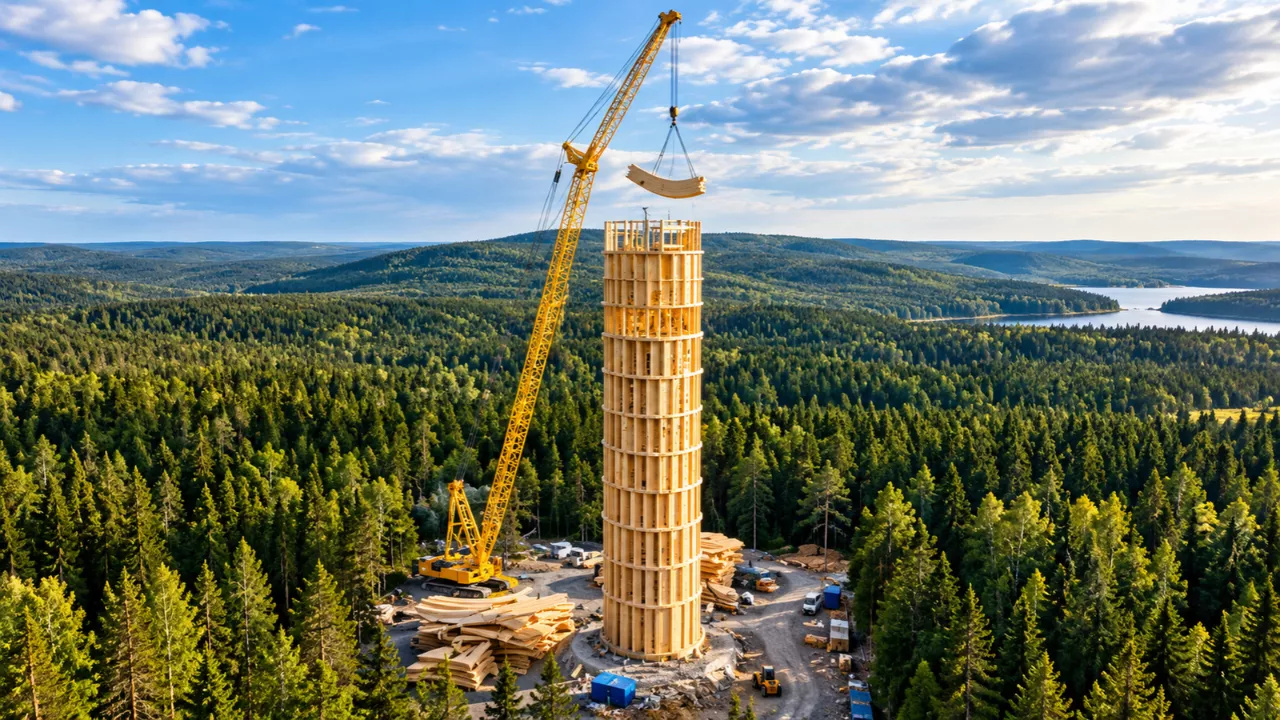
Wind turbines are made of steel, and almost nobody questions it. Then a Swedish company put one on a tower of spruce, and the question became real. The wooden wind turbine near Skara, Sweden, reaches 150 metres at its highest blade tip. It has been feeding electricity to the grid for roughly 400 homes. It is a working machine, and it raises a fair question about whether the material we use for wind towers is the best one.
What Sweden Actually Built
The project is called “Wind of Change.” It was built by Modvion, a Swedish wood-technology company, for the energy company Varberg Energi. A common mix-up is worth clearing up here. The wooden tower is 105 metres tall. The 150-metre figure is the full height once the blades reach their highest point. The turbine on top is a 2-megawatt machine from Vestas, the Danish manufacturer, which has been a Modvion shareholder since 2021.
Key facts at a glance:

- Location: near Skara, northeast of Gothenburg, Sweden
- Tower height: 105 m, or about 150 m to the blade tip
- Output: 2 MW, enough for roughly 400 homes
- Material: laminated veneer lumber (LVL) from Scandinavian spruce
- Tree use: about 200 trees went into the tower, according to press coverage
How a Tower Made of Wood Stays Standing
Wood sounds fragile, but this is engineered wood and not a bundle of planks. The tower is built from thin spruce veneers, each about 3 mm thick. They are glued in layers, and the grain direction changes from layer to layer. That lets engineers tune the strength and flexibility of the wall. The finished walls have well over a hundred layers.
The tower is not made as one giant tube. Curved wooden modules are built in a factory in Gothenburg and trucked to the site on standard roads. There they are glued into cylinders and stacked. This is the real innovation. Steel towers get harder to move as they get wider, because the base sections can become too big for roads and bridges. Smaller, lighter modules avoid that problem.

Wooden vs Steel Wind Towers: A Quick Comparison
| Factor | Wooden tower (Modvion) | Conventional steel tower |
|---|---|---|
| Material | Laminated spruce veneer | Rolled steel sections |
| Weight | About one-third lighter (per company) | Heavier |
| Strength per weight | About 55% higher (per company) | Baseline |
| Manufacturing CO₂ | About 125 tonnes for a ~110 m tower (per company) | About 1,250 tonnes |
| Transport | Small modules on standard roads | Large sections, harder at greater heights |
| Maturity | One commercial tower so far | Decades of proven use |
| End of life | Walls can be reused as building beams | Recycled as scrap steel |
The strength, weight and emissions numbers come from Modvion. Independent long-term data on wooden wind towers is still limited.
Why Wood Could Win
The case for wood rests on three things.
- Lower emissions. Making steel is energy-intensive. Modvion says its tower cuts production emissions by about 90%, and the wood also stores carbon.
- Easier logistics. Lighter modules are cheaper and simpler to move, which matters most for very tall towers.
- Room to grow. Taller towers reach stronger, steadier winds, so a bigger base made of lighter material has real appeal.
Wood is not simply taller than steel, though. Steel towers can already exceed 150 metres. The wooden tower’s advantage is that it gets there with a lighter footprint and easier transport.

Limits and What Comes Next
There are honest caveats. This is one commercial tower, and only onshore. The 2 MW turbine is small by today’s standards, and steel towers have decades of performance data behind them. Modvion has since had a taller design certified: 119 metres, able to carry a 6.4 MW Vestas turbine. It is now working on designs of 160 to 170 metres. The company has also announced EU funding of €39.1 million and aims to open a factory around 2027 that could produce about 100 towers a year. Whether wood can compete at scale will depend on durability over time and on cost.
FAQs
Is the Swedish wooden wind turbine really 150 metres tall?
Yes, to the highest blade tip. The wooden tower itself is 105 metres.
How many homes does it power?
About 400 homes, from its 2 MW turbine.
Is a wooden tower better for the environment than steel?
According to Modvion, it cuts production emissions by around 90% and stores carbon. Independent long-term studies are still needed.
Can wooden turbines be built offshore?
Not yet. So far, only onshore towers have been installed.
1 thought on “Sweden built a 150m wind turbine made of wood. It’s taller than steel towers, powers 400 homes…”
Comments are closed.