
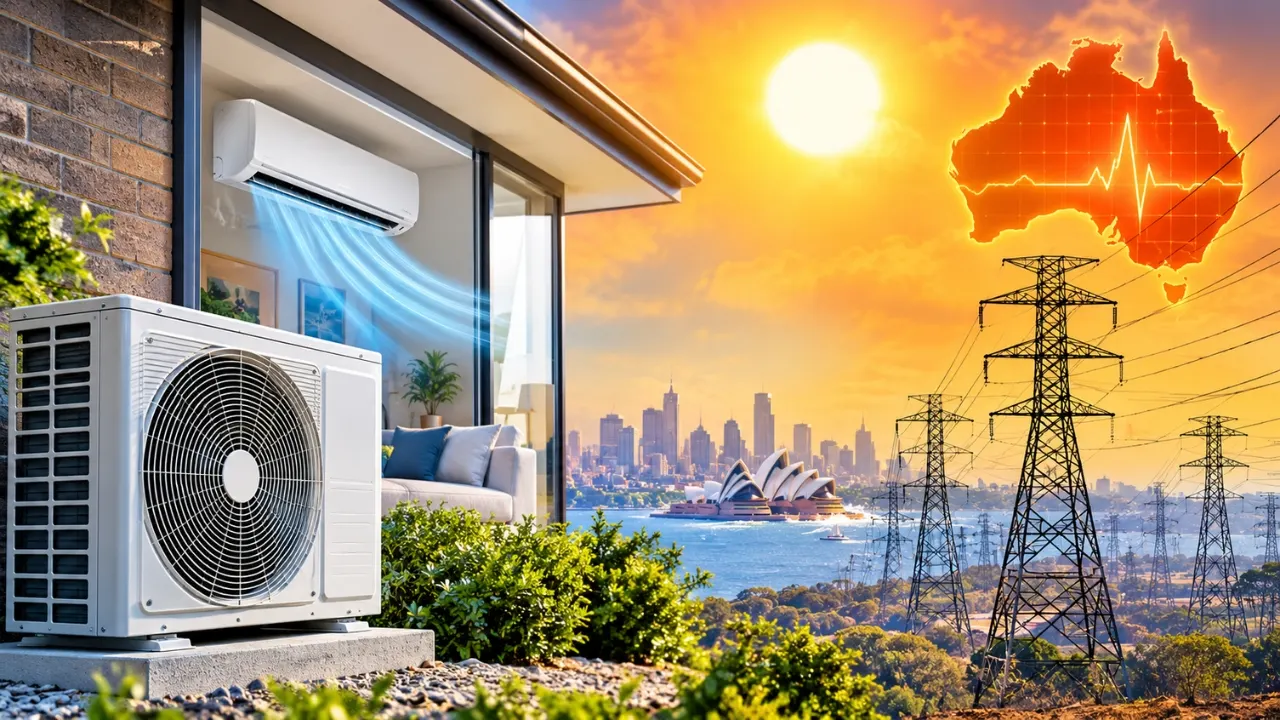
Flicking on the split system on a 38°C afternoon feels like a purely personal decision. Multiply it by millions of homes switching on within the same hour, though, and Australian summer air conditioning becomes something much bigger than comfort. It sets how much electricity the grid must be able to deliver at its busiest moment. That is why heat, rather than the yearly average, drives so much of the summer energy conversation.
Why Peak Demand Matters More Than Total Demand
An electricity network is not built for the average day. It is built for the worst few hours of the year. AEMO’s heatwave briefings explain that in every Australian state except Tasmania, peak demand occurs in summer during heatwaves. Poles, wires and reserve generation all have to be sized for those hours, even though they are needed only a handful of times a year.
The underlying heat trend explains why those hours are getting tougher. The CSIRO and Bureau of Meteorology State of the Climate 2024 report found that Australia has warmed by 1.51 ± 0.23°C since national records began in 1910, with most of that warming since 1950. The Bureau also noted that eight of the nine warmest years on record had occurred since 2013.
Key Numbers at a Glance
| Measure | Figure | Why it matters |
|---|---|---|
| Australia’s warming since 1910 | 1.51 ± 0.23°C | Hotter baselines mean cooling is needed on more days |
| Warmest years on record | Eight of the nine since 2013 (as of the 2024 report) | Extreme summers are becoming more common |
| NEM maximum demand, December quarter 2024 | 33,716 MW | A quarterly record, driven by higher temperatures and electrification |
| NEM average total demand, December quarter 2024 | 23,737 MW (up 2.4% year on year) | Demand is rising even outside the peak hours |
| WA main grid record, 18 February 2024 | 4,233 MW at 5:55 pm | A heatwave pushed demand to a new high in the early evening |
What a Multi-Day Heatwave Does to a Home
Single hot days are manageable. Runs of hot days are the real stress test. AEMO’s heatwave analysis shows that temperatures and electricity demand tend to climb on the third and fourth consecutive hot days. Walls, roofs and furniture have soaked up heat, so air conditioners work harder just to hold the same indoor temperature.
For households, this means:
- Homes don’t reset overnight. If the house never cools down, the next afternoon starts from a higher baseline.
- Older or poorly insulated homes work harder. Heat gets in faster and the system runs longer.
- Everyone does it at once. The same weather hits an entire suburb at the same moment, so individual choices pile up into one demand spike.
Why Early Evening Is the Pinch Point
Rooftop solar has changed the shape of the problem rather than removing it. AEMO’s heatwave material notes that solar helps cut system demand during most summer heatwave peaks, provided skies are clear, but pushes the maximum peak later in the day. Panels fade after mid-afternoon, while houses are still hot and people are arriving home, cooking and running cooling.
The WA record fits that pattern. The 4,233 MW peak in February 2024 came at 5:55 pm, with AEMO linking it to extended heatwave conditions and continued growth in underlying demand. On those days AEMO had to manage tight reserves, which shows how one hot week can strain a whole system.
Practical Ways to Ease the Load
Households can’t change the weather, but a few habits reduce how hard a cooling system works during the critical hours:
- Pre-cool earlier in the day and avoid a sudden evening surge.
- Set the thermostat around 24–26°C rather than chasing the lowest possible number.
- Close blinds and curtains on sun-facing windows before the heat builds.
- Use ceiling fans alongside the air conditioner so you can run it more gently.
- Clean filters and service the unit before summer starts.
- Use ventilation at night when the air outside is cooler than inside.
Over the longer term, shading, better insulation and efficient reverse-cycle systems cut the problem at its source.
FAQs
Why is Australian summer air conditioning a grid issue and not only a comfort issue?
Because the grid is sized for the single busiest hours of the year, and in most states those hours occur on hot summer days when cooling demand is highest.
Is demand still rising?
AEMO reported a December quarter 2024 record of 33,716 MW for the NEM, attributing it to higher temperatures and the shift from gas to electricity.
Does rooftop solar solve the summer peak?
It helps during the day, but AEMO notes it moves the peak later into the evening, when solar output has dropped and homes are still hot.
What is the easiest thing a household can do?
Cool the house earlier, block sun from windows and avoid setting the thermostat unnecessarily low.
All-Electric Offices Are Here: What the NABERS 2025/26 Results Mean for Your Home!
1 thought on “Why Australian Summers Are an Air-Conditioning Problem, Not Just a Comfort Problem..”
Comments are closed.