
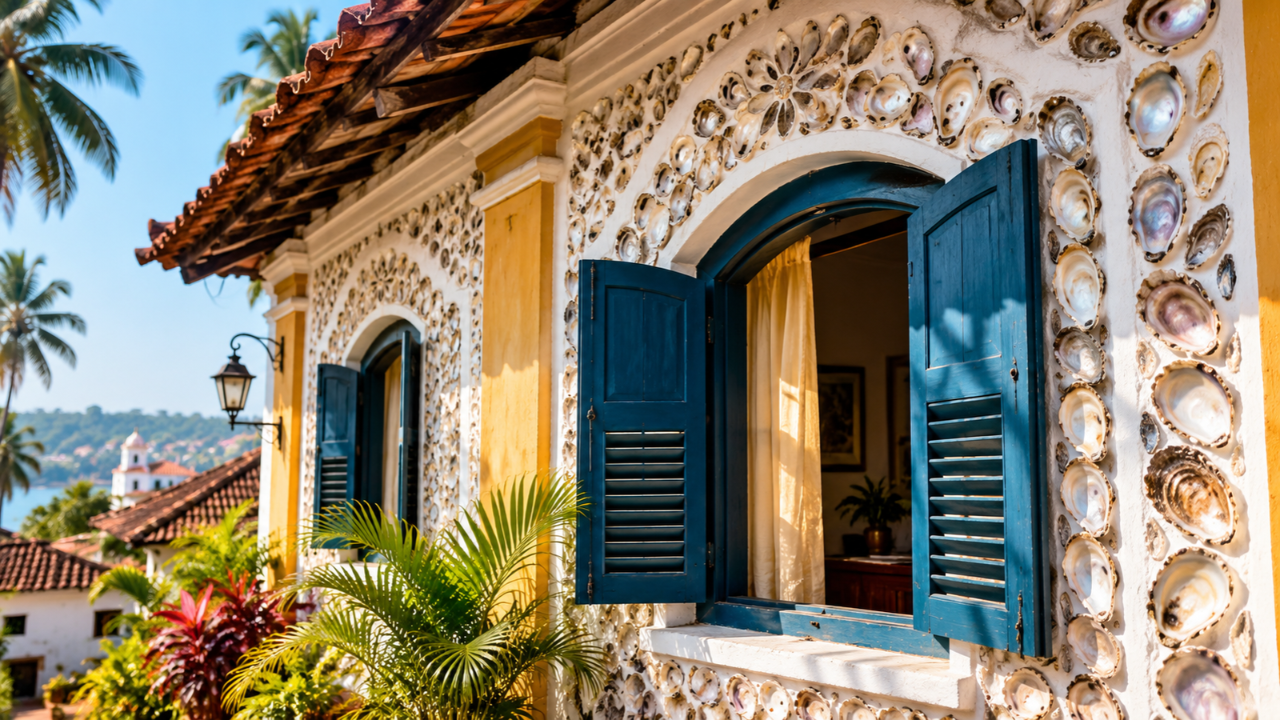
Walk through Panjim’s Fontainhas or an old village in South Goa and you may notice something odd. Some balcony windows glow with a soft, milky light, and there is no glass in them. These are Goan oyster shell windows, made from thin, translucent shells set into wooden grids. They are among the most recognisable features of Indo-Portuguese houses in Goa, and they exist for sound practical reasons as well as for beauty.
What Are Goan Oyster Shell Windows?
The panes come from the windowpane oyster (Placuna placenta), a flat, almost transparent bivalve found in shallow coastal and brackish waters. Artisans cut the shells into small squares and fitted them into slim wooden lattices. These frames were set into sliding or hinged shutters, often on the balcão, the covered balcony at the front of the house. In Portuguese-influenced writing, these shell panes are often called carepa windows.
Seen from inside, the panes look like frosted glass and spread a gentle, even glow. From the street, they catch the light with a pearly shimmer. That quality made them decorative as well as functional.

Why Did Goan Homes Use Oyster Shells Instead of Glass?
Several practical reasons come together here, and they are easier to understand once you picture a Goan house in the 1700s or 1800s.
- Material at hand: Windowpane oysters lived in Goa’s estuaries, so the raw material was local rather than imported. Research on Goan estuaries has also found evidence of a once-thriving oyster population in the region.
- Privacy: As houses opened up to the street with larger windows, families needed a covering that let light in but blocked prying eyes. Oyster shell panes did exactly that.
- Soft light, less glare: The translucent shell diffuses harsh tropical sun, so rooms stay bright without feeling blinding.
- Airflow: Shutters could be slid open to let sea breezes through, and the closed panes still gave light.
- Status: Elaborate windows signalled wealth and good taste, and they were typical of well-off Goan Catholic families.
How Are Oyster Shell Windows Made and Maintained?
The craft was painstaking. Shells were cleaned, trimmed into uniform pieces, and slotted into grids of timber, usually teak or another durable local wood. Because the shell panes are thin and brittle, a cracked piece could be swapped out individually. Some windows also carried a small clear glass peephole so residents could look out without opening the shutter.
| Feature | Details |
|---|---|
| Material of pane | Windowpane oyster shell (Placuna placenta) |
| Frame | Wooden lattice, set into shutters |
| Typical location | Balcão, street-facing windows, sometimes doors |
| Light quality | Soft, diffused, pearly |
| Main benefits | Privacy, glare control, ventilation, local materials |
| Common challenge today | Brittleness, wood decay, fewer trained artisans |
| Where to see them | Heritage homes, Fontainhas in Panjim, museums such as Houses of Goa |
Why Are Goan Oyster Shell Windows Disappearing?
Glass became cheaper and easier to buy, and many families replaced the old shutters during renovations. Shell panes are also fragile, and repairs need skills that few craftspeople still have. Heritage writers also point to a wider ecological pressure, since shell-bearing habitats along the coast have changed over time. Many newer homes now use patterned or frosted glass to imitate the look, but the real thing has a depth that glass struggles to match.
How to Appreciate and Protect This Heritage
If you own or visit an old Goan home, a few simple habits help these windows survive:

- Dust the panes gently with a dry, soft cloth, and avoid harsh chemicals or strong water jets.
- Keep the wooden frames sealed against moisture and termites.
- Ask a conservation architect before replacing any damaged panel.
- Choose heritage stays and museums that maintain original windows.
FAQs
Why do Goan homes have oyster shell windows?
They let in soft light while giving privacy, used a locally available material, and showed a family’s status.
Which shell is used in Goan oyster shell windows?
The windowpane oyster, Placuna placenta, whose shell is thin and translucent.
Are oyster shell windows still made today?
Rarely. Few artisans still work in this craft, and many modern homes use glass patterns that imitate the look instead.
Where can I see Goan oyster shell windows?
Look at heritage homes in Panjim’s Fontainhas and villages in South Goa, and at museums such as Houses of Goa.
Smart Windows That Tint on Demand: A Cooler Way to Cut Summer Cooling Costs!
2 thoughts on “Goan Oyster Shell Windows: The Story Behind Goa’s Glowing Panes!”
Comments are closed.