
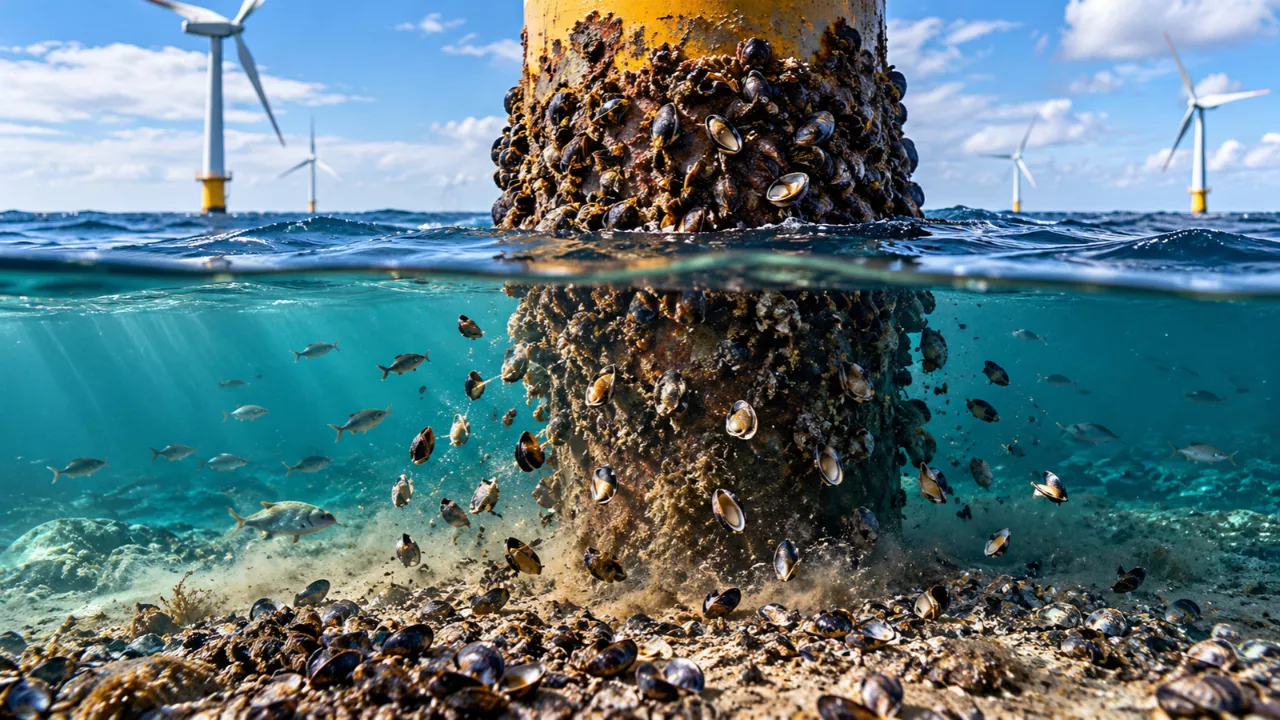
In the southern North Sea, the seabed is mostly soft sand and mud for miles in every direction. Then an offshore structure is driven into it, and within a couple of seasons its submerged steel is wrapped in living shellfish. These wind turbine foundation mussels are more than a curiosity. German research on an offshore platform suggests they shed a steady rain of biomass and shell onto the seabed below. The numbers are striking, though they come with some caveats.
Why do mussels cover a wind turbine foundation?
Blue mussels start life as drifting larvae. In a seascape with almost no hard surface, a steel foundation is the first solid thing a larva may meet. A study of a German Bight research platform tracked this colonisation from 2003 to 2005. It found mussel density climbed to as much as 30,000 individuals per square metre, with about 40 kilograms of mussels per square metre by summer 2005. By the end of that period, the upper part of the structure was completely covered. The lower sections stayed sparsely colonised, which is why the mussel band concentrates near the surface, where food and light are richest.
The numbers behind the “6,000 pounds a year” figure
The headline figure comes from a 2013 study in Marine Environmental Research. It examined an offshore research platform with a footprint comparable to a wind turbine foundation. These are the key findings:
| Measure | What the research found |
|---|---|
| Site | Research platform in the German Bight, about 45 km (28 miles) north of Borkum |
| Footprint studied | 1,024 m² (about 11,000 sq ft) |
| Biomass vs. surrounding soft seabed | About 35 times more bottom-dwelling biomass (soft seabed: 0.12 kg per m²) |
| Biomass leaving the structure each year | At least 2,700 kg (roughly 5,950 lb), an estimate |
| Mussel shells produced during the study | About 3.45 million |
| Earlier mussel density on a similar platform | Up to 30,000 per m², around 40 kg per m² (2003–2005) |
The word “estimate” matters. The yearly export figure is a minimum calculated from real sampling, not a count of every shell that landed.
How falling shells could create hard ground on a soft seabed
Mussels that outgrow their space lose their grip and drop. Their shells are a new kind of habitat in a place that had very little. One researcher’s thesis on this topic noted that the shell litter may change the surrounding sediment and form additional small reefs. That is a likely outcome rather than a proven one.

Living mussels also act as habitat on the steel itself. A study of turbine foundations in a Belgian wind farm found 47 species in mature communities. Of these, 21 lived only on the shells, and all were attached, non-moving species. In 2020, every bryozoan species recorded there was found only on mussel shells.
What this could mean in practice:
- Shell debris adds hard, textured surface to a seabed that is otherwise soft.
- Shells give small attached animals somewhere to settle.
- Many mussels together filter large volumes of water, which could affect water clarity.
What we still don’t know
Scientists are careful on this point. The same research stresses that offshore foundations are not equivalents of natural rock reefs, because they selectively boost certain species rather than recreating a full reef community. The effect on the wider energy flow in the North Sea is described as unknown. Currents also scatter fallen shells, and one platform cannot represent every foundation type, since narrow-legged jackets and wide monopiles behave differently. One estimate suggests around 5,000 foundations would raise total biomass in the German Bight by about 0.8%, a meaningful local effect but not a transformation of the whole sea.

Frequently asked questions
Do wind turbine foundations really grow mussels?
Yes. Studies on offshore structures in the North Sea found dense blue mussel colonies on the submerged steel, especially in the upper water column.
How much mussel biomass does one foundation shed?
One platform study estimated at least 2,700 kg, about 6,000 pounds, leaves the structure each year. It is a minimum estimate from one platform.
Do the fallen shells create new habitat?
They can. Shells provide hard surface for small attached animals, and researchers say the shell litter may alter sediments and form additional reefs.
Is this good for the marine environment?
It is mixed. It boosts local biodiversity and biomass, but it also favours certain species and changes the seabed community. Long-term effects across the wider ecosystem are still being studied.
Why a Terracotta Pot Beverage Cooler Deserves a Spot on Your Patio!
2 thoughts on “One steel wind turbine foundation in the North Sea drops about 6,000 pounds of mussels a year, and the falling shells may be building a new reef floor!”
Comments are closed.