
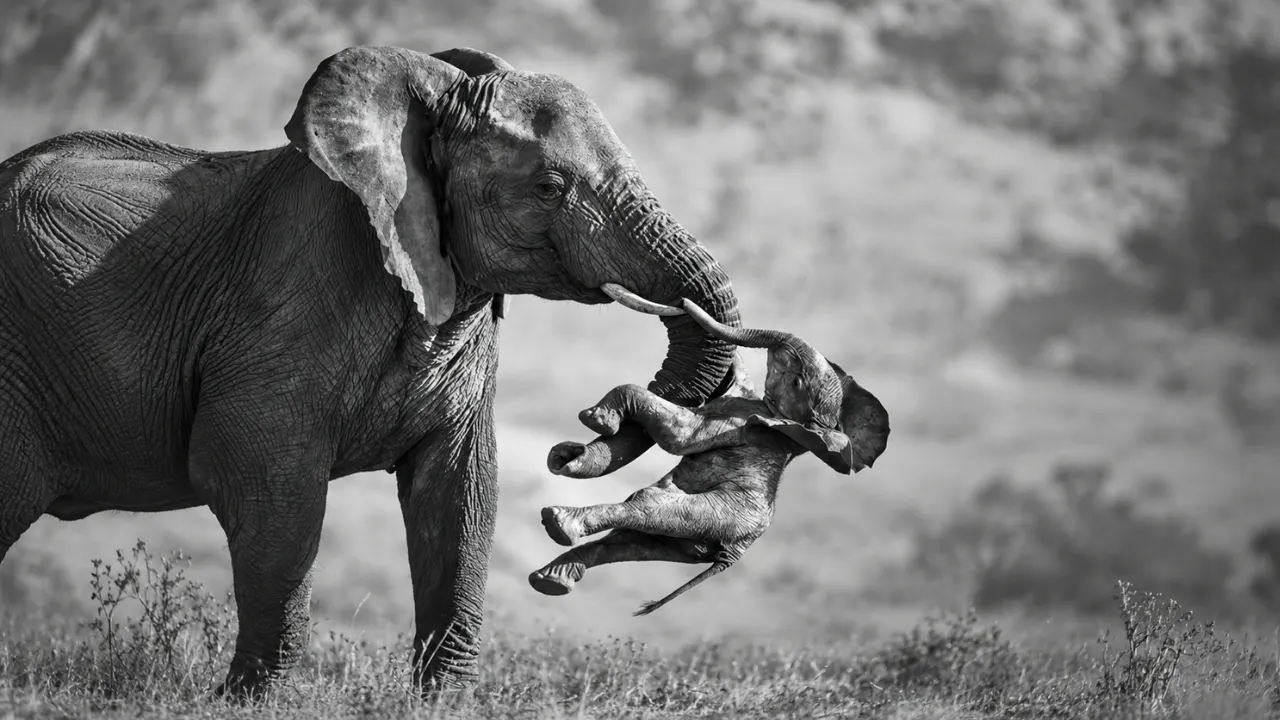
Every October, one exhibition reminds us how little of the natural world we actually notice. Wildlife Photographer of the Year 2026 is no exception. The competition, run by London’s Natural History Museum, drew a record 65,000 entries from 121 countries and territories this year. The winners include an elephant carrying a dead calf, mushrooms glowing under ultraviolet light, and a black bear cooling off in a suburban backyard pool. Together they cover grief, wonder and humour, and they ask a harder question about how humans and wildlife share the same space.
The Overall Winner: “The Aftermath” by Federico Veronesi
Italian photographer Federico Veronesi won the grand title for a black-and-white image called The Aftermath. It shows a female elephant carrying a dead calf through Namibia’s Huab River Valley. He found the scene by following an unusual pattern of drag marks in a dry riverbed.
Veronesi first assumed the calf was hers. Researchers later concluded that the female had lost her own calf years earlier and had been picking up dead calves belonging to other females. Veronesi said that in 20 years of photographing animals, this was the most heart-wrenching and dramatic moment he had seen.
Jury chair Kathy Moran called it an emotional gut punch, and said it is also intellectual proof that animals have cognition. That is why the image stays with people. It doesn’t ask for sympathy. It shows that elephants may experience loss in ways we are only starting to understand.
The Glowing Mushrooms Lighting Up the Night
The “Mycenaeans illuminating the night” in the French headline are Mycena fungi, commonly called bonnet mushrooms. Greek photographer Agorastos Papatsanis won the Plants and Fungi category by using ultraviolet light to reveal their glowing yellow stems on a decaying log. In the species Mycena renati, UV light produces a warm yellow-grey fluorescence, not the cold blue glow many people expect.
This is more than a pretty effect. Mycologists are using the same phenomenon to tell closely related fungi apart by the colours and patterns they show under UV. The photograph is both a work of art and a small piece of science.
A Black Bear, a Backyard Pool and the Urban Wildlife Question
Loren Elliott’s Pooltime Pastime was recognised in the Urban Wildlife category. It shows a black bear cooling off in a backyard pool in Monrovia, California, against the San Gabriel Mountains. It is funny at first glance. It also records how closely wild animals and homes now overlap in many regions.
Other highlights this year show how varied the field has become:
- Animal Portraits: A Watchful Eye by Aaron Sanders (UK) shows a common octopus peering through kelp off Cornwall.
- Animals in their Environment: The Meeting Place by James Lewin (UK) shows a young bull elephant spraying zebras at a waterhole in Kenya’s Chyulu Hills.
- Photojournalism: Warning Sign by Francisco Negroni (Chile) documents a dead puma displayed as a hunting trophy in Argentine Patagonia.
- Young Wildlife Photographer of the Year: Labour of Love by Oscar Whitfield (UK) shows a dung beetle pushing its precious cargo, shot with the photographer lying flat on the ground.
Wildlife Photographer of the Year 2026 at a Glance
| Award or category | Photographer (country) | Image |
|---|---|---|
| Grand Title (overall winner) | Federico Veronesi (Italy) | The Aftermath – elephant carrying a dead calf, Namibia |
| Young Wildlife Photographer of the Year | Oscar Whitfield (UK) | Labour of Love – dung beetle |
| Behaviour: Mammals | Federico Veronesi (Italy) | The Aftermath |
| Plants and Fungi | Agorastos Papatsanis (Greece) | UV-lit Mycena mushrooms |
| Animal Portraits | Aaron Sanders (UK) | A Watchful Eye – octopus in kelp |
| Animals in their Environment | James Lewin (UK) | The Meeting Place – elephant and zebras |
| Photojournalism | Francisco Negroni (Chile) | Warning Sign – puma trophy |
Why These Photos Matter and How to See Them
The strongest wildlife photography does more than show a rare animal. It shows what the animal is doing and why we should care. The Natural History Museum’s director, Doug Gurr, said the winning photographs show the power of wildlife photography to help us see nature differently. This year’s set does exactly that, moving from grief to wonder to the uncomfortable overlap of wildlife and people.
The exhibition opens at the Natural History Museum in London on 16 October 2026 and runs until 11 July 2027. If you can’t travel, the winning images are widely published online, but seeing them printed at full size is a different experience. For aspiring photographers, there is a useful lesson in how these shots were made: patience, fieldcraft, ethics and a willingness to lie in the dirt for the right angle.
Frequently Asked Questions
Who won Wildlife Photographer of the Year 2026?
Italian photographer Federico Veronesi won the overall title with The Aftermath, a black-and-white image of a female elephant carrying a dead calf in Namibia.
Who won Young Wildlife Photographer of the Year 2026?
British photographer Oscar Whitfield won for Labour of Love, a close-up of a dung beetle pushing its prize.
Where can I see the 2026 winning photographs?
The exhibition is at the Natural History Museum in London from 16 October 2026 to 11 July 2027.
How many entries did the 2026 competition receive?
A record 65,000 entries from 121 countries and territories.
What Australia’s New National Environmental Standards Mean for Developers, Wildlife and Offsets!